In this week’s Luxury Briefing, why the next generation of hero bags is being engineered by independents like Janessa Leoné and Métier. Plus, why Charlie Smith jumped from Loewe to the tech company Nothing, and what to expect from ShopMy’s new magazine. In News to Know, retail updates, executive moves and AI-native storefronts defined the week. For tips or comments, email me at zofia@glossy.co
Before entering handbags, Janessa Leoné was best known for her namesake accessories label built around minimalist hats and leather goods. Founded in 2013 and based in Los Angeles, the brand developed a loyal following for its architectural silhouettes, thoughtful materials and design language, all anchored in a slow-fashion ethos that set it apart from more trend-driven brands.
Her debut handbag collection, launched in September 2024, marked the brand’s first major category expansion in over a decade. She expected curiosity, not a breakout. Instead, the bags quickly reshaped her business. “Handbags specifically are the standout,” she told Glossy. “For 2024, we did almost 200% [total sales] growth year over year, and after the 2025 holiday season, we’ll surpass that.”
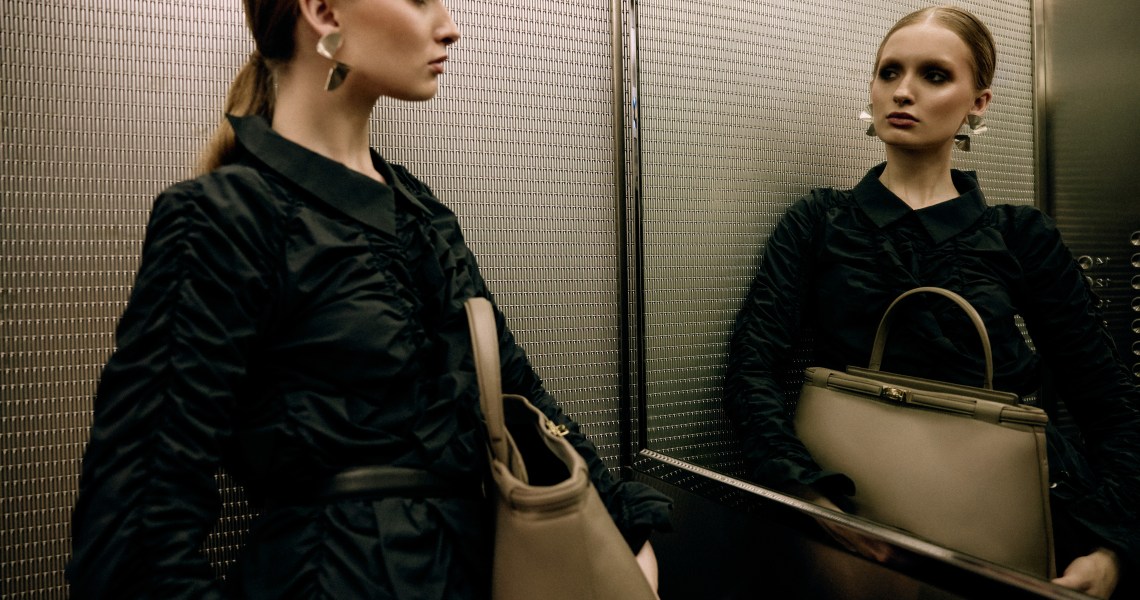
With the launch of her hero style this month, The Leoné, she is now aiming to establish a permanent brand pillar that can scale with demand without compromising craftsmanship. Leoné has modeled another triple-digit growth year for 2026.
With just two styles — each offered in three colorways — the new handbag style has sold out twice across the brand’s DTC channel and wholesale partners like Neiman Marcus and Moda Operandi. At Moda Operandi, two colorways sold out in under 48 hours. Leoné declined to share production volumes, but emphasized the brand’s small-batch approach. Priced under $1,500 and made in the same Veneto-region factory used by major heritage houses, the bags offer a grounded alternative in a price-fatigued market.
This momentum reflects a broader reset. Customers are turning to smaller, value-aligned brands as big houses push pricing to new extremes. The price of Chanel’s classic flap, for example, has more than doubled since 2019, climbing from $5,120 to $11,320.
“[The luxury industry] has lost 70 million customers in the past two years,” said Federica Levato, Bain partner and global head of luxury, in Bain and Altagamma’s 2025 Luxury Report. “This is more than 20% of the customer base.” She noted that “very wealthy customers are upset,” adding: “They don’t see the equation between the creativity brands offer, the value intrinsic in the product and the price they are paying.”
On October 14, for its third quarter, LVMH reported that its Fashion and Leather Goods were down 2% organically, with CFO Cécile Cabanis noting “price was not very different from Q2, and the mix was around neutral.” At Prada, meanwhile, CEO Andrea Guerra said on the company’s third-quarter earnings call: “The worst is over, but I don’t think that we will ever see again in the near future [the success] we have seen in the last decade.”
Leoné built her line around restoring that equation. “We don’t do anything trend-driven,” she said. “Everything is focused on quality and something that is meaningfully designed.” The brand uses raw, uncoated leather that exposes every stitch. “There’s nowhere to hide poor craftsmanship,” Leoné said. And distribution is intentionally tight “to maintain integrity and support storytelling.”
For the launch, Leoné partnered with artists she admired — photographer Sonia Szóstak, creative director Amanda Shadforth, stylist Laura Stoloff and photographer Ash Roberts — to promote the style in their social channels. The campaign introduced new buyers to Janessa Leoné, while the brand maintained a 43% customer return rate during the year.
The rise of Métier reinforces the opportunity for independents. Founder Melissa Morris told the Glossy Podcast in March that she works only with Italian artisans capable of extreme precision — “a dying breed,” she said. Customers, she added, increasingly “appreciate real luxury and real quality, and can see through it.” Her engineered designs and one-bag-per-need philosophy echo the identity clarity driving Leoné’s surge. Métier’s bags have appeared organically in “Succession,” “The Undoing” and “Indiana Jones.” The brand expanded in 2025, opening its first U.S. store in New York with plans for 2–3 additional U.S. locations, adding to its profitable London flagship. It also earned coverage in The New York Times for its “elegant functionality.” Métier’s hero bags include the Vérité City, Private Eye and Incognito.
Across both brands, craftsmanship and a tightly controlled factory relationship are the foundation, not the afterthought.
“Emotion comes later. It is really about rebuilding the ethics and rebuilding the connection with the [luxury] customer,” Levato said, adding, “People are super open to find new creativity and to become loyal to new brands if they have a value proposition that is credible, valuable and gives emotion.”
In August, Leoné launched her brand’s Substack to speak directly to customers about process and philosophy without algorithmic pressure. Her work has also appeared on fashion Substacks like In Moda Veritas (15,000 subscribers). “Instagram feels too transactional,” she said. “The algorithm reward structure doesn’t align with how we want to build long-term relationships.”
She’s not alone. Métier, DeMellier, Manu Atelier and Dragon Diffusion have all gained traction through Substack’s slower, editorially driven fashion ecosystem.
Charlie Smith is bringing luxury’s cultural engine to Nothing, as the brand enters a hyper-growth era
Charlie Smith’s move from Loewe to the London-based tech company Nothing comes at a transformational moment for the company. An independent smartphone brand, Nothing is now valued at $1.3 billion and fresh off a $200 million Series C raise to build what CEO Carl Pei calls a “single intelligent system,” where hardware and software converge. Four-year-old Nothing crossed $1 billion in total sales at the start of 2025 and grew 150% in 2024. It is the only independent smartphone brand to reach scale in a decade. It now wants to build an AI-native operating system that deeply understands each user and works across phones, audio, wearables and future devices.
As Loewe’s chief marketing and communications officer for seven years, Smith oversaw some of the house’s most defining collaborations — including with Studio Ghibli, On Running and Suna Fujita — alongside its TikTok strategy and global celebrity partnerships. That experience underpins his view that tech is overdue for reinvention. “In the consumer tech sector, it’s gotten quite boring,” he said, noting Apple now feels “like another Dell or Hewlett-Packard.” But Nothing, he argued, can reclaim the creative mantle by acting as “the brand for the next generation of creatives.”
As Nothing’s CMO, Smith oversees global brand, image, marketing, communications and retail. His near-term focus is launching Q1 products “in an exciting, disruptive and kind of rebellious-feeling way.” And in the long term, he wants Nothing to operate as a cultural publisher. “We’re publishing music content, we’re working with the next generation of talented musicians, and we’re hijacking music events young people love,” he said, explaining his vision and his current plans.
Smith pointed to Charlie XCX’s “Brat” album as shorthand for the values shaping youth culture now. “The messiness, not brushing your hair and having a good time” represent a tonal shift tech hasn’t embraced, he said. But, he added, Nothing’s retro-futurist visual language and its ambition to make technology “fun” align with that sentiment.
Retail will follow suit. Nothing currently has a store in London, and it plans to open its next one in India. And Smith plans to scale the brand without losing edge by decentralizing creativity globally, echoing Nike’s mid-2010s model. “The key has to be devolving power to groups of creatives around the world,” he said.
According to Smith, cultural relevance will be the growth engine of the next era of consumer tech.
ShopMy is launching a ‘magazine‘
ShopMy’s new year-in-review “magazine,” a one-off report available in print and digital download on Friday, spotlights the creators shaping taste long before trends hit the mainstream; an included First-to-Link list highlights the creators who were the earliest to spotlight brands that later became breakout names in luxury.
The top three tastemakers are personal shopper @LLBaruch (real name Liat Baruch 1,100 followers on ShopMy) for High Sport, @pig.mami (real name Heather Hurst, 1,900 followers) for Kallmeyer and @valerialipovetsky (real name Valeria Lipovetsky, 3,100 followers) for Emme Parsons. The list shows that micro-creators’ instincts are now driving demand for quiet luxury, design-led accessories and the next generation of heritage labels.
Executive Moves
- Altagamma, Italy’s association of top luxury brands, has named Giovanna Vitelli, chair of mega-yacht maker Azimut|Benetti, as its next president amid the country’s booming nautical sector and slowing fashion market.
- Pop Mart appointed LVMH China president Andrew Wu as a nonexecutive director, paying him about $384,000 a year amid soaring Labubu sales and rising collaboration buzz.
News to know
- Shopify launched Agentic Storefronts, a one-step tool allowing merchants to sell directly inside AI chats on platforms like ChatGPT, Perplexity and Copilot. It’s a move that could immediately benefit luxury brands already on Shopify, such as Victoria Beckham, Khaite, Skims, Aesop and Pangaia, all of which can now surface products, answer customer questions and convert sales natively in AI conversations.
- Ralph Lauren will return to the Milan runway for the first time since 2002 to open the Fall 2026 men’s shows on January 16. Milan Men’s Fashion Week announced a 76-event calendar amid Italy’s 3% drop in 2025 fashion revenue and 4% decline in exports.
- Style Capital — LuisaViaRoma’s majority investor and controlling shareholder through a 40% stake — exited LuisaViaRoma after four years, with LuisaViaRoma CEO Tommaso Maria Andorlini taking control and outlining a leaner, partnership-driven model to stabilize the struggling e-tailer amid declining revenues, debt restructuring and a shrinking global market.
- Beyoncé, Nicole Kidman and Venus Williams will co-chair the 2026 Met Gala, joining a star-packed host committee as the event returns on May 4 with a “Costume Art” theme, following a record $31 million year for the Costume Institute.
Listen in
On the Glossy Podcast, Danny Parisi and Zofia Zwieglinska recap recent fashion news: The CFDA will ban fur from NYFW’s official calendar; the U.K. pulled ads from Nike, Superdry and Lacoste over misleading sustainability claims; and the Prada–Versace deal closed just before creative director Dario Vitale exited after nine months. Then, Zofia also speaks with IoDF CEO Leanne Elliott Young about the rise of digital product passports ahead of the E.U.’s 2027 mandate. Listen here.
Read on Glossy
Why brands are getting in on the quarter zip trend. Marimekko launches an app to drive loyalty. Collected is upending the resale model. Aritzia’s app reaches 1 million downloads.