This week, I spoke with designer and founder of Bag Bijoux Ashna Mehta about why high jewelry is moving onto handbags. As charm culture scales at the entry level, a new category is emerging at the top end, shaped by Middle Eastern demand and ultra-wealthy clients. Also, Thom Browne x Asics and the Karla Otto Fall-Winter 2026 report. For tips or comments, email me at zofia@glossy.co.
A new category is emerging at the intersection of jewelry and accessories: fine jewelry designed specifically for handbags. As brands capitalize on the “charm economy” at accessible price points, a small group of designers is pushing the idea into high jewelry territory, with pieces that cost tens or even hundreds of thousands of dollars.
The trend is taking shape at a moment of volatility in the Middle East, one of luxury’s faster-growing regions. Escalating tensions between Iran and the U.S. have led to store closures, softer mall traffic and delayed purchases across parts of the Gulf. According to research from Bernstein this month, the region accounts for roughly 6–8% of global luxury demand and was the fastest-growing geography in 2025, even as the broader sector remained flat. While some consumers have paused purchases due to uncertainty, spending at the very top end is holding up, supported by local high-net-worth clients and private relationships.
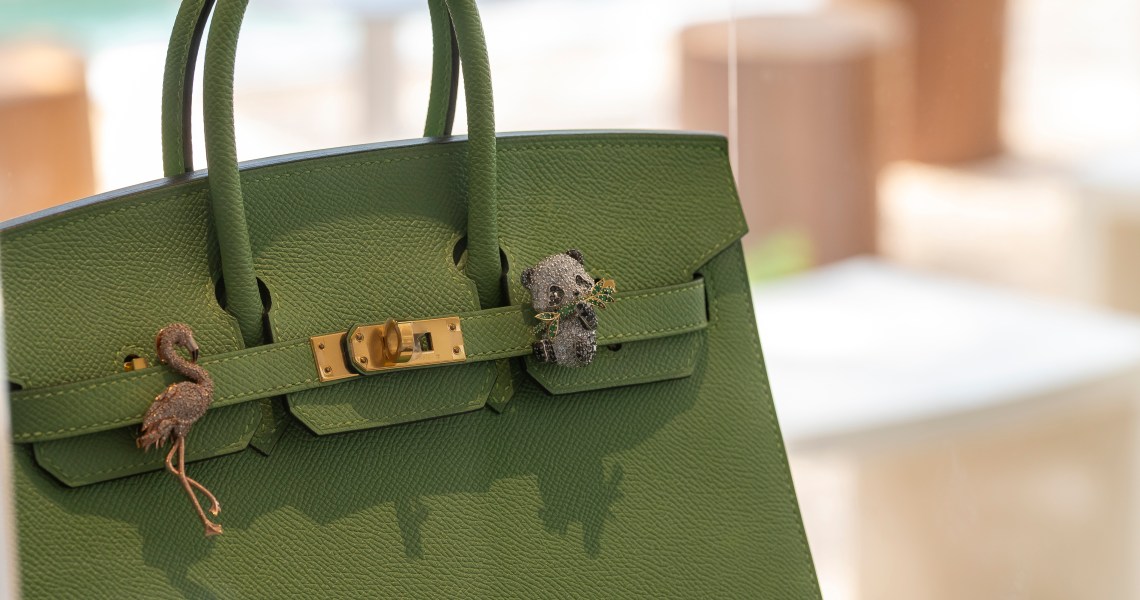
One emerging expression of that demand is a new form of fine jewelry designed for handbags. Often clipped onto Hermès Birkins and Kellys, these pieces resemble bag charms but are better described as high jewelry commissions.
Among the brands operating in this space is Bag Bijou, founded by Ashna Mehta. Launched in 2022, the Dubai-based business now operates across Dubai and India, with revenue split between traditional high jewelry commissions and its handbag-focused designs. Mehta comes from a family with more than 60 years in the diamond trade, and grew up between Belgium, New York and Dubai.
Her designs gained traction after appearing at the Anant Ambani wedding, the multi-month 2024 celebration hosted by the Ambani family, one of India’s wealthiest dynasties. There, diamond-set initials clipped onto handbags circulated among the ultra-wealthy guests like Mark Zuckerberg, Kim Kardashian and Bill Gates. Prices for the pieces typically start at nearly $5,000 and can climb to half a million dollars.
“I was raised around stones, jewelry and craftsmanship,” Mehta told Glossy. “I started by making pieces for myself, and at first, it was more traditional jewelry. But I kept thinking about how to make jewelry part of my everyday life in a way that hadn’t been done before. These are such expensive and rare pieces, and they often just sit in your closet. I wanted to create something you could actually use and carry with you.”
“I was looking at my own Hermès collection and thinking about how to make it feel more personal,” she said. “In Dubai, there is such a high concentration of these bags. I wanted mine to stand out. So I started with initials that attach to the bag, and we wore them to the Ambani wedding. I made them for myself, and then suddenly people wanted them. That’s when I realized this could be something bigger.”
As reported in Glossy’s August 2025 Luxury Briefing on bag charms, brands have turned small accessories into repeat-purchase drivers. At Coach, charms priced between $50-$95 have shortened the purchase cycle to just a few weeks, as customers return to personalize their bags. CEO Todd Kahn described it as a “charm economy,” adding that “the economics of that are really compelling.”
Across the market, these products are typically positioned as accessible add-ons. A core example is the Hermès Rodeo Pegase PM charm, a leather horse-shaped accessory that retails for around $800. At Miu Miu, miniature bag charms, such as mini Arcadie styles, can reach around $1,000, while corded keychains sit closer to $300-$400. Even at the higher end of this segment, most products remain below four figures and function as entry points rather than investment pieces.
Bag Bijou operates in a different price bracket. “The most expensive piece I’ve done that I can talk about is around a quarter of a million dollars,” Mehta said. “And there are others that go even higher. But at the same time, we have pieces that start around $5,000, which is where most of our clients come in. I even tried to create a lower-priced gold version without diamonds at $3,000, but people didn’t really want it. They wanted the diamonds.”
A 2024 Financial Times article noted that jewelry brands including Annoushka and Martha Calvo were already experimenting with bag accessories, from gold-plated charms to pearl designs, typically priced in the hundreds to low thousands.
The broader movement is tied to changes in the luxury market. According to a January 2026 Bernstein report by Luca Solca, demand is increasingly shaped by a “K-shaped economy,” in which affluent and ultra-wealthy consumers continue to spend while lower-income shoppers pull back. “Rich HNWIs need to be excited about expensive products at the top end of the pricing spectrum,” he said in a note.
Jewelry stands out within that environment. Intentions to spend on jewelry are rising across both affluent and ultra-wealthy consumers, even as interest in handbags and fashion has softened in some markets. Bernstein attributes that resilience to the category’s “price depth,” meaning its ability to stretch from accessible pieces to high jewelry worth hundreds of thousands.
For her part, Mehta is seeing demand for highly personal commissions. “A lot of people come to me with very specific ideas,” she said. “It could be their initials, their dog, something from their culture or something that represents their life. I think that’s why it works. Everyone wants something that feels like theirs, and when you combine that with high jewelry, it becomes very special.”
Custom pieces are especially popular in Dubai, she said. “In Dubai, people really wear their jewelry, and they’re not afraid to show it,” she said. “They love things like the evil eye, symbols that have meaning. In the U.S., I see more color and playful designs. It’s different for every market, and that influences what people ask for.”
Even as geopolitical tensions introduce short-term uncertainty, demand for custom pieces has continued.
“I’ve still had people reaching out for commissions while I’ve been traveling,” she said. “Because I work between Dubai and India, I’m able to continue production even when things are uncertain. The interest is still there.”
The fact that the bag-charm hype is real across shopper demos is no surprise. Richemont, which owns Cartier and Van Cleef & Arpels, pointed in its latest earnings call to jewelry’s ability to appeal across both aspirational and ultra-wealthy consumers as a long-term advantage.
Thom Browne’s Asics drop raises the stakes on entry-level luxury
Thom Browne’s recent Asics collaboration is emerging as an early win for Zegna Group.
Executive chairman Gildo Zegna said on the company’s earnings call on March 20 that the sneaker launch is “achieving strong resonance ahead of our expectations, not only in terms of social media visibility, but more importantly, of revenues,” following its global release on March 2.
Crucially, management framed the drop as more than a one-off hit: It is designed to drive “meaningful acquisition of new customers,” according to Gildo Zegna, with a clear funnel into higher-value categories like jersey and knitwear as second purchases. The limited-edition Gel-Kayano 14 styles also saw immediate demand, with some versions selling out quickly and appearing on resale platforms at around $1,000.
Stat of the week
According to Karla Otto, Lefty and Ctzar’s Fall-Winter 2026 Womenswear Roundup released this week, social media users classified as “fashion intellectuals” made up 10% of the conversation around Fashion Month this season, signaling a growing appetite for analysis over pure hype. The month-long event drove $754 million in earned media value, with brands casting streaming-era stars for scale, as well as subculture figures for credibility. Fashion fans also drove great amplification through viral posts and vlogs.
Executive moves
- Christopher Kane has joined Mulberry to lead its ready-to-wear relaunch as part of CEO Andrea Baldo’s strategy to reposition the company as a culturally relevant British lifestyle brand.
- Nick Picchione has been promoted to president of Robert Talbott, after previously serving as svp of merchandising and design, and earlier holding senior roles at Ralph Lauren and Armani.
- Martin Hoffmann will step down as CEO of On Running on May 1, with co-founders David Allemann and Caspar Coppetti becoming co-CEOs and Scott Maguire promoted to president and COO.
News to know
- LuisaViaRoma has filed for a court-mediated “Concordato Semplificato” restructuring procedure in Italy as of March 24, as it seeks to resolve debt and stabilize operations under CEO Tommaso Maria Andorlini.
- European retailers including H&M and Next are warning that a prolonged Middle East conflict could drive up energy and transport costs, leading to price increases of up to 5–10% if disruption continues. Fragile consumer confidence, rising fuel costs, and inflation are expected to pressure spending across fashion and broader retail in the coming months.
- Saks Global will keep open three previously slated-for-closure stores — two Saks Fifth Avenue locations and one Neiman Marcus — as part of its restructuring, following landlord negotiations and a reassessment of store profitability in key luxury markets.
- Meta Platforms has delayed the E.U. rollout of its Ray-Ban smart glasses developed with EssilorLuxottica due to supply constraints and regulatory hurdles around AI features and E.U. requirements for removable batteries.
- OpenAI has shut down Sora, its AI video-generation tool, less than a year after launch, citing high compute costs, legal and copyright risks, safety concerns, and a broader shift toward enterprise-focused AI products.
Listen in
On the tariffs-focused edition of the Glossy Podcast, senior fashion reporter Danny Parisi speaks with Angela Santos about tariff refunds, shifting trade policy and what fashion brands should do next. The discussion comes as brands navigate fresh uncertainty following the Supreme Court February 2026 IEEPA ruling, which initially suggested relief but has since been followed by new tariffs under alternative legal authorities and ongoing litigation. Listen here.
Read on Glossy
Pamela Anderson fronts Aerie’s anti-AI push. How watch heavyweights are responding to war in the Middle East. Brands are launching campaigns with Reddit.