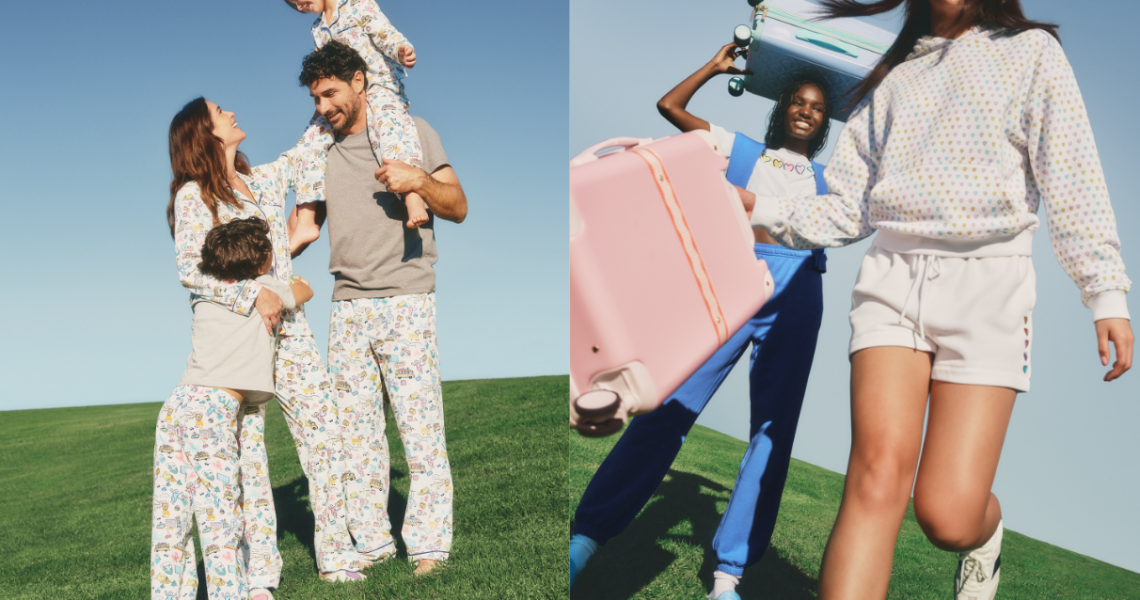
On March 7, Target launched its collaboration with Roller Rabbit, spanning more than 250 items. The assortment included Roller Rabbit’s signature pajamas in its Gen-Z-favorite monkey and colorful hearts prints, offered for the whole family. It also included first-time categories for Roller Rabbit, like pool floats, luggage and even Roller Rabbit-branded products from other Target brands, like Poppi soda cans and Olive & June press-on nails. Extended sizing and adaptive items were also offered.
The collection was primarily aimed at Gen Z, but Target knew it would see “multi-generational” love, said Gigi Guerra, the retailer’s vp of creative curation.
It did nearly $100,000 in sales per minute in the first hour, or approximately $6 million in 60 minutes, and sold some 5,000 items per minute in the first hour online. The family pajamas nearly sold out in just the first 30 minutes, and the store-exclusive pajama set, designed to draw foot traffic, proved the top seller. Overall, the collection outperformed forecast expectations across every category, Target shared.
Collaborations have long been central to Target’s strategy. Over the past 25 years, the retailer has executed more than 200 partnerships, many of which have generated similar excitement. Past successes with Gen Z have included Target’s 2022 collaboration with Stoney Clover Lane, which drove comparable buzz thanks to the brand’s established fandom. Stoney Clover Lane has 640,000 Instagram followers and is known for its culturally relevant collabs — at press time, it was teasing one with “Hannah Montana,” and last June, it actually launched its third capsule collection with Roller Rabbit.
“Gen Z wants to feel a part of something, and these are moments where it’s brands they love, and they’re experiencing it with friends and fellow fans — and that IRL connection is so important to them,” Guerra said. “We’re able to give them that moment in the store. And, as we think about our collaborations, we want to tap into the zeitgeist with what they’re loving.”
She added, “There’s also a [shopper who aims to] collect the pieces is [excited about] the collections’ exclusivity.”
With the Roller Rabbit drop, that sense of urgency was further fueled by the exclusive designs and IRL-only products. Among two newly featured prints was a pattern called Road Trip, plus the collection included Target’s first-ever collaboration mystery boxes.
The collaboration was a smart move for Target, according to Gabriella Santaniello, founder of the consultancy A-Line Partners. “[Roller Rabbit] is feminine, and they have fun prints,” she said, calling the main line expensive, but aspirational. “It’s what every teen girl wants,” she said.
Roller Rabbit was founded in 2003 by Roberta Freymann, before being acquired in 2017 by the investment group RRR Brands LLC. CEO Ed Bertouch, who declined to share the company’s revenue, credited its popularity to a “perfect storm” on social media. It has 267,000 Instagram followers and 194,000 TikTok followers. The brand’s popular pajamas sell for $138-$148 a set.
Following the launch, TikTokers compared the original Roller Rabbit pajamas to the Target versions, many of which sold for $40; plus shared giant hauls, contemplated what to keep and return; filmed the crowds of shoppers scooping up the collection; and criticized the associated mania.
“Brand awareness is always important,” Bertouch said, noting that the brand exited wholesale in 2022. “We don’t have Shopbop and Nordstrom and Bloomingdale’s and Dillards — all the partners that we did have. That has opened up this whole opportunity to do a project like this with Target, because we’re not competing with other third-party channels trying to sell Roller Rabbit.” Recently, Roller Rabbit has also partnered with LoveShackFancy, influencer Lilly Sisto, NYC ice cream shop Café Panna, Starbucks, and both Pottery Barn and PB Teen.
Diehard Roller Rabbit fans — see: the product comparison TikTok linked above — represent a consumer more than willing to both spend full price on the brand’s pajamas and shop its Target offerings. Plus, the collaboration offers the opportunity to meet entirely new customers, Bertouch said, noting Target’s comparatively larger scale.
“It’s an expensive pajama for the right reasons — but there are a whole lot of people who love the brand and don’t want to spend that much money on a pair of pajamas, understandably,” Bertouch said. “Or maybe we’re not even on their radar yet.”
For Target, bringing Roller Rabbit’s design to the masses, speaks to its long history of “democratizing design and [giving] access to everyone” though its collaborations, Guerra said.
The success of the collaboration comes at a pivotal moment for Target. In its March 3 earnings report, Target said apparel and accessories sales had declined 5% year over year to $15.74 billion. It has announced plans to regain ground, in part by responding more quickly to apparel trends.
The retailer has faced ongoing consumer backlash following its decision to scale back DEI initiatives in early 2025. Earlier this month, Atlanta pastor Jamal Harrison Bryant announced the end of the boycott, but many responded that, until Target reinstates the program, their boycotts of the retailer would not end.
Collaborations with Gen-Z-popular brands may offer a path forward. “Target [has] had so many issues over the past few years, and this is something that’s so welcome and brings traffic to the stores,” Santaniello said. “There are people who aren’t going to go back, but there are also people who just don’t care; it’s convenient, so they’re going to pop in and buy something. There is a big disconnect nowadays between what goes on online and what actually happens in the stores.”
Week in review
- On Sunday night, Tatcha teased its new Melting Lip Balms on the Oscars red carpet, placing the balm on the famous lips of Troye Sivan, Iris Apatow, Sarah Pidgeon and Maggie Kang. The $29 balm, which comes in four shades, was co-created with Tatcha’s global director of artistry and education, celebrity makeup artist Daniel Martin. It begins to roll out in stores on April 12.
- Rare Beauty is teasing its new True To Myself Natural Matte Longwear Foundation, which will be available in 48 shades. Founder Selena Gomez made headlines this week after revealing she wore the formula at her wedding. The $38 formula will become available on April 2.
- TooFaced is doubling down on all things bronze with a collection aimed at becoming a destination for the category — it builds on the success of its existing Chocolate Soleil Melting Bronzing & Sculpting Stick, which helped the brand become the No. 2-selling bronzer brand, according to Circana. Now, it’s adding three more products to its bronzing repertoire. They include two powders — the Chocolate Soleil Matte Blurring Bronzer and Sun Bunny Blushing Bronzer — plus the Chocolate Soleil Multi-Use Sculpting & Defining Pencil. It also includes a new brown shade of its Ribbon Wrapped Lash Mascara to extend the bronzed look to the eyes.
- Glossier announced the fourth addition to its You franchise and the first launch under new CEO Colin Walsh’s purview. It’s a beachy take on the existing You scents and includes notes of bergamot, rice milk, tiare water and evening jasmine. Priced at $82, it becomes available on March 26.
Inside our coverage
After exiting CVS, dermatologist-founded Fig.1 heads to Sephora
Bloomeffects founder Kim van Haaster’s 7-year journey to Ulta
Can activewear brands really compete in the denim category?
Reading list
Cardi B reveals Grow-Good Beauty
A daughter finds a real ‘Love Story’ in her mother’s closet
Gen Z brand Playface looks to rebuild trust in sun care with “SPF receipts”