Creator Emma Ambrose knew one of the beauty ads she did did not sound like her. And so did her friends.
“They were like, ‘Emma, what is this?’” said the 21-year-old creator, who began working in content creation full time after graduating from the College of Charleston. “And I was like, ‘You know what? Money’s money right now.’”
Speaking during a Glossy roundtable with five college-age creators from the Glossy Campus community, Ambrose said highly scripted beauty partnerships are contributing to her decision to move toward lifestyle content. Her story exposed a problem for brands buying access to creators’ audiences: A creator agreeing to a brief does not necessarily mean the creator believes it will pay off for the brand or creator.
Several participants described accepting prescriptive work for financial reasons, rejecting deals over the language they were expected to use or preferring categories that gave them more control. Their experiences suggest a gap between beauty marketing’s enthusiasm for relatable personalities and the instructions those personalities receive once a contract is on the table.
Ambrose was particularly candid about that compromise. “I am doing content creation full time right now, so money does matter to me,” she said. “So it’s like I am having to take these deals.”
Sloane Wetzell, a 22-year-old University of Colorado Boulder graduate, also acknowledged accepting a scripted partnership while saving for a move to Australia. She described a skin-care advertiser offering to put paid media behind a video she felt was too inauthentic to generate the engagement it wanted. She did not provide campaign results.
Others have walked away. Addison Campbell, a 20-year-old University of North Florida student, said she rejected a partnership with a brand she loved because its script did not fit her content.
“My audience is gonna know that I do not want to do this,” she said.
Sometimes, a creator knows best. Last November, creator Alix Earle said at Vogue Business’s Gen Z summit that Microsoft chose a video she filmed on a whim over a more polished post she had already submitted. In it, she asked Copilot whether she looked 40, responding to a troll’s comment. The video reached 10 million views, becoming Microsoft’s most-viewed TikTok ad at the time, according to the brand.
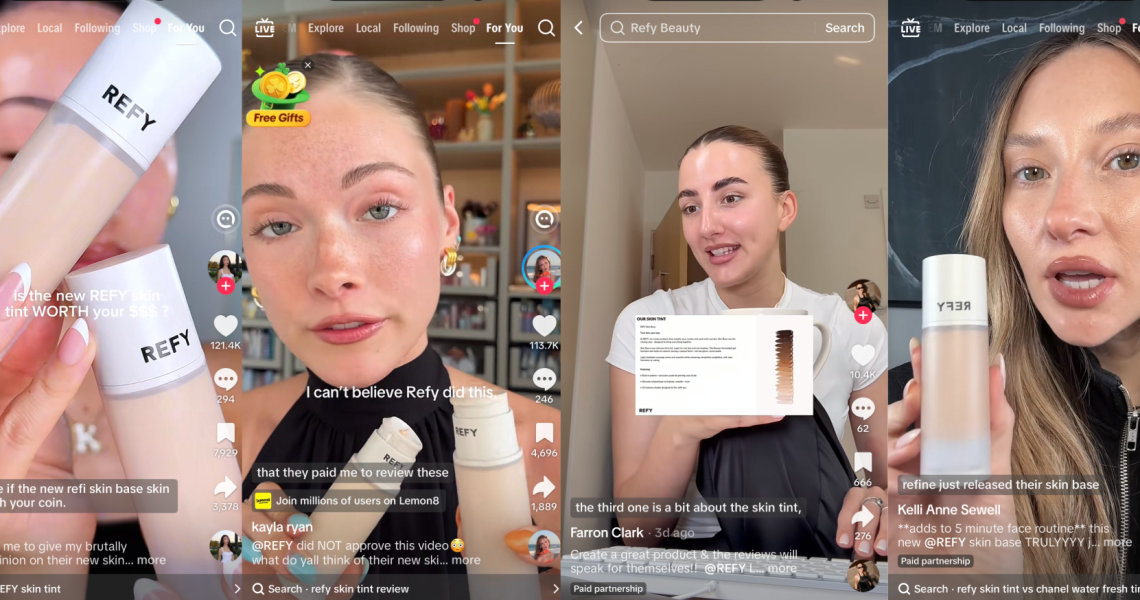
Some beauty brands are already testing how much control they can relinquish. For its Skin Base Skin Tint launch earlier this year, Refy paid 12 creators to post without requiring approval. Creator Kayla Ryan, who had previously criticized other Refy products, publicly expressed surprise at the arrangement, Glossy reported in May.
“Creator marketing has all become very similar,” Charlotte Geoghegan, Refy’s head of brand, told Glossy at the time. She said early Skin Base sales were “above forecast by 200%.” That does not isolate the effect of the creator brief, but the launch offers a commercial example of a brand succeeding while giving up final approval.
The experiment still had structure: Creators received information on the product, as well as its use, ingredients and claims. Seven of the 12 had previously worked with Refy. Geoghegan also acknowledged that she would have liked more participants to mention the unusual arrangement in their videos, a reminder that relinquishing approval means accepting choices the marketing team would not make itself.
Perfume brand Snif has taken a related approach to product endorsements. Ahead of Notewrks’ Ulta Beauty launch this summer, co-founder and CEO Bryan Edwards told Glossy he had asked creators not to promote the fragrances unless they genuinely liked them. The company’s research had found that young fragrance shoppers were wary of recommendations that seemed overly scripted or uniformly positive.
For the roundtable participants, room to interpret a brief was often the deciding factor. Chrishawn Williams, a 19-year-old University of South Florida student, contrasted his beauty partnerships with a Busch Gardens partnership that encouraged him to enjoy a visit with friends before incorporating the required talking points into his content.
“I love when a brand can give me full creativity to create my own script,” he said. He understood the need to get product language right, but found beauty briefs more prescriptive than those from lifestyle businesses and restaurants.
The roundtable did not establish that scripted ads consistently underperform, and participants did not identify the beauty brands behind the deals they criticized. However, it did reveal a cost those advertisers may not see in a campaign report: Creators questioning whether to keep working in the category at all.