For this week’s Luxury Briefing, I look at why London Fashion Week’s return of international buyers did not translate into greater online attention. I spoke to Harrods’ Simon Longland and Bloomingdale’s David Thielebeule about the collections they are backing, and to designers Daniel Fletcher and Susan Fang about converting fashion-week interest into international growth. Also, Gucci’s China-made sneakers, and executive moves at Marc Jacobs, Givenchy and Repossi. For tips or comments, email me at zofia@glossy.co
London Fashion Week closed with the return of something more valuable than hype: buyers. Accredited buyer attendance increased 19% year over year for the spring 2027 season, while international buyer attendance jumped 41%, according to the British Fashion Council.
“A 41% increase in accredited international buyers matters because designers need customers as well as audiences,” said BFC CEO Laura Weir. “To see major British houses choosing London alongside extraordinary emerging talent, retailers opening the industry to consumers and international buyers discovering businesses they want to take into new markets is exactly what London Fashion Week should do.”
But those buyers returned as LFW’s online visibility declined. Posts about the week fell 57% year over year, while earned media value dropped 24% to $27.3 million, according to Lefty and Insights by Karla Otto.
The figures complicate the prevailing “London is back” narrative. This season suggested a more commercially useful fashion week, but one where designers still faced an uphill battle for attention.
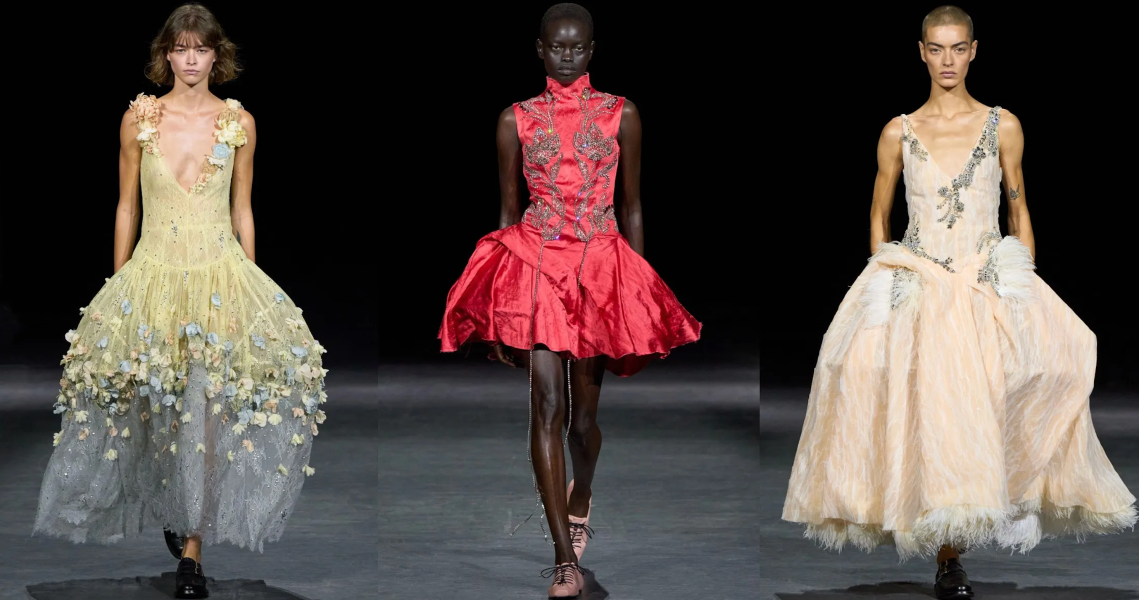
Simon Longland, director of buying for fashion at Harrods, said Erdem, Roksanda, Burberry, Simone Rocha and McQueen delivered the week’s strongest collections. Across them, he saw a return to romance, historical references and a tension between hyper-femininity and menswear-inspired dressing.
“We continue to invest where we see the strongest expression of a designer’s vision,” Longland said. “Our clients come to Harrods for the extraordinary, so our focus remains on pieces that feel truly special, distinctive and difficult to find elsewhere.”
Erdem was his standout. “It was unmistakably Erdem, but moved his language forward through new silhouettes, techniques and an extraordinary level of craftsmanship,” he said. “The interplay between masculine and feminine felt particularly relevant.”
David Thielebeule, fashion director at Bloomingdale’s, also highlighted Erdem, alongside Simone Rocha and Burberry. But he saw no single trend dominating the season.
“London felt less about one big idea and more about designers sharpening their individual points of view,” he said. “The commercial opportunity was clothes with personality and big imagination that still make sense in a woman’s wardrobe. London has always been brilliant at fantasy. This season, the most compelling moments were when that fantasy felt real and often even wearable.”
For emerging brands, converting that interest into international distribution remains the harder part.
At Mithridate, creative director Daniel Fletcher is using physical retail to demonstrate the craftsmanship behind the Guangzhou-headquartered brand. Mithridate opened a Galeries Lafayette pop-up over the summer and is planning a London pop-up in December and a new China store in October. It has also secured its first U.S. wholesale account in Chicago.
“The challenge we face as a young brand is getting people to trust the quality and craftsmanship behind the clothes,” Fletcher told Glossy backstage. “It can feel so different when you see something on the runway compared to seeing it in a store. We want people to be able to feel the clothes, touch them and see them in person.”
Susan Fang is seeing growth across a different mix of categories and markets. The designer said her ready-to-wear business is growing in Korea, while made-to-order bridal demand has increased consistently over the past four years.
“People are still ordering collections from four years ago,” Fang told Glossy. “I’m glad the clothes can feel timeless, particularly for special occasions.” The U.S. is already a significant custom-order market for the brand, she added, particularly for wedding dresses.
The attention surrounding LFW was not distributed evenly. Burberry led Lefty and Karla Otto’s Instagram ranking with $10.8 million in EMV, though that was down 36% year over year. McQueen generated $1.6 million, down 46%, while Mulberry’s Christopher Kane debut produced $388,000.
Separate research from Billion Dollar Boy found that M&S generated 39% of creator impressions among the U.K.-based accounts it analyzed, followed by Mulberry at 24%. Collectively, high-street retailers drove 58% of creator impressions, compared to luxury brands’ 42%.
This season, London succeeded in bringing more people who place orders back into the room. The next test is whether its independent designers can turn that renewed interest into deeper buys, international stockists and businesses capable of holding attention long after the shows end.
Executive moves
- Marc Jacobs has appointed John Wattiker chief marketing officer, effective Monday. He will oversee the brand’s global marketing strategy. The appointment is among the first major executive moves since WHP Global and G-III Apparel Group completed their $925 million acquisition of Marc Jacobs from LVMH earlier this month.
- Givenchy has named Alistair McCallum chief marketing officer and Nicky Grays human resources director, effective Sept. 30. Both executives will report to CEO Amandine Ohayon. McCallum joins from Burberry, where he most recently served as vice president of global communications. His résumé also includes Alexander McQueen and Fendi. Grays was previously the HR leader for LVMH Fashion Group in the Americas, following roles at Farfetch, Stadium Goods and Moda Operandi.
- Repossi has appointed Matthieu Soudan CEO, effective immediately. He succeeds Anne de Vergeron and reports to Stéphane Bianchi, LVMH’s group managing director. Soudan previously held leadership positions at Tag Heuer and Bulgari.
News to know
- Gucci is testing the limits of “Made in Italy.” Two sneakers from Demna’s Primavera collection, including the $1,000 Drip, are made in China. Gucci cited the manufacturer’s technical capabilities and said it has no broader plans to move production outside Italy.
- CFDA vice chair Aurora James is facing a $1 million lawsuit. Brooklyn creative agency The Gathery alleges that James, the Fifteen Percent Pledge and its fiscal sponsor failed to pay for work on the nonprofit’s 2026 gala.
- Luxury brands are maintaining multimillion-dollar runway budgets despite the downturn. Major Milan and Paris productions can cost up to $11.5 million, as brands compete for attention and seek momentum with top-spending clients.
Listen in
On last week’s Glossy Fashion Podcast, senior fashion reporter Danny Parisi and editor-in-chief Jill Manoff unpacked six shifts they observed at New York Fashion Week. They discussed the move toward more wearable collections, designers’ growing use of vintage, increasingly immersive brand storytelling and the week’s packed party schedule. The episode also examines the fallout from former CFDA president and CEO Steven Kolb’s filmed altercation with a PETA protester. Listen here.
Read on Glossy
Why more brands are incorporating vintage into runway collections, stores and marketing. Sephora’s arrived on TikTok Shop – what does it signal about the platform’s growing influence? Plus, a look at Ugg’s new global “Born to Feel” brand platform and Pinterest’s decision to sponsor a phone-free London Fashion Week show.