For the Wellness Briefing, Glossy interviewed Jenny Duan, the 22-year-old founder who has raised $11.6 million to launch a continuous hormone-tracking wearable named Clair. It’s part of the burgeoning hormone-tracking marketplace that could soon upend how women interact with wearables.
Additionally, NYC Mayor Zohran Mamdani announces a new “click to cancel” law that will soon impact gyms and subscription-based CPG. Plus, a new stat illustrates spa worker burnout, and CorePower Yoga and Gold’s Gym experience exec shakeups.
Is hormone tracking the future of women’s wearables?
There’s a gold rush happening now for health-tracking wearables that better serve women.
As previously reported by Glossy, this includes new hardware to better track strength training or sun exposure — both of these trackers are designed to look like women’s jewelry. On the software side, there’s a race underway to train large language models on women’s health to better reach female users.
Now, the industry is in the midst of an influx of innovation around hormone tracking.
“There’s just a lot of optimism in the air, especially because the majority of employees at our company are women,” Jenny Duan, the founder and CEO of Clair Health, told Glossy. “A lot of us have been really waiting for better solutions for our health, so it feels good to be able to take the charge and make a difference in this space.”
Duan and her co-founder, Abhinav Agarwal, are both recent Stanford graduates and among the youngest founders in the wearable game, at 22 and 24 years old, respectively.
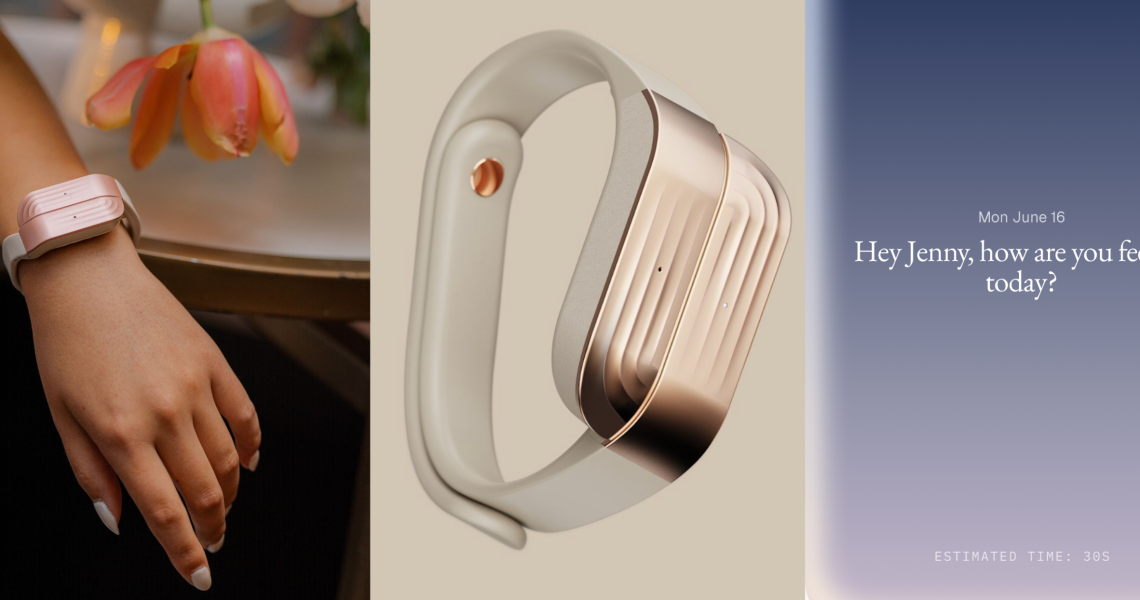
Clair was designed to give users a continuous look at one’s hormones without a blood or urine sample. The watch-like design uses 10 biosensors and more than 130 proprietary biomarkers to monitor hormones using technology inspired by continuous glucose monitors. But unlike CGMs, Clair doesn’t use needles, nor does it pierce the skin at all.
Instead of collecting blood or inserting a needle-like sensor, Clair uses a sensor stack to infer hormone levels by tracking physiological changes, such as body temperature and heart rate. Then users manually track their cycle and symptoms in the Clair app to create a fuller picture of their hormone health.
“We pick up a lot through the signals in our backend,” Duan said. “Of course, this is not something we show users at this time because of FDA regulations. We are a wellness device [not a device meant to diagnose anyone], but our backend is calculating quantitative hormone numbers.”
In June, Clair announced it had closed a seed funding round led by Khosla Ventures — the VC firm that counts DoorDash, EightSleep and OpenAI in its portfolio — bringing total funding to $11.6 million. The company will ship its first models this fall.
The company will use the funding to scale and complete large-scale clinical trials on the path toward FDA approval, which could take a year or more, Duan told Glossy.
Upon launch, Clair will only work for women. “Our device is built off of the HPO axis, which is the hypothalamus-pituitary-ovarian axis [only found] in women,” Duan said. “This is where estrogen, progesterone, LH and FSH, which are the four hormones that we track, are produced, synthesized and cleared.” Duan doesn’t plan to make a version for tracking hormones in men anytime soon.
Early customer data shows that women suffering from PMOS, inflammation or irregular periods, or who are going through fertility treatment or testing, are especially interested in Clair.
While the most novel, Clair isn’t without competition. Earlier this month, Oura rolled out a partnership with Oova, a hormone-tracking app that uses at-home urine testing paired with manual tracking to monitor hormone health. This new partnership integrates Oova into the Oura app to see how hormone fluctuations, daily symptoms and sleep patterns intersect with overall health findings.
“Wearables have become remarkably good at telling women what happened. … But most women are still left wondering why,” Dr. Amy Divaraniya, founder and CEO of Oova, said in a statement. “By bringing hormone data, symptom tracking and wearable insights together, we’re helping women understand the biological patterns behind how they feel.”
Oova was launched in 2017 and is currently privately held by its founder, Dr. Divaraniya. All Oura subscribers gained access to Oova on July 6 as part of the integration.
Earlier this year, Oura also unveiled a partnership with Mira, the 12-year-old fertility-tracking company that uses a small, handheld tool and app to track hormones. Then there is 6-year-old Hormona, which took on $6.7 million in 2020 to bring its DTC urine test and app to market.
The global femtech market is estimated to be worth around $45 billion this year and could reach $97 billion by 2030, according to Grand View Research.
“We believe that a rising tide lifts all boats,” Duan said. “There’s such a huge gap in the women’s health ecosystem that more research, and more resources, is a good thing.”
Executive moves:
- Dan Lynn is the new CEO of CorePower Yoga, the Colorado-headquartered fitness studio company with more than 220 locations. He takes over for Niki Leondakis, who is retiring. Lynn’s CV includes Expedia, Vrbo and, most recently, chief commercial and restaurant officer for Inspire Brands, parent company of restaurant chains like Dunkin’, Baskin Robbins and Buffalo Wild Wings.
- Gold’s Gym, the gym chain with more than 550 locations, is reshuffling its executive lineup in an effort to accelerate growth and franchisee performance. Announced this week, Brad Reynolds is the new CEO of the fitness chain, a role he previously held with co-CEO Danny Waggoner, who has been reassigned as COO. “We are going to build a best-in-class franchise organization, raise the bar on member experience, reflecting the full weight of what Gold’s Gym means to people, and make Gold’s Gym the standard every other fitness brand measures itself against,” Reynolds said in a statement.
News to know:
- New York City Mayor Zohran Mamdani announced a new “click to cancel” rule on Friday that will soon impact gyms, fitness studios and CPG subscriptions. The new law will go into effect on October 1, 2026 for all brands serving New York City-based consumers. It requires all companies to make canceling a membership or subscription as easy as it was to sign up. “For years, companies have built their business model around making it harder for working people to hold onto their money,” Mayor Mamdani said during a press conference on July 10. “Whether it’s hidden fees that suddenly appear at checkout or subscriptions that take one click to sign up for and a dozen steps to cancel, the result is the same: working people pay more while corporations profit. That ends now. If you can sign up with one click, you can cancel with one click.”
- Is nervous system regulation the next wellness frontier? The concept is commonly discussed in wellness circles on social media, oftentimes with individuals aiming to better control their “fight or flight” response to everyday stress. Now, Toronto-based longevity studio Supernatural is opening a new boutique class concept called The Portal. Its first location will offer group classes that use sound meditation, breathwork, movement and storytelling to create feelings of emotional wellbeing and connection, according to the company.
- Partnering with boutique fitness concepts continues to be a winning tactic for CPG brands. Hint, the independently held, 21-year-old bottled water brand, is partnering with Stretch Zone to reach consumers in more than 100 of its studios across the country with free samples. “Partnering with Stretch Zone lets us reach people at exactly the right moment when they’re prioritizing their bodies and looking for feel-good habits that fit real life,” Michael Pengue, CEO of Hint Water, said in a statement.
- Move over, vitamin stickers — supplement strips are the new novel form factor for dosing vitamins and minerals for sleep, immunity, recovery and more concerns. First movers claim the format allows for better absorption. Currently available are Smart Strips, a Bulgaria-based company that sells a one-month supply of its vitamin blends for around $34, and Dissolvd, a Utah-based company that sells vitamin blends and peptide strips for $39-$199 for a one-month supply.
Stat of the week:
One in three spa practitioners have considered leaving the industry because of concerns about their own wellbeing, according to a new survey of 159 U.K. and international spa, beauty, and wellness therapists. The survey, conducted by Hayley Snishko, a British massage therapist and mental health advocate, found that spa therapists increasingly feel emotionally overwhelmed and exhausted despite feeling fulfilled by their work. In a post on her LinkedIn page, she has called “for employers and leaders to create healthier, more sustainable workplaces.”
In the headlines:
Bryan Johnson’s girlfriend wants to share her body with the world [WSJ]. Why wellness is booming at festivals in the UK [BBC]. The $8.5B kids’ wellness market is creating a new gen of mobile franchises [NewsWeek]. Brands won this season of ‘Love Island USA’ [Modern Retail]. To manage 300,000 creators, Unilever automates everything but the relationship [Digiday]. Can scent help you sleep better? Kimba raises $5.4M to show it can [Beauty Independent]. Forget the supplements and bring on the berries [McGill]. The traditional Chinese medicine practice Novak Djokovic brought to Wimbledon 2026 [Vogue].
Need a Glossy recap?
How Bandit Running is expanding internationally while staying hyperlocal. Milani CEO Mary van Praag unpacks the strategies behind 19 quarters of growth, trends she’s betting on for 2H. Social networking app Pie announces creator and founder Nadya Okamoto as chief marketing officer. Hung Vanngo Beauty is rethinking shade-matching with first foundation launch. Stripes Beauty expands to 448 Ulta stores as menopause care moves into the mainstream. Physicians Formula returns to ‘2016 makeup’ with a Jaclyn Hill and Manny MUA partnership. How fast-growing Pink Palm Puff aims to expand beyond its core teen demographic. On is betting on robots and nearshoring to gain an advantage.