Suddenly, bare nails are trending.
The complex, hours-long appointments that led to Hailey Bieber-inspired glazed donut nails, as well as nails dotted with berries or stars or bedazzled with gems, no longer apply. Now, the trend is a nude, simple manicure, and even (gasp!) simply bare, unpainted nails.
More women are choosing to go bare — or, bare with a little help from a new class of products dedicated to making going bare chic.
“I’m a die-hard naked nail person,” said Amy Welsman, founder and CEO at Paume, a brand that primarily focuses on hand care. Paume, in fact, does not sell a single polish product, sticking to a $29 All-in-One Cuticle & Nail Cream and a $28 Hand & Nail Brush. Welsman developed the cream as an alternative to cuticle oils, which she found didn’t absorb quickly. A cream, however, “allowed for more active ingredients to treat various nail issues.”
“Our product is formulated with biotin and keratin, similar to what we put in our hair, but for our nails,” she said. “It helps with strengthening nails and preventing that peeling that can happen.” She noted that alcohol in the formula also helps kill bacteria in the nail bed.
According to market research firm Spate, the popularity of nude nails has remained relatively stable year over year, with 6.9% growth across platforms. However, the trend has accelerated more recently, posting 53% quarter-over-quarter growth, suggesting new momentum. Clear nails, meanwhile, have seen over 26% year-over-year growth. The data is based on Spate’s Popularity Index (U.S., ending April 2026), which combines Google search volume, TikTok views and Instagram posts to measure consumer interest.
“From my review of consumer behavior around nude nails, it’s clear that nude manicures, including gel and acrylics, are trending. Simultaneously, the bare nail trend is experiencing a significant surge on TikTok, showing 197.3% year-over-year growth and averaging over 311,000 weekly views,” said Mathilde Riba, beauty insights manager at Spate. Riba also pointed to the rise of brands like Manucurist, whose popularity has grown more than 275% year-over-year across platforms. The brand focuses on nail care products that improve nail health while subtly enhancing their appearance.
While Paume’s nail cream and brush are not new, a number of nail brands have recently launched products meant to care for one’s nails or create a sort of no-makeup-makeup for nails.
And then there are the brands that have dedicated their entire raison d’être to nail care. Bare Hands, for example, launched in 2020 with a minimalist kit dubbed “The Dry Gloss Manicure” ($42). It includes a cuticle oil, a precision glass file and wood sticks to push the cuticles down, all in an aesthetically-pleasing carrying case. The brand was, perhaps, ahead of its time.
Soon, a new brand with a similar mission will hit the market: Dubbed Buff Beauty, it is the brainchild of Katia Beauchamp, co-founder of Birchbox and former CEO of Victoria Beckham Beauty. In a LinkedIn post published two weeks ago, Beauchamp wrote, “The beauty industry has skinified almost everything. Hair became scalp care. Lips became serums and masks. … The line between what ‘treats’ and what ‘decorates’ has collapsed into one expectation: performance. But look down. Our nails, hands, and feet are still living in the cosmetics era, where ‘treatment’ is mostly a step toward covering the nail-polish, gel, press-ons. The skin that shows our age the fastest. The feet that carry us through the world. The bare nail beneath all that cover. Still so much whitespace.” The brand declined an interview via its PR firm. Though Glossy does not yet have details about the products the brand will offer, it is clear that it aims to capture customers looking to treat their nails rather than adorn them.
In another post, Beauchamp replied to a Reel in which creator Grace McCarrick spoke to the polished effect a manicure can give an overall look, writing, “I want to give people another option for feeling done, put together, or ‘polished’ (I want that word back!). … Looking forward to sharing Buff and a new beauty ideal.”
To some, bare nails are now the ultimate flex. They fit right in with other timely trends — think: the clean girl aesthetic and quiet luxury, both of which have dominated our feeds for the past couple of years.
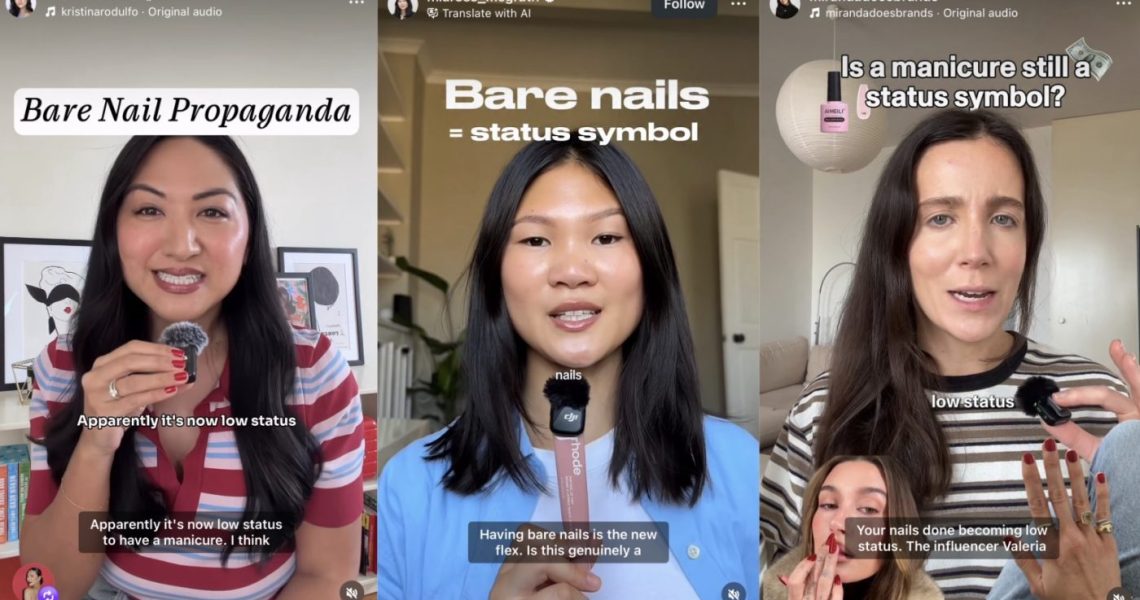
In an April 29 Reels post by Miranda Shanahan (@mirandadoesbrands; 18,000 Instagram followers), she responded to a post made by creator Valeria Lipovetsky (2.5 million Instagram followers), in which Lipovetsky said she’d recently decided to forego manicures. “This prompted an outpouring from other successful women, saying the same thing: Their time is too valuable to waste hours going to the salon every three weeks,” Shanahan said. Analyzing the shift, she offered this explanation: “This is textbook counter-signaling. The status symbol becomes common. The people at the top opt out to show they don’t need it.” Bare nails, Shanahan suggested, make for the perfect status symbol, as they are, in fact, harder to pull off. “We all know a gel nail can hide a multitude of sins, so now the bigger, emerging flex is simply not needing one,” she said, implying that natural nails are preferred — if they are perfectly manicured on their own.
To some, however, idealizing bare nails introduces problematic ideals around class and even racial beauty standards.
On May 14, creator, and former Women’s Health beauty director Kristina Rodulfo (over 56,000 Instagram followers) posted a Reel titled “Bare Nail Propaganda.” The Reel received over 19,000 likes and over 1,300 comments. In it, Rodulfo addresses the complications of declaring bare nails superior to decorated ones.
“Apparently, it’s now low status to have a manicure. I think that’s bullshit. My friend sent me this Reel saying that short bare nails are the new status symbol, signifying a level of nonchalance afforded by wealth and privilege. … What I’ve noticed is a glaring lack of intersectionality. It’s harmful to conflate naked nails with better taste or class, which are often just euphemisms for white supremacist beauty standards,” Rodulfo explains in her post, adding, “There’s nothing inherently wrong with liking nude nails. I like nude nails — but what I have a problem with is respectability politics and perpetuating beauty rules that shut down marginalized communities. We all shouldn’t aspire to be indistinguishable clean girl clones. Not only is it boring, but it fails to acknowledge the rich cultural history of nails. We can’t talk about nails without talking about how central it is to self-expression in Black and Latino communities, and across Asia, and Japan, and Korea, and Vietnam. Nail art is not just about pretty colors; it’s about how these communities of color show up in a society that constantly devalues them.”
Rodulfo noted that, furthermore, nail art as it exists today is, in fact, art. She cited examples like the often mind-blowing work of Mei Kawajiri (aka @nailsbymei).
In addition, she said, if the current trend suggests that bare nails are what make someone look “high class” or “rich” or “old money,” then that suggests that the opposite is also true — “If you have nail art or a manicure, you are lower status or lower class. And that is so problematic.”
In yet another Reel posted by Mia McGrath (279,000 Instagram followers) this Wednesday, she posed a question asking whether the new bare nail trend is “genuinely a positive beauty trend, or is it a recession indicator?” As for herself, she said, “As someone who is frugal-chic, … I like being frugal, but at the same time, I know where to splurge and save. … I currently don’t value [getting my nails done]. To me, it’s a large portion of time taken up to book the appointment and attend. You can’t really multitask and do anything while you’re there.”
So perhaps it’s unsurprising that brands are looking to create products to help split the difference, so to speak.
Brands like Manucurist, which in February launched its Active Blur polish, a $19 no-makeup-makeup-for-nails product, include Orly, which has a number of recent launches that also tint, blur or otherwise improve the appearance of one’s nails. In a press release for Active Blur, the French brand describes the product as a nail filter, calling it a “hybrid between care and makeup polish.” The product also contains ingredients to help strengthen the nails.
In a call with Glossy, Julie Ventura, Orly’s global education manager, similarly described one of the brand’s newer products, Nail Retouch, which launched last September. “We say it’s like a filter for your nails. It’s like you get to Photoshop your nails,” she said, explaining that lemon extract helps to neutralize any discoloration, a fermented complex supports stronger, healthier nails, and antioxidants defend against environmental damage. Such products seem to reflect the “skinification” Buff Beauty also wants to bring to the nail care space.
Though Orly has long focused on nail health and treatment-focused products, Nail Retouch was a true standout hit for the company, said Elina Gitig, its brand manager. The product sold out with 10,000 units in the first three weeks, then sold through an additional 6,000 units a couple of weeks later, Gitig said, depleting the brand’s stock once again. Now, through its own DTC site and Amazon, the brand sells 2,000 units per week of the SKU.
Last November, the brand launched its pH Perfector polish in two shades, Cool Blush and Warm Blush. The pH Perfector, Gitig said, is based on K-Beauty pH-adjusting lip and cheek tints. “This one is a very unique product. It’s like a nail tint for your natural nails — I like to use the word stain because that’s truly what it does. It’s the no-maintenance manicure. You put it on, and it’s going to work with your nails’ natural pH to determine how intense the tint is on your nail,” Ventura said. Because it’s only a tint, there are no concerns about chipping, and it naturally fades over time, offering a much lower-maintenance take on a “polished” nail and nail look.
Of course, nail art and manicures have not disappeared. But there remains a confluence of factors that have led many women to pull back on what once may have been weekly or monthly nail appointments. For example, there’s the cost and the time spent on them. There have also been debates about the safety of gel manicures (a complicated, separate conversation), which may have led some consumers to seek out ‘cleaner’ products or simply pull back on using products on their nails at all. And there are the shifting aesthetic trends, too.
“It’s all about ’90s nostalgia at the moment,” Welsman said, pointing to the Carolyn Bessette Kennedy obsession brought on by “Love Story,” which premiered in February. “It’s natural that the bare nail trend would stem from that, as well. A quieter, more casual look, inspired by Carolyn — everyone is seeking an effortless, low-maintenance but polished style, and painted nails conflict with that.”
Week in review
- Maje partnered with Blanca Miró (735,000 Instagram followers), the designer of La Veste, on a capsule collection. The collection is dubbed “Vacanze sulla Costa Italiana,” meaning a summer on the Italian coast. It is bright and summer-ready and includes pieces like bright yellow polos, red trousers and a sun hat featuring bright wraparound sashes.
- On the heels of their first collaboration, Amika and Ellis Brooklyn have joined forces on their second dry shampoo ($29), this time infused with Ellis Brooklyn’s Guava Granita scent. Their first collaboration, the Perk Up Miami Nectar Dry Shampoo, sold out in 15 days.
- Refy launched the Water Bronzer, Water Blush Liquid Cushion with Ceramides ($24) in three shades and Water Bronzer Liquid Cushion with Ceramides in five shades, alongside a corresponding brush. The products appear K-Beauty inspired, as they match the format of cushion compacts.
- Michael Preysman, founder of Everlane, launched stillradical.com, which he said will be a clothing brand that, unlike his previous brand, which just sold to Shein, will not take money from private equity or venture capital. For now, the website is just collecting email addresses. Crestfallen (former) Everlane fans are waiting with bated breath.
Inside our coverage
Exclusive: Patrick Ta sets the record straight on ‘transition blush’
What the Estée Lauder-Jo Malone lawsuit means for eponymous brands
A profitable brand builder, eyewear is fashion’s new favorite category
Reading list
Bella Hadid’s ‘Ôrebella Closes Series A Funding Round
Who owns the visual language of modern skincare brands?
The Korean beauty giant coming for America’s dollars