In this week’s Luxury Briefing, I check in with analysts Luca Solca and Simeon Siegel on the state of Capri as it looks to grow Michael Kors and Jimmy Choo with new executive hires. Also, executive moves at Lanvin, Diane von Furstenberg and Tod’s. For tips or comments, email me at zofia@glossy.co.
After selling Versace to Prada for $1.375 billion in cash in December, Capri Holdings is now only a two-brand company, with its future resting on Michael Kors and Jimmy Choo. Its turnaround comes as price increases across high-end luxury have created an opening for both of these recognizable brands, positioned at comparatively accessible price points.
On Wednesday, Capri reported fourth-quarter revenue of $796 million, down 3.7% year over year. For fiscal 2027, the company expects low-single-digit revenue growth to approximately $3.53 billion, while operating income is expected to increase 60% to approximately $190 million. The Versace sale helped Capri cut net debt to $222 million at the end of fiscal 2026, from approximately $1.4 billion a year earlier. The company also restarted share buybacks, repurchasing $79 million of shares during the fourth quarter and planning a further $200 million in fiscal 2027.
“A year ago, our priority was to stabilize the business and create a stronger foundation for growth,” Capri chairman and CEO John Idol said during the earnings call. “Today, we are building upon the improving trends resulting from the success of our strategic initiatives.” The brand did not respond to comments about its strategy.
Analysts Glossy spoke to see a broader market opportunity behind the strategy. “I do think that credible and desirable accessible luxury brands have an opportunity in a market where high-end brands have materially increased prices,” Luca Solca, senior analyst for global luxury goods at Bernstein, told Glossy. Solca cited the success of Polo Ralph Lauren and Coach as evidence that middle-class consumers are moving toward lower price points.
The strategy comes as consumer spending remains deeply divided: In its March 10 Consumer Checkpoint report, Bank of America Institute said the gap in spending growth between higher- and middle-income households remained “very substantial,” while the BoF-McKinsey State of Fashion 2026 report, released last November, found that luxury prices had risen 61% on average between 2019 and 2025, creating more room for accessible-luxury brands.
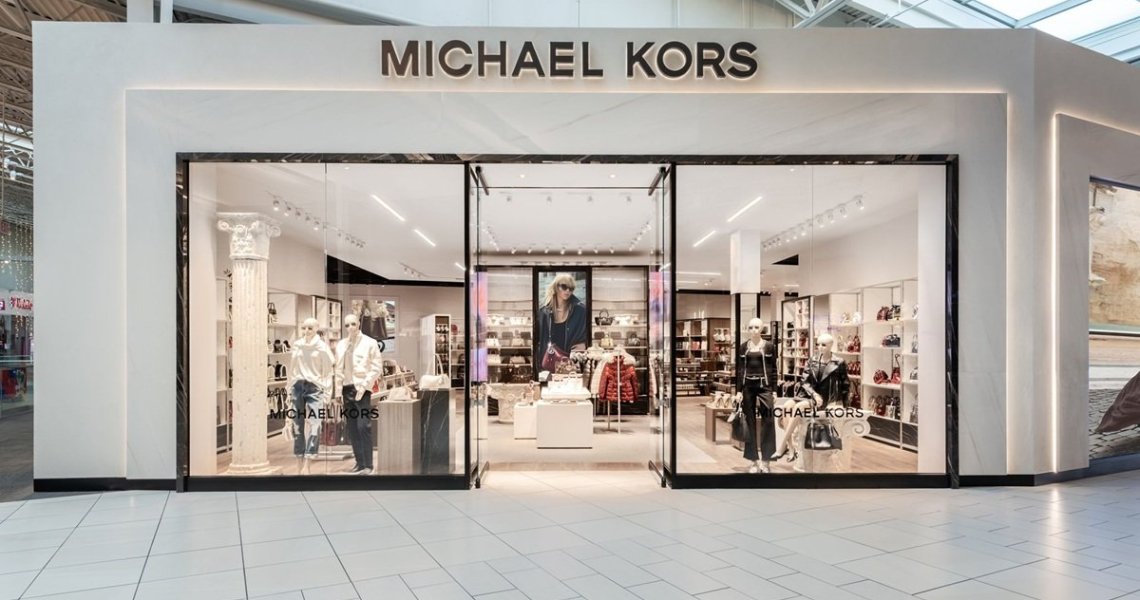
For Michael Kors, Capri is first trying to improve the quality of its sales. Fourth-quarter revenue at the brand declined 5.5% year over year to $656 million. Capri said reductions in promotions, third-party sales, off-price shipments and store closures cut more than $150 million from the brand’s fiscal 2026 revenue.
There are early signs of progress from the brands. Michael Kors’ full-price comparable sales turned positive across all regions during the fourth quarter, while average unit retail increased by low double digits. Revenue grew in EMEA and Asia, but fell 14% in the Americas. Outlet sales also remained under pressure, although outlet AUR turned positive.
“I’d argue a real brand turnaround is predicated on a reduction in promotions and the ability to return to setting, rather than accepting, price,” said Simeon Siegel, managing director and senior analyst at Guggenheim Securities, told Glossy. “Before a brand can sell more, they need to sell better.”
Capri is supporting that effort to turn the brand around with new products, updated stores and a more focused marketing push. Michael Kors’ spring Hotel Stories campaign continued its “Jet Set” positioning, while its February runway show generated 4.3 billion impressions, according to the company. Capri revived Michael Kors’ Jet Set positioning in February 2025, recasting its travel-and-glamour heritage through destination-led Hotel Stories campaigns and updated accessories.
And the brand has executive changes, too. Corey Moran joined Michael Kors as chief marketing officer in April from Google, where he most recently served as head of industry for fashion and luxury. Previously, he held senior marketing roles at Coty across luxury fragrance brands including Marc Jacobs, Chloé, Bottega Veneta, Miu Miu and Balenciaga.
On the other hand, Jimmy Choo is approaching the accessible-luxury opportunity from a stronger sales position. Fourth-quarter revenue increased 5.3% year over year to $140 million, as the brand continued to broaden its product offering beyond occasion footwear.
That includes the Bar family, a day-to-evening bag design featuring a JC-monogram bar closure, and the Curve family, which includes top-handle, crossbody and clutch styles. On Jimmy Choo’s U.S. site, Bar bags currently range from $795-$1,495, while Curve styles range from $575-$2,195, including embellished versions above $1,500.
“We have also seen highly encouraging consumer responses to our Bar and Curve groups, supported by our strategy to expand our pricing architecture to include bags positioned below $1,500,” Idol said on the call.
As higher luxury prices push more middle-class shoppers toward accessible alternatives, Solca said Jimmy Choo’s lower-priced handbag expansion is well-timed. “In this [luxury pricing] context, I believe Jimmy Choo is acting smart, and I am getting very positive feedback from multi-brand retailers on how the brand is doing,” Solca said.
But Jimmy Choo’s growth has introduced a margin question. Its fourth-quarter operating loss widened to $20 million, from $10 million a year earlier, while gross margin declined to 65.7%, partly due to lower initial markups associated with its broader pricing architecture.
Capri expects Jimmy Choo to return to low-single-digit operating profitability in fiscal 2027. It is developing a profit-improvement program that could include closing underperforming stores, reducing SKU counts, improving efficiencies at its factories and lowering SG&A expenses.
“We know we have work to do on the profitability of that business,” Idol said.
The program follows Jimmy Choo’s appointment of Andy Holmes as svp, CFO and head of operations in March. Holmes joined from Richemont-owned Dunhill, where he most recently served as chief operating and financial officer and interim CEO, after previous finance roles at Burberry and Marks & Spencer. At Michael Kors, meanwhile, Moran takes on the task of converting renewed engagement into broader sales recovery.
With Versace gone, Capri’s turnaround case is clearer but narrower, according to these analysts: Michael Kors must show that reduced promotions can restore durable demand, while Jimmy Choo must prove that a more accessible product offering can drive profits as well as sales.
Phia’s celebrity cap table this week is testing fashion AI’s crowded future
Phia’s newest investor announcement this week is stacked with celebrity names. The shopping app, founded by Phoebe Gates and Sophia Kianni, has named the celebrity and tech backers behind its $35.5 million Series A, including Alix Earle, Khloé Kardashian, Sydney Sweeney, Priyanka Chopra, Karlie Kloss, Rachel Zoe, Sophia Amoruso, Paris Hilton, Ice Spice and Alexandre Arnault.
The company says it now has more than 1.5 million users, over 9,600 retail brand partners and scans more than 350 million products to help shoppers compare prices, find alternatives and assess resale value. “Online shopping is still wildly broken for consumers, and Phia is solving that,” said Amoruso in a statement to Glossy. The challenge is that many companies are chasing the same problem. Retailers, resale platforms, search engines and shopping assistants are all trying to become the place where consumers decide what to buy. For luxury brands, Phia’s rise points to a bigger problem, where shopping tools are getting better at comparison, and the industry’s old levers of desirability, scarcity and controlled pricing may become harder to manage.
Executive moves
- Lanvin has appointed former Eric Bompard CEO Barbara Werschine as chief executive, succeeding Andy Lew. This comes as the Lanvin Group-owned luxury house works with artistic director Peter Copping to rebuild demand in Europe, before pursuing growth in the U.S. and Asia, while developing new home and lifestyle categories.
- Diane von Furstenberg has appointed Henry Zankov as its first artistic director, following the success of his 2025 capsule for the brand. DVF is rebuilding distribution after taking the business back in-house from its Chinese licensee in February 2025. It is preparing to show Zankov’s debut spring 2027 collection at New York Fashion Week in September.
- Tod’s CEO John Galantic left the Italian luxury group at the end of April for personal reasons. This comes less than two years after joining from Chanel, following Tod’s 2024 privatization by the Della Valle family and L Catterton; the company has not named a successor.
News to know
- Saks Global, which filed for bankruptcy in January owing $1.7 billion to unsecured creditors, is seeking court approval on June 5 for a reorganization plan that would wipe out existing equity holders and unsecured claims. It is also looking to establish a $20 million litigation trust to investigate matters including its $2.7 billion Neiman Marcus acquisition, and install a new seven-member board controlled in part by lenders Pentwater Capital Management and Bracebridge Capital.
- Fashion designer Jeremy Scott’s May 16 Kansas City Art Institute commencement speech, in which he tore up AI-generated remarks before arguing for the importance of human creativity, generated 2.5 million Instagram views and earned him an honorary doctorate from the school. His remarks came eight days after University of Central Florida graduates booed commencement speaker Gloria Caulfield after she called AI “the next Industrial Revolution.”
- Selfridges is proposing changes to its head office teams that could reduce its total workforce by around 2%, subject to employee consultation, two years after a previous restructuring affected approximately 70 head office roles.
- Gucci has signed a multiyear deal to become the title partner of Alpine’s Formula 1 team from the 2027 season. It is launching the new Gucci Racing platform across product, content and high-end client experiences, as parent company Kering seeks to rebuild Gucci’s desirability through a sport that CEO Luca de Meo said reaches more than 1.5 billion people each season.
- Following FSI’s increase to a 73% controlling stake and Katjes Quiet Luxury’s acquisition of about 27%, Missoni plans to expand retail in the U.S. and Europe, growing sales from approximately $145 million in 2025 to $153 million in 2026, with a target of about $232 million within five years.
Listen in
This week on the Glossy Fashion Podcast, Sourcing Journal climate and labor editor Jasmine Malik Chua joins international reporter Zofia Zwieglinska to discuss Everlane’s reported sale to Shein and what the deal means for the brand’s “radical transparency” positioning. The conversation goes into whether Everlane’s sustainability credentials can survive under Shein’s ownership, why responsible fashion remains difficult to scale profitably and what the acquisition signals about the future of values-led fashion brands. Listen here.
Read on Glossy
Brands are betting on the profitable eyewear category. Why marketers don’t trust AI to build brands. Why brands are honing in on at-home reformer pilates.