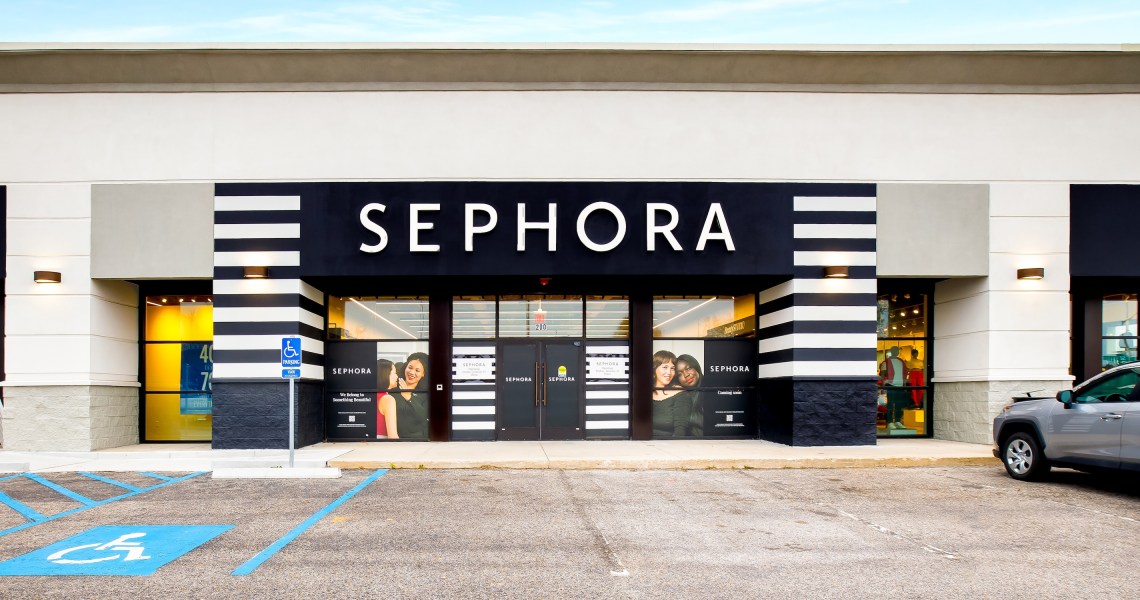
This week, I checked in on Sephora’s and Ulta’s bets on AI through integrations with ChatGPT and Google Gemini. Additionally, Zara fires back at Estée Lauder’s lawsuit over its use of Jo Malone’s name on perfume, and Circana reports on the beauty sector’s growth in Q1.
Why Sephora and Ulta are betting on AI
In March, Sephora announced an integration of its app within ChatGPT, allowing shoppers to use their Sephora loyalty points and perks within the ChatGPT interface. Just under a month later, Ulta Beauty announced its own artificial intelligence integration via a partnership with Google Gemini, which will see Ulta’s beauty assortment surfaced in Google Gemini shopping results in the coming month and the rollout of a new Ulta AI assistant powered by Gemini.
There’s good reason for brands and retailers to want their products to appear on emerging AI platforms like OpenAI’s ChatGPT and Google’s Gemini. According to NielsenIQ data, consumers conduct over 1 billion beauty-related searches per week on ChatGPT. An April 2026 report from Tinuiti states that more than a third of beauty shoppers — and over half of Gen Z — are using AI to research or purchase products.
But while AI is increasingly a part of beauty consumers’ research and discovery behavior, how much AI can drive conversion remains to be seen — ChatGPT already walked back its “Instant Checkout” feature. Rather than wait for the AI shopping pipeline to fully materialize, however, the two beauty retail giants are jumping in lest they be left behind.
“People are increasingly starting their shopping journey on these chatbots. I think the question is: Are they converting via that? Is it just informational? Is it just top of funnel?” said Meghana Dhar, a technology and AI advisor who previously served as head of partnerships at Instagram Shopping. “I’d argue that the funnel isn’t fully built out yet, but I do think that they’re moving towards it.”
Sephora’s and Ulta’s AI bets also come as a digitally native retailer increasingly infringes on their beauty territory: Amazon.
“[Retailers] are all kind of playing catch-up to Amazon,” said Jason Wielenmann, svp of marketplace performance within e-commerce agency Front Row’s marketplace partnership division. “[Amazon] has had their own algorithm for years and years and years. The best way for other retailers to close that gap is to partner.”
According to data from Front Row, Amazon sold $8.1 billion worth of beauty products in Q1 2026 alone, representing a 13% increase from the same period last year. According to Amazon, its AI bot Rufus is helping drive some of those sales; during the months of November and December, Amazon shoppers who used Rufus to make a purchase spent 80% more than those who did not, the retailer told Glossy.
According to Ulta’s most recent earnings report, net sales at the retailer increased 11.8% to $3.9 billion in Q4 2025. LVMH does not break down results by individual brand, but according to its Q1 2026 results, its selective retailing division, which includes Sephora, saw organic revenue growth of 4%, down 3% on a reported basis.
But getting a customer to buy a lipstick or a sunscreen via an AI chatbot isn’t necessarily the only value in integrating with artificial intelligence. For retailers and AI platforms, customer data is just as valuable a currency as a direct sale.
“Ideally, what they’re looking for is to have a closed-loop journey of data. So you’ll be able to understand if someone is searching for something or a brand specifically, how many of those customers end up continuing that brand conversation, and how many actually, then, check out or check out in the future,” said Wielenmann. “That’s just such a data gold mine.”
For Sephora, getting its app in front of ChatGPT users can help the retailer reach those consumers who are starting their beauty shopping journey on the AI platform. But there’s a clear upside for OpenAI to partner with Sephora, too; in February, the AI giant announced it would start showing ads to some U.S. users. Letting those users shop the Sephora app may give them more reason to stay on the ChatGPT interface longer — an important metric for advertisers.
“It ultimately goes down to engagement,” said Dhar. “Why did we launch Instagram Shopping? Because we just wanted people to stay in the app longer so we could deliver them more ads and we could sell their eyeballs, right? And so, now, with ChatGPT having an ads model for the free users, there is a clear incentive to get people on the chatbot, engaging further, deeper, longer.”
But while the ultimate goal for investing in AI-powered shopping remains clear, how retailers and AI platforms formulate the most effective tools — and who gets there first — remains to be seen.
“The TLDR is that I don’t think anyone knows the right go-to-market with [AI] shopping. Everyone’s trying to figure it out. It’s a race to figure it out,” said Dhar.
Executive moves:
- Eduardo Valadez joined Maison Francis Kurkdjian as interim head of sales, North America. Valadez was previously vp of marketing at The Fragrance Group and held roles at Diptyque. Co-founder and CEO Marc Chaya recently stepped down from the luxury fragrance brand, which has yet to name a successor.
News to know:
- Armani is considering selling a 15% to LVMH, L’Oréal and EssilorLuxottica following the designer’s passing in September. Per Giorgio Armani’s will, the fashion house must sell a 15% stake of the company within 12-18 months of his death.
- Zara denies infringing on Estée Lauder’s Jo Malone trademark. The Estée Lauder Companies sued the perfume founder Jo Malone and Zara in March over the use of Malone’s name on a collaborative perfume between the fast fashion retailer and her perfume brand Jo Loves. Malone sold her eponymous fragrance brand to Estée Lauder in 1999, the terms of which prevented her from using her name to market perfume.
- Costa Brazil opened a flagship store in New York’s Hudson Yards. The body-care brand founded by former Calvin Klein designer Francisco Costa folded in 2023 when its then-parent company, Amyris, ceased operations. Costa relaunched the brand in 2024.
Stat of the week:
U.S. prestige beauty retail dollar sales grew 6% to $8.1 billion in the first quarter of 2026, according to data from market analysts Circana. Mass beauty sales grew 7% to $18.1 billion in the same period, with unit sales in both mass and prestige also growing in the low single digits.
In the headlines:
In the Hudson Valley, a beef tallow beauty brand opens its first store. Inside Grasse, where flowers for Chanel No. 5 have been grown for more than a century. How beauty brands make the cut at — and get cut from — Erewhon.
Listen in:
What is PDRN and how did it get so popular? In this week’s episode of the Glossy Beauty Podcast, co-host Sara Spruch-Feiner dives into the trendy ingredient with New York City-based dermatologist Dr. David Kim; the former editor-in-chief of Allure magazine and fractional CMO for K-Beauty distributor Landing International, Michelle Lee; and the founder of Rodial, Maria Hatzistefanis. They discuss what it purports to do for the skin, how it got so popular and how it is expanding beyond Korean beauty.
Need a Glossy recap?
Glossy 101: How did BPC-157 become the wellness industry’s star peptide? Why TikTok’s comments section is driving the majority of first purchases right now. Coty is pivoting CoverGirl to Gen X market amid 1% decline in net revenue. Bluemercury is taking a hands-on approach to staying ahead in a competitive beauty retail environment. How beauty tapped in at the Miami Grand Prix.