In this week’s Luxury Briefing, I speak to experts and luxury fashion sources about the impact of the war on luxury shopping in the Middle East. Also, a final buyer’s take on Paris Fashion Week as the show season wraps up, and news to know from Nina Ricci and GIII. For tips or comments, email me at zofia@glossy.co
Just as the final shows of Paris Fashion Week wrapped on Wednesday, images of new-to-store pieces from Chanel began circulating on social media. For Gab Waller, the Sydney-based luxury sourcing consultant and founder of Gab Waller Consulting and Sourced By, those posts normally spark immediate demand from her Middle Eastern clients. For her, they are among the most active luxury buyers globally and often spend significantly more per purchase than other international shoppers. This time, the response was different.
“When I posted new-season Chanel pieces, clients from the region asked about prices but didn’t complete purchases because of uncertainty around shipping and travel,” Waller said. “I can confirm that since the [war’s] escalation, my Middle East clients have paused on purchases. Some have secured pieces but asked for shipping to be delayed.”
Waller said the hesitation reflects uncertainty rather than logistical breakdowns. “Thankfully, there haven’t been logistical disruptions from my side so far,” she said. “We had shipments already in transit to Dubai [at the start of the conflict], and they arrived without issue. The hesitation I’m seeing is more about uncertainty.” She added that geopolitical instability often slows luxury spending in the short term. “Typically, these moments slow down consumption.”
The move reflects a broader change unfolding across luxury retail in the Gulf. Since the escalation of conflict in the region at the end of February, travel disruptions and slowing mall traffic have begun affecting one of luxury’s fastest-growing markets.
Until recently, the Middle East had been one of the few bright spots for luxury brands navigating weaker demand in China and uneven spending in Europe. According to new Bernstein research, the region accounts for roughly 6% of global luxury sales and was the fastest-growing geography in 2025, growing 6-8% while the broader sector remained flat.
Analysts say the share may be even larger. “The Middle East is now worth roughly 7-8% of global luxury demand,” Bernstein luxury goods analyst Luca Solca told Glossy. “The large groups are almost equally exposed. Some openly report their sales in the Middle East, while others include them under ‘rest of world.’”
Analysts estimate that Richemont and Zegna each generate around 9% of sales from the region, while Ferrari derives roughly 7%. Large luxury conglomerates, including LVMH, Kering and Prada Group, are estimated to generate 5-8% of revenue from the Middle East, while Moncler has one of the lowest exposures at roughly 2% of sales, according to Bernstein.
Tourism has been a major driver of that growth. Dubai welcomed 19.59 million international overnight visitors in 2025, a 5% increase from the previous year and the city’s third consecutive year of record tourism growth, according to Gulf News. December alone brought more than 2 million arrivals, while average hotel occupancy reached 80.7%. Data from shopping service Global Blue shows that travelers from GCC countries account for about 12% of tax-free luxury purchases in Europe, but their average transaction sizes are among the highest globally, often exceeding €4,600, or $5,299, per purchase.
Tourism remains central to the region’s luxury ecosystem, said Achim Berg, founder of FashionSights and former senior partner at McKinsey & Company specializing in fashion and luxury. “The Middle East has positioned itself as a safe haven with sunshine, preferential tax treatment and strong infrastructure,” he said. “But tourist inflow is crucial. If travelers stop coming, that immediately affects luxury.”
Safety has become the immediate priority for retailers and mall operators across the Gulf, where economies such as the UAE rely heavily on expatriate labor. Immigrants make up roughly 85–90% of the population in the United Arab Emirates and Qatar, according to government sources, and they staff much of the retail, hospitality and tourism industries that keep the region’s luxury mall ecosystem running.
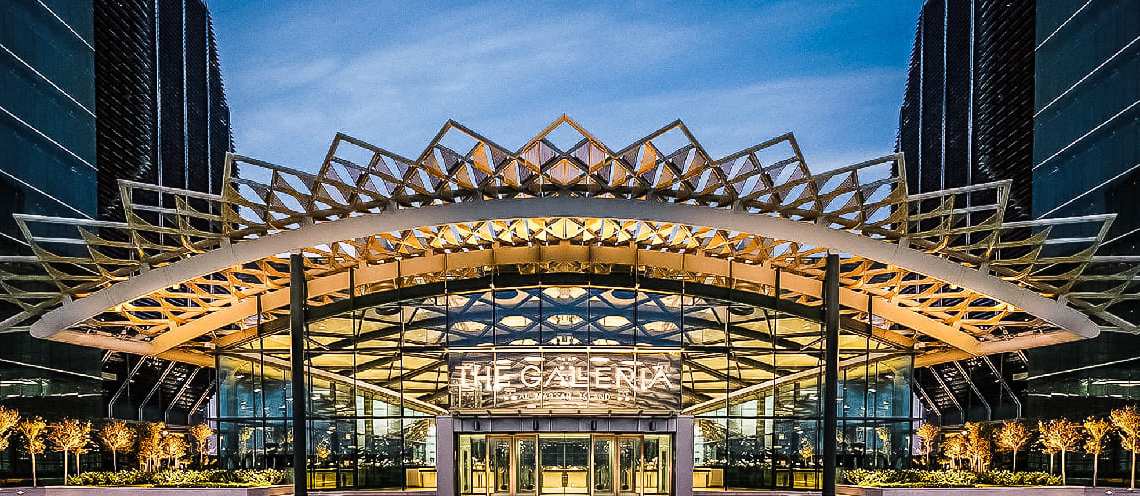
Unlike in Europe or the U.S., luxury shopping in the Gulf takes place almost entirely in large destination malls. Dubai Mall — widely considered the world’s largest shopping mall by total area — hosts hundreds of luxury boutiques and is operated by Emaar Properties. In Abu Dhabi, The Galleria Al Maryah Island anchors the luxury retail district and is managed by Gulf Related. Other major destinations include Mall of the Emirates, operated by Majid Al Futtaim Group, and Place Vendôme Mall, one of the region’s newest luxury developments. While social media videos from the past week have shown an empty Dubai Mall, overall, there has been limited social media footage of Abu Dhabi. The city has been dealing with missile strikes, which were still hitting buildings as of March 12.
In the days following the initial escalation, several international retailers temporarily shut stores across the Gulf, according to Reuters. Kering said on March 2 that its stores in the UAE, Kuwait, Bahrain and Qatar were closed, while LVMH brand stores also temporarily shuttered boutiques in the region. Outside of luxury, companies including Apple and H&M also paused store operations during the initial disruption.
The area’s malls combine luxury boutiques, restaurants and entertainment venues, making them central hubs for tourism and high-end consumption. Luxury brands have invested heavily in the region, as a result. According to Bernstein, labels including Dior and Gucci each operate around 20 points of sale across the Middle East, while brands such as Louis Vuitton and Prada maintain extensive retail networks spanning malls and airport locations.
But the model depends on foot traffic. “If traffic goes down, the system doesn’t work,” Berg said.
Early signals suggest foot traffic in stores has slowed across parts of the region, particularly in markets such as Qatar, Kuwait and Bahrain. Even so, luxury demand has not disappeared entirely.
“From what I hear, brands have moved to a Covid-19 paradigm, focusing on reaching out to clients and remote selling,” Solca said. “Traffic in store is far from zero, with sales probably down just 20-30%.”
At Moncler, which operates three stores in the Middle East, including a flagship in Dubai Mall, store traffic has declined but not collapsed, according to a note from Bernstein following a call with Moncler’s team. Local teams have shifted toward one-to-one outreach and ad-hoc client engagement to maintain demand. The region represents about 2% of Moncler’s revenue and 1% of Stone Island’s, according to Bernstein.
“When traffic slows, brands rely more on personal relationships with clients,” Berg said. “That’s something the Middle Eastern luxury market has always been strong at.”
In a statement to Glossy, Chalhoub Group said its Risk & Crisis Management Committee has been activated and that the company’s priority is “the safety and wellbeing of our people while maintaining business continuity.” The company declined to comment on the potential commercial impact of the conflict. Kering and Majid Al Futtaim Group declined to comment on this story. Public commentary on political developments in the United Arab Emirates is also limited; UAE law prohibits public criticism of the government, ruling families or state institutions, with strict regulations governing public speech and media commentary in Dubai and other emirates.
For now, many luxury executives are still assessing the situation. As brands begin reporting earnings over the coming weeks, analysts expect companies including LVMH, Kering and Richemont to provide more detail about how the conflict is affecting tourism, store traffic and sales across the region.
Even though the Middle East represents a relatively small share of global luxury demand, Berg said the region’s recent growth has made it particularly important. “It’s only about 5% of the global market,” he said. “But it was the 5% that was growing.”
And that is why the industry is watching closely.
“This is clearly a tough blow for the local business,” Berg said. “But the bigger question for luxury is how long it lasts.”
A buyer’s take on PFW: Harrods sees ‘exceptional jackets’ and a confident product focus
Luxury retailers left Paris with a clear message: Strong product is back at the center of the conversation. According to Simon Longland, director of fashion buying at Harrods, many fashion houses used the Fall 2026 season to sharpen their core offering rather than chase novelty.
“This season in Paris delivered remarkable strength across the board,” Longland said, pointing to standout collections from Chanel, Tom Ford, Dior, Givenchy and Hermès that felt “both confident and deeply resolved.”
One item emerged as the season’s clearest commercial anchor: jackets. “Exceptional jackets were undeniably the standout pieces,” he said, highlighting styles across Tom Ford, Saint Laurent, Dior, Chanel, Celine and Alaïa.
More broadly, Longland described the season as a moment of stability following a period of creative-director shakeups. “After several seasons marked by high-profile creative debuts, this felt like a moment of consolidation and confidence,” he said. Designers, he noted, appear “increasingly settled within their houses,” which translates to collections with “enduring appeal.”
News to know
- G-III Apparel Group reported on Thursday that its fourth-quarter net income fell to $31.9 million on $771.5 million in sales (down 8.1%). Its $17.5 million in bad debt was tied to the Saks Global bankruptcy, and $45 million in impairment charges weighed on results as the company continues its exit from licensed businesses with PVH Corp.
- Also on Thursday, Salvatore Ferragamo reported revenue of €976.5 million (about $1.06 billion, down 5.7%) and a net loss of €3 million (about $3.3 million) in 2025. Weaker wholesale and China demand weighed on results, while the company focused on growth in DTC (75% of sales), core footwear, leather goods and retail optimization, including about 70 store closures and stronger performance in the Americas.
- A U.S. federal judge ordered Perplexity AI to temporarily stop using its Comet AI browser agent to make purchases on Amazon, after the retailer sued the startup for allegedly accessing password-protected customer accounts without authorization.
- Puig has parted ways with Harris Reed as creative director of Nina Ricci after more than three years. The designer is stepping down to focus on his own label, and the company has not yet named a successor.
Listen in
On the Milan Fashion Week edition of the Glossy Podcast, international fashion reporter Zofia Zwieglinska and Bloomingdale’s fashion director Marissa Galante Frank discuss the Fall 2026 collections, which included major creative director debuts and strong showings from heritage houses including Prada, Gucci, Bottega Veneta and Fendi across 52 runway shows and 89 presentations. Listen here.
Read on Glossy
How rising oil prices will affect the industry. Vintage sellers are taking their wares to live shopping. Fashion brands are weighing selling in alternative channels to Saks.