This week, I checked in with Muriel Gonzalez, president of The Vitamin Shoppe, and Steve Martocci, founder and CEO of supplement tracking app SuppCo. The former debuted its inaugural “Suppie Awards” last week through a sponsored partnership with Hearst Magazines, while SuppCo unveiled a new “Tested by SuppCo” certification program on Tuesday with a who’s who of supplement brand participants. Additionally, MyFitnessPal acquires rival app, a new strength training wearable launches, and the period-care category expands with an overhaul at Kotex, a Lola partnership announcement and the U.S. launch of South Korean brand Inertia.
Supplement brands have two new ways to stand out in an increasingly crowded space.
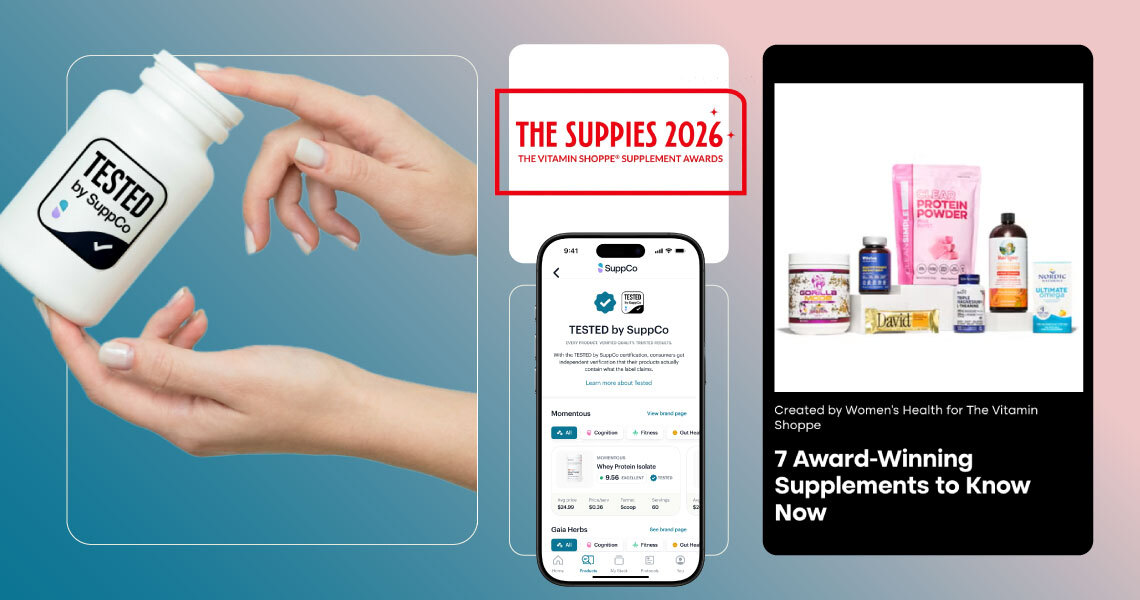
The first, launched last week, is an inaugural awards program from retailer The Vitamin Shoppe called the “Suppie Awards.” In addition, on Tuesday, supplement-tracking app SuppCo rolled out third-party ingredient testing called “Tested by SuppCo.”
Both provide supplement brands a way to earn third-party validation of their products. So far, brands are lining up to participate. The former awarded David Protein, Mary Ruth’s and Barebells with awards, while the latter counted Momentous, Thorne, Niagen and Integrative Therapeutics in its initial rollout.
“There’s so much misinformation out there,” Muriel Gonzalez, president of The Vitamin Shoppe, told Glossy. “We [launched ‘The Suppies’ because we] wanted to spotlight the brands and the products that were delivering really exceptional quality and breakthrough performance in the industry, and to help consumers confidently navigate today’s expanding supplement marketplace.”
To create a more authentic award format, The Vitamin Shoppe enlisted Hearst Magazines’ brands Men’s Health and Women’s Health to judge certain categories, co-host an awards dinner in New York City, and disseminate the winners through branded content across both publications.
Content promoting the inaugural rollout of the annual awards will run until the end of March. The editors of Men’s Health and Women’s Health independently evaluated those nominees and selected eight category winners based on quality, innovation and cultural impact, according to Vitamin Shoppe. The other five categories were judged by either the retailer’s merchant team or a pool of 1,000 store associates.
“We gave them a few lists to choose from [for the awards], but they absolutely were independent in terms of what their selections were,” said Gonzalez. “Obviously, we looked at sales, but there are also certain buyer and merchant favorites that are new and emerging [on the lists].”
The 13 winners include David Protein, Mary Ruth’s, Barebells, Clean Simple Eats, Transparent Labs and BodyTech, among others.
For Gonzalez, sales are a secondary goal of the program. “It’s really to talk about our standards — to talk about [brand] champions for us, in terms of excellence; we wanted to make sure our customers knew what we stood for,” she said. “We also wanted to reward the brands that are great partners and call them out.”
Gonzalez has been with the Vitamin Shoppe for five years. Her CV includes EVP of Beauty for Macys and BlueMercury, and SVP at Bergdorf Goodman. The Vitamin Shoppe has 640 locations within the U.S.
Programs like this are fueled by a growing consumer desire for better health and nutrition. For example, last week, financial services provider Deloitte released findings from a November 2025 survey of 1,500 U.S. adults. The group found that 84% of participants said it was important to eat healthy foods, while only 30% said their diets are very closely or completely aligned with their perception of ideal eating habits.
It’s something that SuppCo understands quite well. “We track [somewhere around] 300,000 supplement products in our database, which is insane, and the rate that it grows is wild — I bet it’ll grow 20% this year,” Steve Martocci, SuppCo founder and CEO, told Glossy.
SuppCo is a supplement tracker app that helps users add, assess and monitor their “supplement stacks” to remain educated and ensure supplement optimization. For example, the company keeps users abreast of FDA warning notifications on product recalls and other issues related to the user’s “stack,” as well as new research driving the industry.
Once a supplement is popular enough among users, SuppCo’s team analyzes it and assigns it a “Trust Score” based on 29 factors such as manufacturing standards and independent lab testing. Tuesday’s launch of “Tested by SuppCo” adds a second scoring metric to its app.
“We’ve gone and done all the research to tell you these numbers, but we really want to validate that when the consumer puts it in their hand, it is what they say it is,” Martocci said. “It’s almost like a little ‘secret shopper’ kind of thing.”
Using a stable of labs, SuppCo independently purchases the products and has them tested for ingredient list accuracy. It does not test for contaminants, like heavy metals, or for efficacy or absorption. Brands opt in to the program and pay a fee for testing, knowing that their score, whether favorable or unfavorable, will be posted in the app and shared with users.
Brands like Momentous, Thorne, Metagenics, Gaia Herbs, Designs for Health, Fatty15, Solaray, Niagen, Integrative Therapeutics and Pendulum all participated in its inaugural rollout.
SuppCo launched in 2024 and is privately held by its founders. Paid subscriptions are its primary revenue driver, and women make up around 55% of its subscribers.
“Playing that role in-between government regulation and the Wild West [of supplement growth] is a really nice spot for us,” said Martocci. “I’m proud of the diligence we’ve taken getting the ‘trust score’ to be in such a spot that it can [assess] tens of thousands of products, and I’d love to see ‘Tested by Suppco’ get that kind of reach at some point, too.”
News to know:
- The period care category is growing as new brands emerge and existing brands fight to stand out. South Korean retailer Olive Young’s top menstrual brand, Inertia, launched in the U.S. last week with innovative, plant-derived materials. The line now sells DTC and through Amazon. Meanwhile, American mainstay brand Kotex has completely overhauled its offerings with a new assortment of products designed for specific needs, like “night defense” and products meant for teens. Finally, organic menstrual darling Lola announced earlier this month that it had gained more third-party validation for its products through a partnership with USC Athletics. The partnership with the University of Southern California athletic programs follows its New York Liberty and Minnesota Lynx WNBA partnerships.
- MyFitnessPal, the 21-year-old food-tracking wellness app owned by P.E. firm Francisco Partners, has acquired a rival calorie-tracking app called Cal AI. The AI-powered startup was built by two high school teenagers and has racked up 15 million downloads and over $30 million in annual revenue in under two years, according to reporting this week by TechCrunch. Cal AI will remain independent under MyFitnessPal.
- Fort, a new wearable startup created by ex-Tesla engineers, has announced the development of a wrist tracker that monitors the user’s strength training and muscle health. It also tracks reps and provides feedback on the user’s form, intensity level and muscle activation. The screenless wearable will be released this summer.
- Speaking of wearable innovation, Clair has unveiled a new continuous hormone monitoring wearable. The new device, which ships at the end of the year, will track skin temperature, heart rate, HRV, breath rate, electrodermal activity and sleep data for estimates on estrogen, progesterone, LH and FSH in real time, according to reporting by Fitt Insider this week.
- Stéphane Demouy — a French fitness trainer known for his celebrity clientele, Paris boxing gym and fitness concept within the Carlton Cannes luxury hotel — has launched a remote exercise system called VoyaGym. The subscription-based platform has more than 200 exercise videos that utilize a custom equipment pack with accessories like stretchy bands, which VoyaGym sells DTC.
Stat of the week:
The U.S. mental health app market is expected to reach $18.14 billion by 2035, up from $3.87 billion in 2025, thanks in part to growing insurance reimbursement opportunities for digital therapies, according to market research platform SNS Insider.
In the headlines:
Why Dame is refunding $10,000 in tariff surcharges to customers [ModernRetail]. How dreams and frog hearts led to the discovery of neurotransmitters [McGill]. Function sues Superpower over biomarker claims [Fitt Insider]. Ultrahuman bets on redesigned smart ring to win back U.S. market after Oura dispute [TechCrunch]. The estrogen patch surged in popularity, now it’s in shortage [NYT]. Behind the bone density drama [WSJ]. A massive wellness real estate project is coming to Miami’s Biscayne Bay [Athletech News]. Aspen Sauna Company brings wellness to world-class athletes [Aspen Times]. Can a cortisol detox retreat rewire your stress response? [Vogue].
Listen in:
How will Trump’s tariff reversal impact the beauty and wellness industries? Glossy Beauty Podcast host Lexy Lebsack is joined by senior fashion reporter Danny Parisi and senior beauty reporter Emily Jensen to unpack the SCOTUS ruling, the State of the Union, the latest status on tariff refunds and the ways brands are responding now.
Need a Glossy recap?
Meta is auto-generating AI ads for its advertisers, causing headaches for image-conscious fashion brands. Why everyone wants a piece of Carolyn Bessette Kennedy. How Schwarzkopf is winning pop culture, from Sarah Pidgeon’s CBK transformation to Alysa Liu’s halo hair. On takes aim at Lululemon with proof-first leggings strategy. ‘The perfume houses of tomorrow are scaling up today’: Matiere Premiere’s CEO on priming the brand for global expansion.