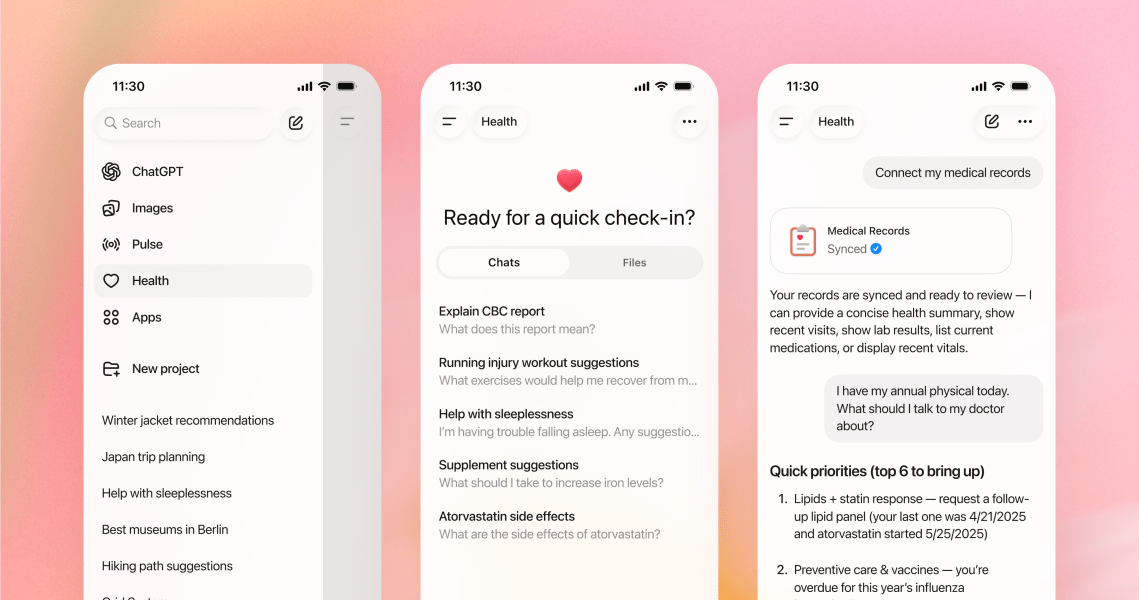
This week, I checked in with health technology experts to unpack the beta launch of ChatGPT Health, a new AI-powered chatbot from OpenAI that seeks to store and analyze a user’s medical records, health-tracker data, and wellness insights. Additionally, Target announces plans to increase its wellness offerings by 30%, smart fitness technology company EGYM merges with ClassPass-owned Playlist, and the FDA shares its plans to limit regulation on fitness wearables.
Inside the race to be the hub for consumer health data
Wellness consumers are sitting on mountains of health data. This includes insights collected by smartphones, health and fitness apps, and elective imaging, like MRIs and breast sonograms. Then there’s the data being collected by health-tracker rings and watches, smart fitness equipment, and a flurry of niche hardware. That includes smart toilets, smart menstrual cups, earrings that track blood flow to the head to mitigate migraines and bed frames that monitor a user’s sleep.
This influx of personal health data doesn’t even include actual doctor visits, which often yield appointment notes, blood panels, diagnostics and care plans that wellness consumers have become more interested in better understanding.
“The short answer is that, yes, consumers want [help analyzing their health data],” said John Harmon, managing director of technology research at Coresight Research. “To consumers, half of our health data [feels like] it’s written in Latin, plus it’s spread across various platforms, and there’s no dashboard or portal [today] that gives consumers an accurate overview of their health.”
This rise in health data over the past few years has left a growing white space for a company to become the data hub for all things health and wellness. Now it seems ChatGPT owner OpenAI is courting the role.
Quietly launched on January 7, OpenAI released a new AI-powered chatbot called ChatGPT Health. The company describes it as a new way to turn the scattered pieces of your health data and history into something that actually makes sense.
The standalone platform is now in beta testing, with a waitlist that consumers can join on OpenAI’s site. OpenAI has not shared how many users have been admitted or how many are on its waitlist.
According to OpenAI, health is already a top reason why users enter the chat, with hundreds of millions of people already asking health and wellness questions on ChatGPT each week.
ChatGPT Health is a dedicated platform where users can upload their medical records and sync their health trackers to glean an analysis of their health data. Similar to ChatGPT, it also stores conversations and inquiries, creating a living record of health issues, doctor appointments and more.
The app also provides fact-based information on things like OTC supplements, nutrition and meal planning, and dissects health-tracker data results using additional context, like a user’s medical records, to provide insights beyond what one may find in tracker portals. However, it does not diagnose or treat illness, which allows it to go unregulated. For example, if the platform did seek to diagnose or treat illness, it would be heavily regulated by the FDA as a medical device.
ChatGPT Health is currently able to upload data from a select roster of companies like Apple Health, Weight Watchers, MyFitnessPal, Function Health, AllTrails, Instacart and Peloton. It also reviews a user’s previous ChatGPT conversations to identify additional applicable data or life events that may affect the user’s health, like ongoing headaches or a recent move. Data from other apps and trackers must be imported manually, which could provide a hurdle for OpenAI.
The new launch is powered by OpenAI’s acquisition of Torch earlier this month for more than $100 million. Torch is a consumer-facing health data platform that analyzes doctor visit notes, records, diagnostics and patient visit audio recordings to help patients better understand and advocate for their health. Torch was founded by Ilya Abyzov, who previously co-founded Forward Health, a direct-to-consumer primary health-care provider.
Coresight’s Harmon described ChatGPT’s Health launch as a “big leap forward” for the aggregation and management of medical records and tracker data, but noted that cybersecurity is perhaps the biggest hurdle. “I would think this kind of data would be a very attractive target for hackers,” he said, noting that ChatGPT has not been immune to being hacked in the past.
According to OpenAI, “ChatGPT Health builds on the strong privacy, security and data controls across ChatGPT with additional, layered protections designed specifically for health — including purpose-built encryption and isolation to keep health conversations protected and compartmentalized.”
Then there are issues within AI when it’s incorrect or makes mistakes, often referred to as “hallucinations” or “drifting,” said Harmon. He told Glossy that OpenAI is likely to have a very slow and meticulous rollout to ensure the AI model doesn’t drift beyond its guardrails or hallucinate inaccurate answers. To wit: Glossy spoke to several experts and wellness enthusiasts on the waitlist for ChatGPT Health but failed to find anyone who had been accepted into the beta test.
In many respects, it’s still anyone’s game to become “the” health and wellness data hub.
At the end of last year, Bevel, a longevity-focused operating system that collects and analyzes consumer data through wearables, biomarkers and consumer input, took on $10 million in funding led by the VC fund General Catalyst.
“This funding lets us grow the team, move faster on [customers’] feature requests, and expand across more platforms and devices,” said CEO and co-founder Grey Nguyen. “We’re still early, but this is a huge step toward building something that helps everyone understand and improve their own health.”
Earlier this month, Bevel made its offering free. “For most people, getting this full picture means paying for multiple apps,” Nguyen said on LinkedIn. “Starting today, Bevel replaces all of that. No more juggling subscriptions. Just one app that helps you understand your body.” The company will still charge for Bevel Intelligence, the AI-powered health companion within its app, as it develops its next release, Bevel 3.0, Nguyen said.
Meanwhile, VyTrac, a comprehensive health management platform designed to connect data and doctor visits, is scaling not through consumers, but instead through doctors who “prescribe” the platform to patients, paid for by insurance or Medicare.
“A generality with using AI like this is that, while it is more accessible, you start to lose a lot of the community and the professionals,” said Zachary Fink, CEO and co-founder of VyTrac. “You start to go to ChatGPT for all your answers, and you don’t go to the professional — the person who’s going to be thinking really differently about what’s going on [with your health].” He believes that the winner of the data analysis race will inevitably rely on the participation of one’s primary care physician, especially when it comes to America’s aging population, which is less tech-savvy.
Executive moves:
- Kathryn McLay, Walmart’s international president and CEO, is set to step down from her role effective January 31. She has held the role for two years. Prior, she was president and CEO of Walmart-owned Sam’s Club U.S. Her replacement has not yet been named.
News to know:
- The Food and Drug Administration said it plans to limit regulation on wearable devices and software designed to support healthy lifestyles. FDA Commissioner Marty Makary clarified the group’s stance earlier this month by classifying health-tracker tools and AI programs as low-risk wellness tools, and therefore exempt from regulation, as long as they do not diagnose or treat illness. “We want to let companies know, with very clear guidance, that if their device or software is simply providing information, they can do that without FDA regulation,” Makary told Fox Business, as reported by Reuters.
- EGYM, a smart fitness technology company, is merging with booking app conglomerate Playlist, parent company to ClassPass, Mindbody and Booker. The deal includes $7.5 million in investments from L Catterton, Affinity Partners, Vista and Temasek. EGYM and Playlist had combined revenue of $800 million in 2025.
- Amped Fitness, the low-cost gym chain with 35 U.S. locations, has taken on investment from Princeton Equity Group, investor in Barry’s, Stretch Zone and D1 Training. Amped Fitness will use the undisclosed funding to expand to more U.S. regions. The chain currently operates in Alabama, Arizona, Florida, Georgia, Tennessee and Texas.
- In an era where fitness and wellness apps primarily drive revenue through a monthly subscription model, Alo Yoga is shifting its strategy toward free. The company removed the paywall from its hero digital fitness class product, Alo Wellness Club, previously called Alo Moves, earlier this month. Instead, it will focus on growing its loyalty program in 2026. “Since removing the paywall, we’ve seen membership grow by 250%, reinforcing our mission to make mindful movement and meditation more accessible around the world,” Summer Nacewicz, Alo’s evp of creative and marketing, told Glossy in a statement. “Beyond growth, the most encouraging signal has been engagement. We are meaningfully outperforming industry benchmarks, and people are coming back consistently and integrating the Wellness Club into their daily routines.”
Stat of the week:
Target plans to increase its wellness offerings by 30%, including thousands of items priced under $10. Announced earlier this month, the change also includes more protein-focused products, an influx of supplement brands and forms, derm-led skin-care brands, and in-store wellness events. “About 70% of guests are already shopping wellness at Target, and right in time for the new year, we’re bringing them even more newness and value by adding some of the most trusted, relevant and inspiring brands across our assortment,” Lisa Roath, evp and CMO of food, essentials and beauty at Target, said in a statement. “Our goal is to make wellness really accessible — fun, easy, affordable and personalized — so consumers can focus on building routines that help them look and feel their best.”
In the headlines:
Legal questions swirl around FDA’s new expedited drug program, including who should sign off [AP News]. Is there such a thing as eating too much protein? [Vogue] The hard truth about weight-loss drugs: You probably need them forever [NYT]. The death of the spa appointment is changing wellness tourism [Athletech].
Listen in:
After a few sleepy years, beauty and wellness M&A had a gangbuster 2025, including three deals worth more than $1 billion each, leading many insiders to speculate on whether the momentum can continue in 2026. Kimber Maderazzo, professor of marketing at Pepperdine Graziadio Business School and former Proactiv and L’Oréal Group executive, joins the Glossy Beauty Podcast to discuss her 2026 predictions.
Need a Glossy recap?
As professional hair care grows in US retail and e-commerce, Davines bets on old-school salons. Why Cocokind is sending unreleased products to creators with 200 followers. NRF 2026 Briefing: ‘Authenticity is really important’: Why AI is set to propel influencer marketing.