This week, I checked in on the Estée Lauder Companies’ integration with Shopify as it seeks to make its operations more nimble. Additionally, Sephora makes the move to TikTok Shop, and OPI’s parent company files to go public.
‘We have to decide on what our core competency is going to be’: Why the Estée Lauder Companies is outsourcing its e-commerce operations
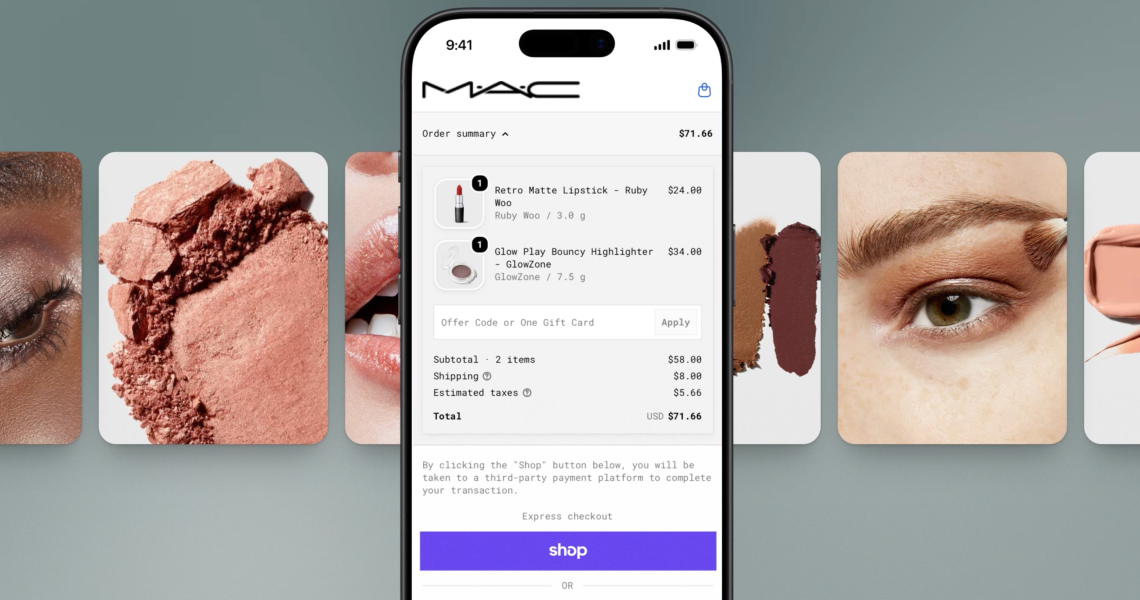
MAC consumers may have noticed something different when purchasing a lipstick or foundation on the beauty brand’s website: Their orders will now be fulfilled using Shopify.
The Estée Lauder Companies first announced a partnership with Shopify in October and began by migrating its Tom Ford and Lab Series brands’ e-commerce sites to the platform. In August, it announced the launch of MAC’s e-commerce site on Shopify. The company has also launched Shopify at checkout at five of MAC’s physical stores and plans to migrate most of its e-commerce sites, along with additional freestanding stores, to the platform by the end of fiscal year 2027.
“We have to decide on what our core competency is going to be,” said Omer Iqbal, svp of omnichannel and consumer technology at The Estée Lauder Companies. “Are we going to be an organization that’s competing with the Salesforces, the Shopifys on checkout? No, we’re going to leverage them.”
The integration fits with the “Beauty Reimagined” plan the conglomerate announced in 2025 to prioritize agility and meeting consumers where they are in order to return to growth. Since then, the beauty giant has adjusted its distribution network to prioritize higher-growth sales channels: It launched MAC at U.S. Sephora stores in March and announced the reduction of its department store footprint in May. In its most recent earnings report in August, the company posted a 5% sales growth for the fiscal year 2026 to $15 billion.
Outsourcing to Shopify means letting go of its proprietary software system and adopting a system that consumers may already be familiar with. According to Iqbal, 60% of ELC’s consumers are already using Shop Pay, Shopify’s account system that allows consumers to save their credit card and shipping information for checkout across multiple websites.
“Our platform, while it served really well for us over the last 15, 20 years, it became very hard to keep up with all the innovation that was going about,” said Iqbar of its previous proprietary e-commerce system. “It was costly. It took a lot of time in terms of resources.”
The partnership also fits with Shopify’s ambitions to showcase its ability to bring frictionless shopping capabilities to large-scale companies at speed. According to the software company, migrating MAC’s system to Shopify took roughly 120 days.
“[MAC] has one of the largest beauty operations in the world, and it’s not just about a website,” said Sandy Jeong, director of enterprise solutions engineering at Shopify. “You’re really talking about all the nuts and bolts that go behind that: promotions and loyalty and checkout rules and fulfillment and payments and tax.”
Shopify and ELC are also betting that they will be in a prime position to leverage an environment where agentic shopping is increasingly driving purchases. Despite widespread negative sentiment around the rise of artificial intelligence, Shopify said it is seeing more AI-driven purchasing behavior. According to Jeong, Shopify is seeing a 14% higher average order value for shoppers coming from an AI channel.
“Part of the infrastructure that’s really critical there is product data, and having that clean. Because what you don’t want to rely on is an agent just scraping your website or crawling the internet for information on your brand,” said Jeong. “So Shopify has given brands a very structured way through our catalog to send your product data directly to the agents through APIs [application programming interfaces].”
ELC’s outsourcing of some of its technological capabilities comes as major beauty brands are increasingly working with tech giants rather than competing against them.
Companies like Orveon, which owns the likes of Laura Mercier and Bare Minerals, have adopted Amazon’s “Buy with Prime” feature that lets consumers utilize Amazon fulfillment on brands’ DTC websites. Both Sephora and Ulta have announced plans to join TikTok Shop, as the social media app’s hyper-engaged consumers and livestream-fueled shopping capabilities threaten to take a bigger share of the beauty market.
“It’s very difficult to keep up with innovation, especially at a global scale across multiple brands, so a platform like Shopify really helps in that,” said Iqbal. “We’re building our own consumer experiences, but we don’t want to compete with the Shopifys and the Salesforces of the world on having a better checkout. I don’t think we can win at that, but we can certainly use our data to win at better consumer experiences.”
Partnering directly with those emerging tech giants can also help beauty stalwarts have a voice in where that innovation goes.
“We want to drive some of [Shopify’s] roadmap,” said Iqbal. “Right now, we’re a preferred client of theirs. We’re trying to push them into markets that are important to us.”
Executive moves:
- The Estée Lauder Companies announces a slew of leadership changes in anticipation of Sandra Main retirement as global brand president of La Mer and skin care brands. Justin Boxford will take on the newly established role of global president, luxury beauty brands, which will encompass La Mer, Estée Lauder and Aerin, among others. Erica Kwok will be named svp and gm of the Estée Lauder brand.
- Topicals names Sukiana “Suki” Chancy as CEO, succeeding founder Olamide Olowe. Chancy joins from Fenty Beauty, where she served as gm of skin, hair and fragrance. Olowe will remain with the skin-care brand, overseeing both day-to-day business and long-term goals.
- L’Oréal appoints Kaustav Ghosh to its India Technology Hub. Ghosh will lead the group’s commercial B2B portfolio out of Hyderabad. He previously held roles at EY India, Deloitte and McKinsey & Company.
News to know:
- Sephora will launch on TikTok Shop on September 19. The LVMH-owned beauty retailer announced that it will pilot the “Sephora Drop Shop experience” for U.S. consumers, offering exclusive monthly releases. The beauty giant will also introduce livestream shopping featuring celebrity hosts and brand founders. Rival beauty retailer Ulta Beauty also joined the social media shopping platform earlier this year.
- Wella Company files for a U.S. IPO. The owner of brands like OPI, Briogeo and Wella received backing from global investment firm KKR back in 2020, with the firm acquiring a 60% stake in Wella from Coty in a deal that valued the company at $4.3 billion.
- L’Oréal USA Chairman David Greenberg will receive The Fragrance Foundation’s Circle of Champions Award. Greenberg has worked at the French cosmetics giant since 1993 and has held roles such as CEO of L’Oréal USA, President of the North America Zone.
Stat of the week:
Victoria Beckham Holdings reports a profit for the first time, with 2025 revenue increasing 15% to £129.8 million ($175 million). According to the company, the former Spice Girl’s beauty line was responsible for two-thirds of overall revenue.
In the headlines:
How AI’s nouveau riche are spending on beauty. America fell in love with filler. Then came the great deflate. Can blockbuster fragrances make a comeback?
Listen in:
On this week’s episode of the Glossy Beauty Podcast, Glossy West Coast correspondent Lexy Lebsack sat down with Wizard Wellness CEO and founder Loren Lucree to learn firsthand how he took on allergy incumbents and what it’ll take to become a leader in the space.
Need a Glossy recap?
Wellness Briefing: Life Time launches LT Social as gyms enter their entertainment era, plus news. Glossy Pop Newsletter: How Maybelline leveraged “Love Island” to supercharge lip gloss sales.