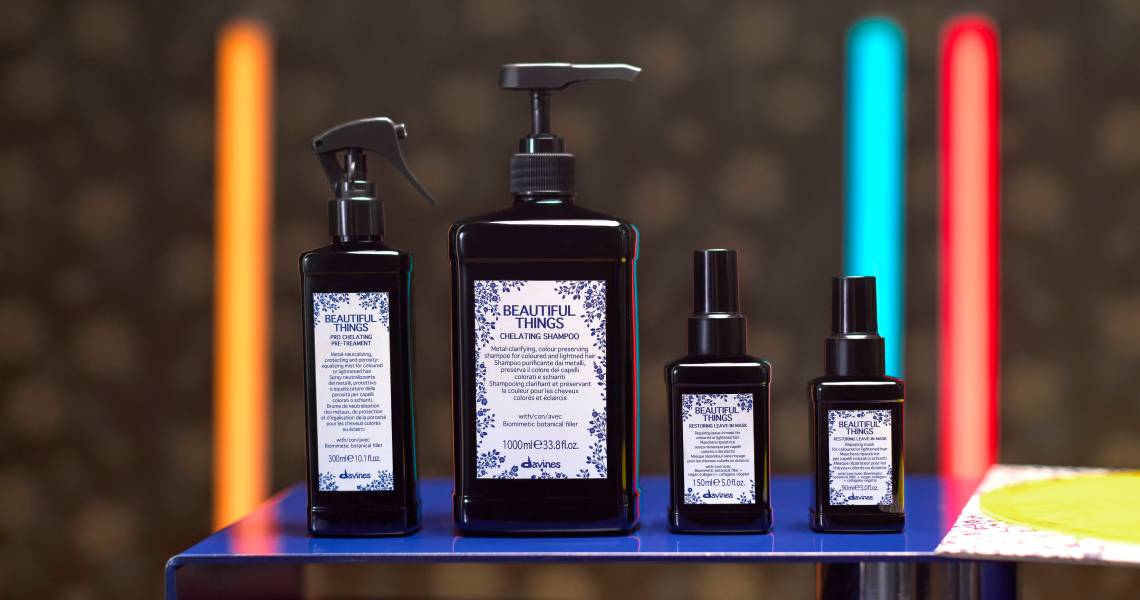
In 2025, searches for terms like “recession hair” and “recession blonde” surged as tariffs and economic uncertainty threatened many Americans’ bank accounts. But data shows Americans were already tightening their spending on salon services before 2025: According to data from the market research group Kline + Company, sales of hair-care products at U.S. salons declined 1.4% between 2019 and 2024.
However, the Italian beauty company Davines Group said it has bucked the trend. According to the company, U.S. sales of Davines brand professional hair-care products grew 42% in the salon channel during that same period. In 2025, the group passed $350 million in sales for the first time.
“Consumers don’t go to salons as often. They don’t go to salons as a routine. They go to salons more for special occasions. The slightly fewer visits mean there is also less opportunity for retail [in salons]. So the majority of manufacturers, in an opportunistic way, shift all their investments or their focus on retail,” said Davide Bollati, chairman and founder of Davines Group, which owns both the Davines hair-care brand and the Comfort Zone skin-care line. “We want to think that the constant growth we are having in the U.S. is paying off because of our loyalty to the community of hairdressers.”
Prestige hair-care sales in the U.S. grew by 8% in the third quarter of 2025, according to market research firm Circana. Retailers like Ulta and Sephora have expanded their selections of professional-grade hair-care brands in recent years, and professional brands have also found popularity on Amazon, with the likes of K18 and Colorscience reporting over 100% growth on the e-commerce platform in 2025.
Davines products are available on both Amazon and Sephora.com. But Bollati said Davines sees its e-commerce channels as an opportunity not just for sales, but also for directing more traffic to its 8,500 salon partners across the U.S. In the first half of 2025, the brand’s U.S. salon sales grew by 10.5%, while the market as a whole fell 3%.
“We could go more into retail. But we want to make sure that our strategy brings consumers to our salons, and not the opposite,” he said. “We invest the … not the minimum, but we are reasonable in our investment in [retail], because we want to stay close to salons, and we want to invest the majority of our money in B-to-B to C-to-B.”
Investing in salons also means rewarding loyal partners. In September, Davines hosted its first Titanium Gathering in Parma for salon partners that purchase more than $100,000 of Davines products each year. The event invited 225 partners to tour the Davines Parma facilities and connect with fellow salons from around the world, offering a channel for Davines to boost its relationship with those salons, Bollati said. The company is planning an event for later in 2026 in Valencia for its global network that will see more 1,100 of its U.S. salon partners in attendance.
Investing more in color has also been beneficial, despite a slowdown in the sector as a whole. In March, the company launched its demi-permanent hair color line, The Present Time. According to Davines, U.S. sales for its color category grew 14.5% in the first half of 2025, while figures from Kline + Company found the U.S. market for hair color declined 3.9% in the same period.
Davines is not the only hair-care company looking to foster its connections with stylists. In November, L’Oréal teamed with Mastercard to launch the L’Oréal Mastercard Business Card, a credit card geared to professional stylists to streamline business expenses and offer rewards for products purchased from L’Oréal’s network. And in January, the beauty conglomerate opened the L’Oréal Academy in New York’s Hudson Yards, where it will offer educational courses for stylists led by its hair-care brands like Redken and Kérastase.
For 2026, Davines is reinvesting its revenue in new product lines, the launch of a new tagline and a $50 million expansion of its headquarters. But even in challenging economic times — Bollati said Davines has not raised the prices of its products used in salons in response to U.S. tariffs — Bollati is confident consumers will turn to salon-level hair services. That is, provided they see results.
“Hair coloring is one of those things that is probably more powerful than Botox and more powerful than surgery or aesthetic medicine. Because if you have it well taken care of, the perception of longevity and freshness in your face is incredible,” said Bollati. “Everybody is trying to look younger. Everybody’s looking for the longevity solution, fountain of youth or whatever.”