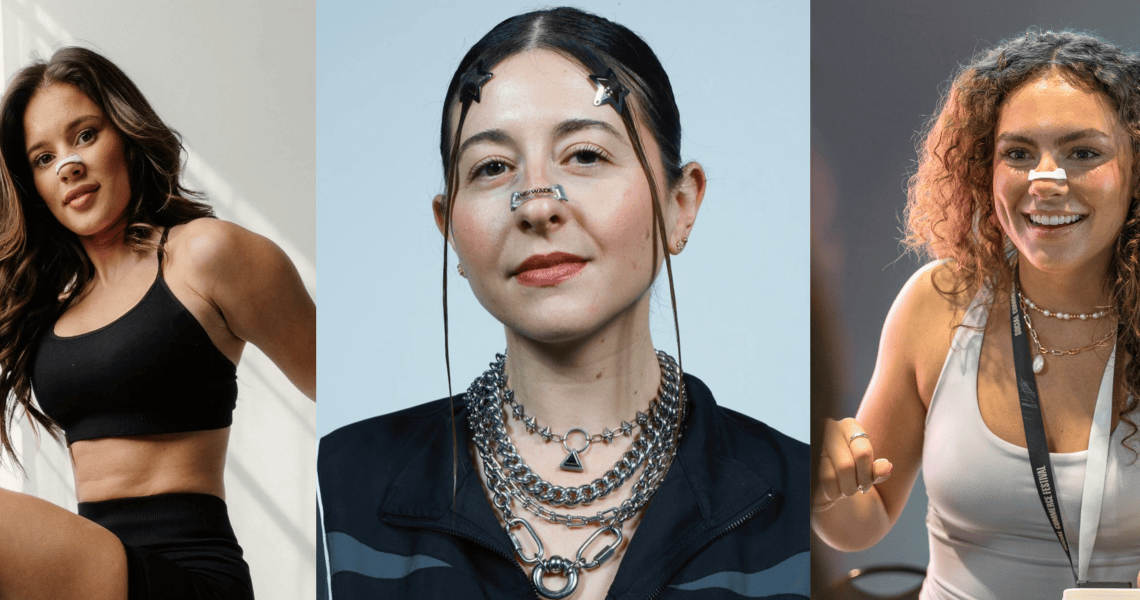
For the Wellness Briefing, Glossy sat down with Elle Lanning, president of private equity firm Camino Partners, and Alex Huack, CEO of Intake Breathing, to learn about Camino’s $62 million bet on optimized breathing. Additionally, ferritin is the buzzy new nutrient du jour, Kate Hudson backs indie supplement maker HealthyCell, and a new study highlights a consumer wellness education gap.
Could a magnetic nose dilator become the next wellness status symbol?
Announced Wednesday, Camino Partners has invested $62 million in 8-year-old Intake Breathing, the SoCal-based maker of a patented nasal dilator system that opens airways to optimize breathing.
The company, which launched in 2018, has sold more than 100 million pairs of its breathing tabs DTC and through Amazon. It’s currently approaching $100 million in annual sales. Camino Partners is owned and funded by Daniel Lubetzky, the “Shark Tank” regular and Kind Snacks founder. Its investments include the Barry’s fitness studio chain, Cymbiotika supplements and Prose hair care.
In a way, Intake is well-positioned to turn its plastic nasal dilator into a status symbol for wellness aficionados already interested in optimizing their health, diet and fitness. The dilator comes in black and clear, and sticks to the nostrils through single-use magnetic strips.
“If you’re gaining that benefit [of easier breathing], you’re not going to care so much about what people think, then normalizing it happens through time and through influence,” Alex Huack, CEO of Intake Breathing, told Glossy. “People used to call kids with glasses ‘four eyes,’ so it’s not uncommon that over time things eventually find their way [to normality]. Pimple patches, like Starface, are another good example of this.”
Intake has a broad awareness strategy to bring this vision to fruition, including professional sports, such as a partnership with 26-year-old L.A. Dodgers pitcher Justin Wrobleski. The company also partnered with fashion brand Jade/Wade to appear in its Fall-Winter 2026 runway show during NYFW in February. The company also has numerous partnerships with dentists, physical therapists, massage therapists and doulas who now offer the tool during procedures, massages and births.
“[When consumers] are getting the benefits of this, they feel like they’re winning,” Huack said. “[Plus, our device] almost looks like an accessory with your AirPods.”
Elle Lanning, president of Camino Partners, sees an endless runway for growth, including as a status symbol among younger consumers, but that’s just one piece of the pie for the firm. “You’ll see the adoption curve is probably different generationally,” she said. “You are starting to see people wear different kinds of badges for the lifestyle that represents them, and I think Intake has an opportunity to be that [for younger generations].”
Intake Breathing lacks many of the same challenges as tech wellness status symbols like health trackers. For example, execs from Oura Ring have told Glossy that its biggest challenge is sizing consumers for the ring, which it addresses with pricey retail activations and splashy in-person events.
Each $49 starter kit from Intake Breathing has four sizes of its nasal dilator to ensure the perfect fit and offer options for various activities. The kit also includes 15 sets of magnetic adhesive strips for 15 days or nights of wear.
Intake’s biggest competitor is Breathe Right, which launched in 1993 and sells adhesive nose dilator strips in drug and mass stores. The company was purchased earlier this year by NY-based Prestige Consumer Healthcare Inc., owner of drugstore staples like Clear Eyes, Monistat, Dramamine and Chloraseptic.
“When we started to learn about Intake, one of the stats that stood out to us was that 74% of buyers had not been legacy category buyers,” Lanning said. “[The public understands this category] as a cold or sinus remedy. … The way that Intake was born and built was fundamentally different.”
Instead, Intake hopes to be an everyday tool for better breathing, worn with the same confidence as a health tracker ring, polarized sunglasses, pimple patches, a bike helmet or any other tool that improves one’s quality of life. Still, Intake’s most common use case is sleep since the device can help temper snoring by reducing mouth breathing.
The company will use the $62 million to buy out early friends-and-family investors, grow its staff of 35 people, diversify its marketing, and, most importantly, enter big-box retail. “We have suitors [hoping we enter their stores],” Huack told Glossy.
Lanning told Glossy she’s looking for retailers that understand today’s wellness consumer. For her, that means sorting products by solution, not by category. “When you start to interact with merchants who are thinking about a solution or use case for consumers, versus item sorting, that’s where you start to see the right forms of evolution [in retail].”
News to know:
- Is ferritin the next hot supplement ingredient? Ferritin is a cellular protein that safely stores iron in your body and releases it when needed, according to the Cleveland Clinic, and it’s often bundled into iron supplements sold today. While not new, the nutrient is having a viral moment online thanks to creators who claim low ferritin levels create “ferritin face” that includes dark under-eye circles and dull skin. Just this week, ferritin has been discussed by news outlets like the BBC and The Times, while consumer outlets like Vogue have published guides to the nutrient. This new wave of awareness could signal a rush of new products or campaigns into the marketplace.
- Kate Hudson has joined supplement maker HealthyCell as investor and creative strategy partner. The brand makes liposomal supplements, a trending supplement form factor where nutrients are formulated with microscopic fat bubbles said to aid in absorption. Market leaders include Cymbiotika and Lypo-Spheric. HealthyCell was launched in 2019, is independently held by its CEO and founder, Douglas Giampapa, and sells direct-to-consumer.
- The runway for at-home hormone testing continues to grow with a new round of funding going to UK-based Unravel Health. The company has taken on $3.3 million to launch an at-home, saliva-based hormone test called Micro Labs. The round was led by Conduit EIS Impact Fund and Wrightwood, plus participation from Leo Capital, Hermesa, and Embryo Ventures.
- More than 4 million tubes of toothpaste have been recalled by the Food and Drug Administration this week including formulas made for kids under brands like Evo and Brush Buddies. The recall is tied to failure to adhere to FDA’s current good manufacturing practices.
Stat of the week:
There’s a consumer education gap around the role of the FDA in supplement safety. According to a new study by PartnerCentric, a NYC-based digital marketing agency, 27% of Gen-Z respondents didn’t know supplements could be sold without FDA approval. In reality, the FDA does not approve dietary supplements for safety and effectiveness before they reach the consumer market. The study is based on a 1,002-person September survey. It also found that 63% of respondents check whether a medicine, supplement or peptide is FDA-approved before buying. Meanwhile, doctor recommendations and reviews lead wellness purchase decisions, at 25% and 23% respectively, while price and clinical-study backing drive purchase intent for 17% and 14%.
In the headlines:
The proponents of ‘dark nutrition’ think everything you know about food is wrong [NYT]. How marketers protect their data strategy during renewed M&A activity [Digiday]. Men are finally swapping skincare tips. Atwater is reaping the rewards [Beauty Independent]. Inside the underground world of DIY peptides [Women’s Health]. Can swapping out your plasma slow the aging process? [Self]. Curology partners with Dove Cameron to launch new skincare line [Beauty Packaging]. Why returns are becoming a bigger focus for TikTok Shop and DoorDash [Modern Retail]. SLT sues Lagree Fitness over Megaformer supply, territorial rights [ATN].
Listen in:
Supplement company Cymbiotika has sold more than 200 million liposomal sachets. Now, it’s taking on the beauty supplement category with a splashy, fashion-forward advertising campaign made with OBB Bolded. Durana Elmi, Cymbiotika’s co-founder, chief creative officer and chief experiential officer, joins the Glossy Beauty Podcast to walk through the strategy behind the launch.
Need a Glossy recap?
The products that led L’Oréal Group’s 7% earnings jump this summer. How QVC is building a flywheel across TikTok and TV ahead of the holidays. Bath & Body Works has a successful holiday season on its wishlist. Can Zooey Deschanel help it deliver? 3 months after the World Cup, fashion brands are tapping soccer stars like Bellingham and Yamal for partnerships. Glossy+ Research: Brands’ focus on owned channels wavers for the 2026 holiday season. Beauty Briefing: Jennifer Lawrence steps into the celebrity beauty arena. Glossy Pop Newsletter: SharkNinja is turning its fans into beauty sellers ahead of the holidays.