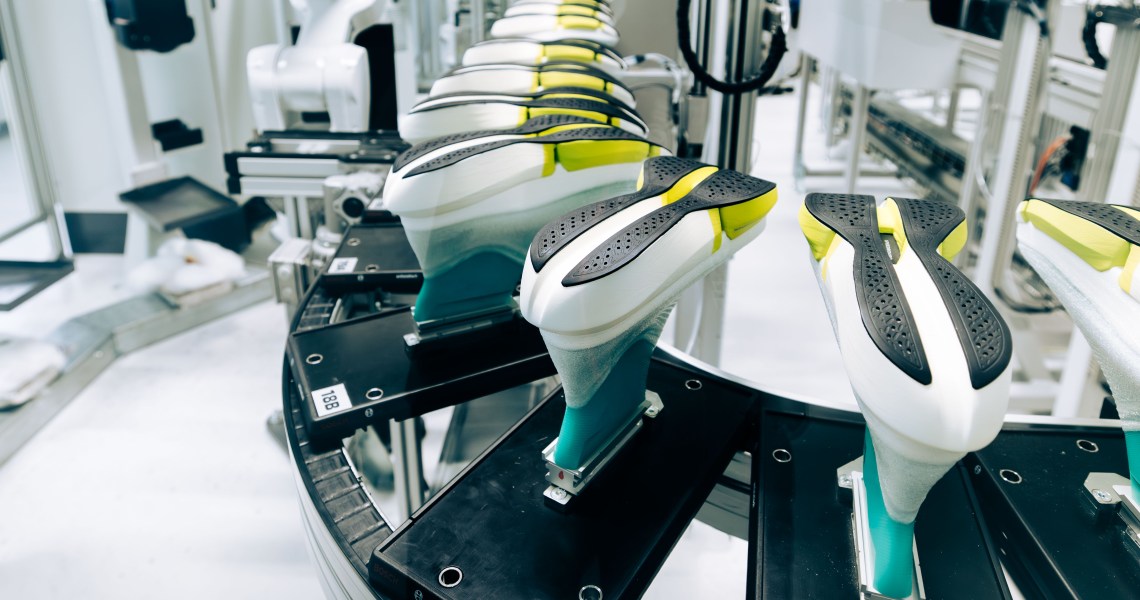
On is exploring how to expand its automated LightSpray manufacturing system beyond Switzerland and South Korea, potentially establishing production in Europe and the U.S.
For On, faster production closer to demand is ultimately about selling with less guesswork. The company could launch smaller quantities, restock winners more quickly and avoid committing as much inventory months before it knows what customers want. Over time, that could mean fewer markdowns, more regionally localized product drops and a supply chain that reacts to demand rather than forecasting it from afar.
In short, LightSpray turns the production of a shoe’s upper into a compact robotic process, cutting out much of the sewing and manual assembly that has kept footwear manufacturing concentrated in Asia.
At a press event at On’s Zurich headquarters in June, the company demonstrated LightSpray’s use of a robotic arm to spray 1.5 kilometers of thermoplastic filament in a tornado-like pattern around a shoe-shaped form. In minutes, the material became a seamless, one-piece upper, condensing a conventional workflow that, according to On executives, can involve around 200 stages across multiple facilities into a fully automated process.
“It’s reinventing manufacturing,” co-founder and co-CEO David Allemann said during the presentation. “We can put robotic-arm factories into Switzerland. We can put it in Korea. You can put it in any other place really close to our consumers.”
He said proximity could allow On to respond to demand “very fast and flexibly,” which is why the company is considering investing in more facilities in its major markets.
On introduced LightSpray in 2024, opened its first production facility in Zurich in 2025 and followed with a second robot-based production site near Busan, South Korea in April this year. Company representatives said infrastructure work to expand production capacity via European and U.S. facilities could tentatively begin in 2027, with increased production potentially following in 2028. The locations, operating model and timelines have not been finalized.
The company is already testing potential impacts of scale on the production model. Its Zurich facility has capacity for 150 pairs per day, compared with 1,500 at the newer, larger Busan site. On representatives said the automated process requires relatively few production staff, and the Korean operation has improved the economics compared with the smaller Swiss facility. The company has not disclosed the production cost per pair or exact staffing levels. It expects future facilities to accommodate the scale of local markets, executives said.
The Americas remain On’s largest market, accounting for about 54% of first-quarter net sales, compared with 25% for Europe, the Middle East and Africa, and 21% for Asia-Pacific — Asia-Pacific is its fastest-growing region, with sales up 44.4% year over year in the quarter. On does not break out the U.S. separately.
The push also comes as tariffs and geopolitical disruption are forcing fashion and footwear companies to reassess long, Asia-dependent supply chains. U.S. trade measures have raised costs for brands sourcing heavily from markets including Vietnam and China, while disruption across the Red Sea and Middle East has increased freight volatility and delivery risk. In response, companies have renewed efforts to diversify sourcing, automate production and move selected manufacturing closer to end markets, even though industry research shows that large-scale nearshoring has remained difficult to achieve.
Salomon, for example, partnered on an automated footwear factory in France designed to produce up to 500,000 pairs annually, while Veja added production in Portugal in 2023 to serve European demand more quickly. But large-scale nearshoring remains difficult. The 2025 USFIA Fashion Industry Benchmarking Study report found that sourcing from Mexico, Canada and CAFTA-DR countries actually declined year over year, underscoring how limited regional capacity and entrenched Asian supplier networks continue to slow a broader shift.
The robot’s unique programmability is set to facilitate comparatively seamless expansion. On can alter an upper’s fit, reinforcement and structure by changing its digital spray path, rather than cutting new textile patterns or reconfiguring a sewing line. Its development team said a LightSpray upper weighs around 30 grams, compared to 70-90 grams for a conventional upper, and can be prototyped up to three times faster.
That could allow On to install standardized robotic “cells” with multiple robots working together near important markets, send product designs to them digitally and produce smaller quantities closer to demand.
LightSpray is also becoming a broader commercial platform. On launched the $330 LightSpray Cloudboom Strike racing shoe in 2024, followed by the $280 LightSpray Cloudmonster 3 Hyper in March 2026. The latter is made from eight components and weighs 205 grams. A next-generation LightSpray Cloudboom Strike 2 is set to launch on July 30, while a LightSpray track spike is also in development. The original LightSpray Cloudboom Strike remains listed at $330 in the U.S.
And leadership is also pushing to franchise LightSpray across other sports. Allemann described LightSpray as one of On’s key growth initiatives, developed over five years and now moving toward greater scale. During On’s first-quarter earnings call on May 12, co-founder and co-CEO Caspar Coppetti said the Busan factory opening had increased LightSpray capacity thirtyfold. The technology represented close to 20% of footwear net sales during the opening week of On’s Boston store, he said, adding that the company was selling several hundred LightSpray pairs per day through its direct channels.
Compared to a mass-market competitor, On’s premium pricing may give it more room to absorb the costs of regional robotic production.
“We only want to make the best possible product, and so the only route available was the premium one,” Coppetti said in Zurich. He added that On is reinvesting its margins in more expensive technologies, including LightSpray.
Footwear brands have spent years testing 3D printing and other digitally controlled production methods as a way to make smaller product runs closer to demand. Most have remained limited projects. LightSpray is a more advanced test of whether digitally controlled footwear production can move into meaningful commercial volume.
Adidas’s Speedfactory project shows why automation alone does not guarantee successful nearshoring. Adidas opened automated facilities in Ansbach, Germany and Atlanta in 2017. In 2019, it said both would stop production by April 2020 and that the technology would instead be deployed through Asian suppliers, where existing production capacity could be used more flexibly and economically.
Meanwhile, Salomon’s Advanced Shoe Factory 4.0 opened in Ardoix, France in 2021 and began producing Salomon footwear in 2022. The project combines automation with skilled labor and focuses on select technical shoes.
On’s bet is that it does not need to rebuild the entire sneaker factory. By automating the upper, it can shrink one of footwear’s most fragmented production stages into a repeatable robotic unit. That proposition is now reaching customers for the first time beyond a single race-day product as LightSpray expands into training shoes and additional performance models.
The company is also exploring how more production stages could be brought together. For now, LightSpray upper manufacturing and the rest of the shoe remain separate processes. Details of the Busan facility from On describe 32 robots that spray, move, and brand uppers, with technicians overseeing the line and carrying out quality control; On has not disclosed midsole-molding or full shoe-assembly equipment at the site – it may still be to come.