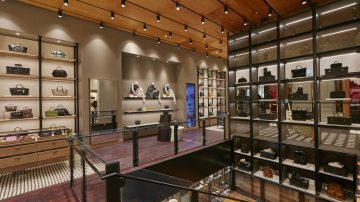
This week, a deep dive on cult Canadian Gen Z brand Garage, including how it has achieved 30% profit margins and making each new store profitable from day one. We also speak with JCPenney CEO Michelle Wlazlo about what’s bringing Gen Z back to the mall.
The cult Canadian fashion brand Garage is on a retail tear. It’s planning multiple new stores opening across the UK soon, plus, since November, it has opened locations in Louisiana, Hawaii and San Francisco.
Overall, the 51-year-old company has been opening around 20 stores per year for the last two years, and it plans to continue that trend over the next two or three years. It’s paying off. Garage parent company Groupe Dynamite has seen its profits soar over the last two years, from $27 million last year to $51 million now, and its annual revenue is well over $1 billion. In its most recent earnings call, the company reported a 37% increase in year-over-year revenue.
Garage’s leadership puts this success down to two things: investing in malls just as Gen Z shoppers are embracing them and focusing on profitability in its retail locations, which mitigates the costs of opening them.
“There’s a mall every three miles in the United States, so we have to be very choosy about where we put our brand,” said Stacie Beaver, president and CEO of Groupe Dynamite, which also owns the workwear brand Dynamite. “We go where there’s a lifestyle that matches the brand — where there’s dinner, movies, places where the customer is already going.”
Beaver said Groupe Dynamite separates malls into tiers. Tier-one malls include luxury stores, public transportation and seated dining, for example, while tier-two malls are similar but don’t include luxury stores like Gucci and Louis Vuitton. The company prefers to open stores in tier-one and tier-two centers, though it does have about 40% of its stores in malls rated between tiers three and five. Lower-tier malls would be places that lack lifestyle amenities, like dining, or are in low-foot-traffic areas.
But Beaver said those tier-one and -two malls are becoming “increasingly important” as Garage increases in-store sales volume. Garage is closing two of its low-tier stores this year, and Beaver said she would like to close more in the future. One hundred percent of Garage‘s sales are direct-to-consumer.
“Our tier-four and -five stores are still profitable,” Beaver said. “We don’t have a single store that isn’t profitable. But they turn their inventory much slower, because they get a handful of people coming in. The top-tier stores are doing way better, in terms of sales and volume, than the bottom-tier stores, and they require a lot faster inventory turn.”
The focus on those higher-tier stores, especially in the brand’s new markets like Hawaii, is helping Garage reach profitability per store very quickly. Beaver said that every store is profitable from day one. The company boasts an average profit margin of 30% on its sales.
Foot traffic to American shopping malls has increased in five of the first six months of the year, according to data from Placer.ai. Circana data shows that Gen Z is leading the mall comeback, with younger customers accounting for 62% of purchases in malls this year. Not all of Garage’s stores are in malls. It has plans for street-side flagships and already has a few street-level standalone stores.
On social, Garage has a large TikTok following of over 500,000 followers. It has focused on working with mid-tier influencers like Brooke Lewitt and Jess Qualter through its ambassador program.
Groupe Dynamite CEO Andrew Lutfy said that stores, particularly high-return stores in top-tier malls, will be key to the brand’s continued success.
“We will continue investing in our brands, high-return store growth, digital capabilities, talent development and, of course, technology,” Lutfy said in Groupe Dynamite’s first-quarter earnings call in mid-June. “These investments are about building a stronger, more resilient business that can continue to outperform over the long term.”
JCPenney brand CEO Michelle Wlazlo on targeting Gen Z shoppers
Another retailer that’s well-aware of Gen Z’s love for the mall is JCPenney. The company is in the middle of a turnaround effort, coming off a $177 million loss in 2024 and a merger with SPARC Group last year to form the new parent company Catalyst Brands.
The last year has seen JCPenney launch new marketing campaigns, including the recurring “Yes, JCPenney” commercial series and its Texas-based take on Paris Fashion Week. Most recently, JCPenney linked its rewards program with the popular Gen Z mall brand Aéropostale. The announcement leaned into both companies’ mall pedigree, stating in a press release that “the two iconic mall staples are connecting their programs so every dollar you spend at either store — online, in the apps or in store — earns you real money to spend at both.”
The throughline across all of JCPenney’s recent efforts is a focus on affordability and on targeting a Gen Z audience as they return to the mall. Glossy spoke with Michelle Wlazlo, JCPenney’s brand CEO, about the company’s new loyalty program and the state of the mall as a destination.
What have you found to be the most effective strategies for increasing customer loyalty and return rates at JCPenney?
“It comes down to three key things: making loyalty actually valuable, creating experiences that matter and proving we understand what families need.
When we relaunched the JCPenney loyalty program in 2024, we introduced CashPass – a deliberate choice that gave customers real money they can use on their purchases, rather than just points that disappear in an app. Since then, we’ve seen a 24% increase in loyalty membership. People engage because they see the value.
The second piece is creating reasons for customers to come back beyond just product. That’s why we’ve invested in experiences like our Portrait Studios and Salon. Families know they can get everything they need for the whole family under one roof.
And then there’s an understanding of what customers are actually facing. Trust in JCPenney has grown to 81% [according to internal metrics], up significantly from a year ago, because we’re showing that we know what the American family wants and needs: value and authenticity.”
What changes are you seeing in the JCPenney customers’ shopping habits?
“Gen Z and Gen Alpha are rediscovering the mall as a destination — they want the experience, that discovery moment of finding something in person. What’s interesting is the strong crossover between JCPenney’s and Aéropostale’s customer bases. We’re already seeing shoppers cross-shop among brands, so when we connected the loyalty programs, we were just formalizing what was already happening organically. We’re meeting customers where they already are.
What’s also shifted is intentionality. Families are under real financial pressure right now. When customers come to us, they’re not browsing aimlessly; they’re planning their mall trips around key moments — like back-to-school — and they’re looking for value and quality they can count on.”
What’s the toughest part of the retail/apparel business right now?
“Between high gas prices and ongoing inflation restraints, today’s families are having to make choices about where they spend and what they’re spending on. They’re searching for ways to stretch their dollars further, and in some cases, making trade-offs they haven’t had to make before. That puts real pressure on us to deliver authentic value.
For [us], it means staying true to our mission — democratizing fashion and value for working families — and backing it up with real action and results.”
Glossy’s fashion coverage
- How Bandit Running is expanding internationally while staying hyperlocal
- Inside On’s innovation engine and apparel ambitions, as its founders return to lead the next phase
- How Meta leveraged Kylie Jenner, Peggy Gou and Substackers in its first fashion campaign
- How Wimbledon players became fine jewelry brands’ ultimate ambassadors