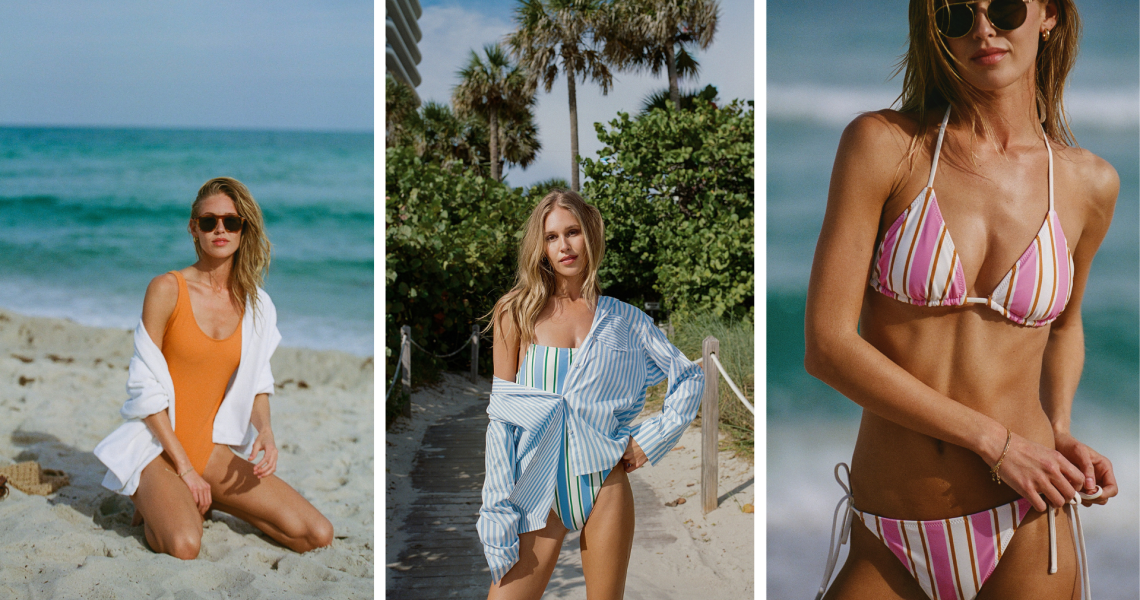
Target is using swimwear to sell more than swimsuits. The retailer is positioning the category as part of a full summer wardrobe that includes bikinis, one-pieces and cover-ups, as well as Havaianas sandals, accessories and sun-care products.
Target has held the No. 1 market share in swim for the past decade, according to the Circana data, as retailers, specialty brands, DTC labels and fashion-driven resortwear players vie for the swim customer. But this year, Target’s swim push is part of a bigger business initiative: The company is trying to reassert its merchandising authority after a period of uneven performance in discretionary categories.
Target’s first-quarter earnings, reported on Thursday, showed net sales of $25.4 billion, an increase of 6.7%, with comparable sales up 5.6%, driven by foot traffic. But CEO Michael Fiddelke noted on the earnings call that home and apparel sales remained below 2024 levels. Meanwhile, categories including beauty, food and beverage, and Fun101, referring to toys and entertainment, showed growth.
For Target, swimwear is a place where its broader merchandising strategy is showing up in practice. The category combines owned brands, timely collaborations and adjacent products, from cover-ups to sandals and sun care, allowing the company to treat swim as a full summer outfitting business rather than a seasonal basics category.
“Fit matters in every category, but it matters in swim even more,” said Gena Fox, Target’s svp of design. “That mix of trend, quality, fit and value comes through from a Target standpoint, and that’s our winning formula.”
Target is offering a variety of entry points into its swim products through its own brands. Swimwear by Wild Fable, launched in 2018, offers a fast-moving, trend-led brand aimed at younger shoppers. As of this week, it also offers personalization through Wild Fable “Bikini Bars,” where shoppers can add charms to the brand’s ring-detail swim styles. Shade & Shore, also founded in 2018, features more elevated details, including texture, beading and tropical prints. The retailer has also added influencer-driven launches and collaborations, including a new Target-exclusive collection with Solid & Striped, launched on Thursday. For its part, Solid & Striped adds a more polished, resortwear-adjacent point of view for the high-summer period.
For Solid & Striped, the appeal of the partnership lies in its national reach. “Summer is our season, and Target is known for exciting brand collaborations that make fashion accessible to a wider range of shoppers,” said Michelle Guiles, CXO at Solid & Striped. “Historically, the majority of Solid & Striped customers are on the East Coast and shop our brand online. This collaboration opens up a new dimension of reach by bringing Solid & Striped into stores across the country to shoppers who may be discovering us for the first time.”
WWD reported in 2021 that Solid & Striped, which declined to share revenue, had roughly 60% direct-to-consumer sales and 40% wholesale. Guiles said Solid & Striped kept the collection focused on recognizable brand codes: stripes, simple silhouettes, textured fabrics and complete looks. “It balances simplicity, versatility and play, which is very Solid & Striped,” she said.
Target is also using social-led partnerships to bring more heat into its seasonal categories. In swim, Fox pointed to Wild Fable’s recent capsule with Demetra Dias, a Gen-Z fashion creator with 1.1 million followers on Instagram and 4.4 million on TikTok, as a “surprise” moment for the brand’s younger shopper. The collection, priced $18-$25 per piece, includes floral, gingham, striped and reversible polka-dot bikinis. Target’s product pages show some styles have sold thousands of units online in the past month, including one reversible polka-dot bikini top with more than 6,000 purchases. According to an internal statement, sales have “exceeded expectations.”
More broadly, Cara Sylvester, Target’s executive vice president and chief merchandising officer, said on Thursday’s earnings call that recent partnerships with Parke and Roller Rabbit generated significantly higher social engagement compared to prior collaborations, and some of its strongest launch-week sales ever for limited-time collections. The Roller Rabbit collection generated about $100,000 in sales per minute during its first hour after launch, according to previous Glossy reporting, while Parke brought Target into the orbit of a TikTok-driven brand that grew from $100,000 to about $16 million in sales in three and a half years, according to Inc.
The competitive backdrop has changed sharply since Target first took the swim lead. Victoria’s Secret, once one of the category’s most visible players, exited swim in 2016 as it narrowed its focus to bras, panties, beauty and Pink. That decision was significant: Victoria’s Secret’s swim business had reportedly been worth about $525 million at the time, and analysts later said the company underestimated its value as a seasonal traffic driver. Its exit created room for DTC and social-first brands including Andie, Summersalt, Frankies Bikinis, Left on Friday and Cupshe to build audiences around fit, inclusivity, affordability and Instagram-era discovery. Victoria’s Secret brought swim back online in 2019 and into stores in 2021.
Behind the scenes, Target is using trend data to move faster and stay ahead of a more fragmented swim market. One tool is Target Trend Brain, a proprietary Gen AI-powered trend intelligence platform the retailer publicly began discussing in late 2025. Target has said the tool analyzes large volumes of visual and written trend data, including social media signals, runway and fashion-show imagery, online consumer commentary and purchasing trends, to help teams identify colors, materials, silhouettes, prints and product details faster than manual research.
Fox said Target used trend signals to shape its current vacation edit more than a year before launch, then continued making updates just months before products hit stores.
“We’re continuing to build our muscle around some of the indicators of where trends are moving,” Fox said. “How do we become even faster? How do we think about these partnerships continuing to elevate even more?”