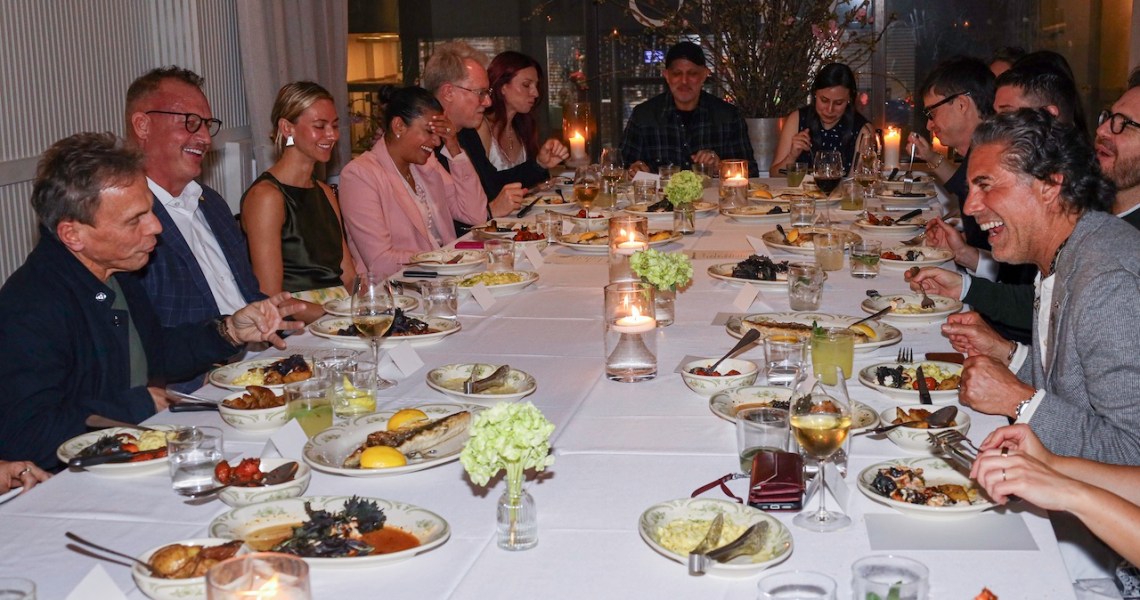
During the most recent Glossy and Modern Retail Leaders Dinner, hosted in partnership with Global Payments on April 29, brand and retail leaders discussed the current dynamics impacting their growth. Among them: AI, rising customer acquisition costs, wholesale risks, changing discovery habits and the evolving role of stores.
The clearest takeaway was that, while AI is changing how companies work and how consumers shop, the brands in the room signaled that they’re not treating technology as a replacement for physical connection. The discussion kept circling back to the importance of stores, events, community and more intentional customer relationships.
As one attendee put it, “You cannot replace the human touch, the human experience.”
Below is a rundown of all the discussion’s noteworthy takeaways. The Chatham House Rule was in place, allowing guests to speak freely without being directly quoted.
AI is forcing brands to rethink search and discovery
AI came up early and often. Executives discussed using AI across productivity, marketing, product development and commerce, while also acknowledging the pressure to keep up. “It’s in stores, it’s in commerce, but it’s also in productivity,” one attendee said.
One executive compared the current moment to the early days of the internet. “The bad news is that Google is open to everybody. The good news is it’s open to everybody,” the person said, making the point that smaller brands can use AI tools to move faster, even as competitors do the same.
A big change, they noted, is happening in discovery. “People don’t search the same way anymore,” one marketer said. Google Search and Bing Search were cited as channels that no longer work the way they used to. Brands now have to think about whether their websites are serving a human shopper, an AI agent scanning information on the shopper’s behalf or another automated system, according to attendees.
That is changing the focus of commerce teams. “Your web has to be different, your chat has to be different, your documentation has to be different,” one attendee said. Optimizely and Adobe were mentioned as companies rethinking how web experiences should work for both people and machine-led discovery.
Paid digital fatigue is prompting a reliance on events
Several attendees described growing frustration with paid digital channels. Meta and Google came up as the clearest pain points, with attendees pointing to rising costs, weaker trust in advertising among consumers and the growing amount of AI content online.
One attendee said relying only on digital advertising has become a “money suck.” Another described making a sharper budget move: “I cut my digital budget in half and hired two community managers.” Their role, the person said, is to run events every week, either in-store or externally.
The broader mood in the room was captured in one blunt comment: “It’s only getting harder, it’s only getting more expensive.” Another attendee linked that frustration directly to customer acquisition costs, saying, “Every week, there’s just a different reason why it’s that much higher.”
That frustration is pushing brands toward more controlled, in-person forms of marketing, according to attendees. Events are no longer being treated as soft brand-building alone. They are becoming customer acquisition, retention and content-generation tools.
Stores are being redefined as marketing assets
The role of the store was another strong theme of the conversation. Attendees repeatedly described physical retail as a place for service, storytelling, community and content, not just transactions.
“My windows are my marketing, and our stores are marketing,” one attendee said.
But store expansion was not romanticized. One executive described opening in a market that looked strong based on e-commerce data and customer profiling, only to find that sales were slower than expected. The response was to quickly add events, customization, local partners and community programming to bring energy into the space.
The takeaway: Opening a store is no longer enough. Brands have to program it. As one attendee said of retail events, “It is very grassroots. It’s a very heavy lift for the team, but it’s helping brand awareness.”
Events are moving from spectacle to intimacy
The room was also skeptical of scale for scale’s sake. One attendee described an anniversary event that drew hundreds of RSVPs but left little room for meaningful customer interaction. “It sounds great, but all you’re literally doing is just supporting everybody being there, and you have no ability to have communication with anyone,” the attendee said.
The lesson was that a crowded room is not always a useful retail experience. “It’s really about the quality over quantity,” another attendee said.
That is especially true for brands selling premium or luxury products, where service and one-on-one attention are part of the value proposition. Smaller events with 10, 20 or 60 customers can be more valuable than a packed room if they create real service moments and customer relationships.
That is increasingly important as loyalty becomes harder to secure. “Customers are not loyal,” one attendee said. In that environment, community has to be actively built, not assumed.
Commerce is becoming more fragmented and more measurable
The conversation also turned to livestreaming on Instagram, TikTok Shop, Amazon and affiliate platforms. Several attendees said live selling has become part of their ongoing retail or social strategy, evolving from a pandemic-era workaround.
One attendee described livestreaming as a way to make the store work harder: “If you’re taking the best [videos] in the stores, there’s a marketing tool.” Another said social is now one of the few places where brands can still speak directly to customers “in your language.”
TikTok Shop was also cited as a channel that can drive sales beyond TikTok itself. One attendee said the platform had boosted its Amazon sales, as consumers discovered products on TikTok and then completed purchases on Amazon due to the convenience of fulfillment.
Other less glamorous conversion channels came up, too. Rakuten and AmEx offers were mentioned as tools that can influence where consumers choose to shop, especially when shoppers are actively looking for promo codes, cash back or in-store offers.
ShopMy and LTK were also mentioned in the creator-commerce conversation. “Numbers don’t lie,” one attendee said, describing the appeal of platforms that show which creators are actually driving volume. Another said the data has changed how their team thinks about influencer strategy: “Our strategy has changed night and day from last year to now.”
For premium brands, that is changing how budgets are spent. The creators producing the best returns are not always the biggest names. Increasingly, attendees said, the value is in knowing which relationships drive measurable sales.