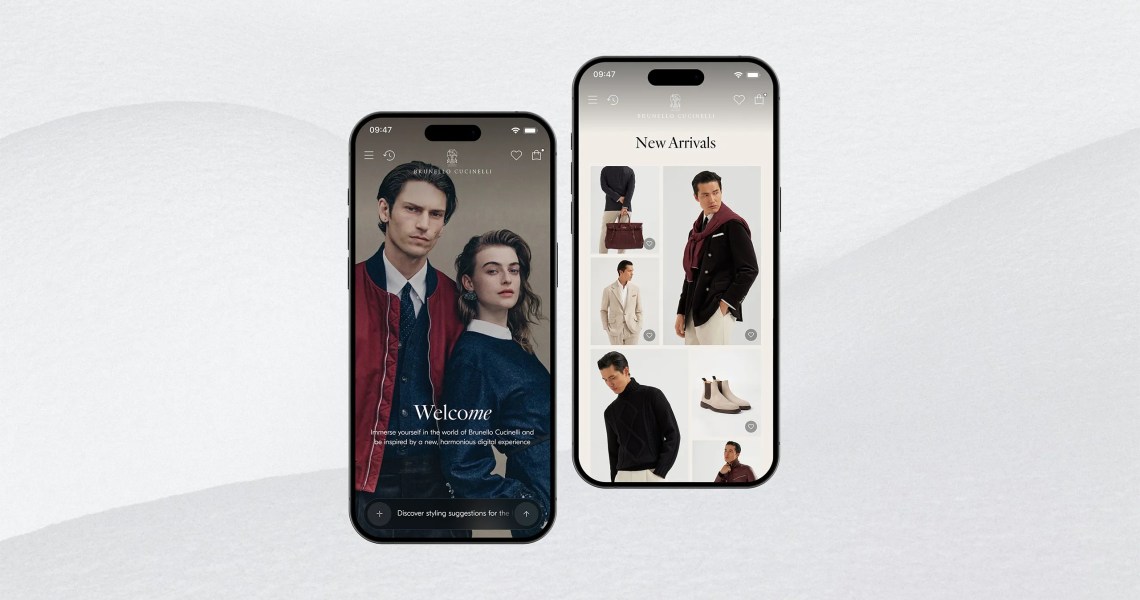
For this week’s Luxury Briefing, I sat down with Francesco Bottigliero, chief of humanistic technology at Brunello Cucinelli, at the inaugural Shoptalk Luxe to get an inside look at the new Brunello Cucinelli AI-driven website. He broke down why most luxury websites no longer reflect how customers actually shop and how Brunello Cucinelli is trying to change that. Also, a look at the rise of experiences at luxury auctions and the latest Q4 Lyst report, as well as news to know. For tips or comments, email me at zofia@glossy.co.
Luxury fashion websites have long followed a familiar structure: a homepage, product categories, filters and a search bar designed for shoppers who already know what they want. That approach works for repeat purchases. It works less well for discovery, browsing and emotional decision-making, which is how many luxury purchases actually begin.
That disconnect is what led Brunello Cucinelli to rethink its e-commerce experience. The brand launched its new AI-driven website in January, starting in Italy, the U.S. and the U.K., with plans to expand to additional markets in the coming months. The platform builds on BrunelloCucinelli.ai, an experimental site introduced in late 2024 through the brand’s AI platform, Callimacus, and was developed by the company’s Solomei AI unit.
Rather than redesigning navigation or visuals, the project focused on a more fundamental question: How do people actually shop for luxury online?
Francesco Bottigliero, Brunello Cucinelli’s chief of humanistic technology, described a gap between how customers think and how most websites are built. “The silent criteria in fashion shopping have always been the intent or context behind the fashion shopping mission,” he told Glossy.
In a press statement regarding the site launch, Brunello Cucinelli said, “I believe the world of Fashion, ever in search of Beauty, can enter into a gracious dialogue with technological knowledge, drawing from it insight and contribution for contemporaneity and new visions. I am fascinated by the idea that AI can nurture and enhance human intuition—the highest capacity of our mind to imagine, understand, and create beyond what is already known. For this reason, I like to think of AI as a handmaid of humanity, to collaborate with in harmony, rather than as a mere automation for actions, relations, and behaviours. Our freedom to learn, choose, and act — even in our digital lives — is itself a source of richness.”
In physical stores, the context surrounding a purchase decision is often shared with store associates. Online, it’s typically non-existent. Shoppers end up compressing motivations like aspiration, confidence or self-reward into a single keyword. Bottigliero gave an example: Someone considering a new fitness routine for the new year may search for one item – leggings. “All of that context has been reduced to leggings,” he said. “That doesn’t really serve the needs of that person searching for a healthy start to their year.”
The new site is designed to respond to that missing layer.
Instead of sending every visitor through the same fixed journey, the platform adapts in real time as the user browses. It looks at how quickly someone moves through the site, what they pause on, and whether they appear to be browsing or narrowing toward a purchase. This data is analyzed in real time using AI, and the information is stored.
“It looks at your behaviour,” Bottigliero said. “[It will assess] if you are in a rush, if you are calm or relaxed, if you click continuously on the content, or if you dedicate more time to what you are reading and seeing.”
Those signals shape what appears next. A fast-moving shopper will see more product options and less editorial content on the site. Someone browsing slowly is shown more storytelling and inspiration behind the brand, with more copy and visuals including video. When the system senses a customer is close to buying, it deliberately reduces the number of choices on screen. “It focuses your attention by narrowing the options in front of you,” Bottigliero said.
The goal, he stressed, is clarity, not more content. “The whole point is to reduce choice overload,” he said. “It is not about giving people more content and more information to process.” This can be a common problem for brands looking to express the rich storytelling of their marketing on their site.
The move toward a simpler luxury shopping experience comes as AI-driven shopping tools outside brand websites are also gaining traction. AI search engine ChatGPT, which launched in November 2022, now processes an estimated 2 billion to 2.5 billion queries per day, according to industry sources. It is increasingly used for product research and shopping-related questions, and the company is testing chat-based advertising this year. More recent fashion-focused tools like Phia, launched in April 2025, and Daydream, which debuted in June 2025, allow users to search conversationally across multiple retailers using natural language and images.
But most of that activity happens away from brand-owned sites, pulling discovery into chat interfaces and third-party platforms. Luxury brand websites themselves have remained relatively unchanged.
Brunello Cucinelli’s bet is that this kind of adaptive, intent-aware experience needs to live on the brand’s own digital property, not somewhere else.
Building it required changes internally. Engineers, stylists and editors at the brand worked together without a traditional hierarchy. “This was about solving a problem,” Bottigliero said. That process wasn’t always smooth. “These groups sometimes clash, but they do so constructively, and working through those conflicts is how you create game-changing solutions.”
It is still too early for the company to share firm performance results, which Bottigliero stressed in the interview. He said early data has been skewed by competitors and industry players scanning the site following its launch, inflating traffic and engagement. For now, Brunello Cucinelli is using familiar metrics such as time on site, products viewed and conversion as reference points, while focusing on cleaner signals like weekend behavior and overall engagement patterns.
One data point already shaping the strategy is the link between online and offline shopping. “We know that 70% of the people visiting our boutiques have already visited our website,” Bottigliero said. “Quite often they show up with a printed page of the website saying, ‘I saw this.’”
Why auctions are resonating with today’s luxury consumer
Sotheby’s Lake Como auction lot, created with Edition Hotels and jewelry designer Dyne, sold for $21,950 last month, marking Edition’s highest-earning experiential auction to date, according to the company.
The lot combined first access to the Lake Como Edition during its opening season with a penthouse stay, private lake experiences and a limited-edition Dyne necklace designed to function as a souvenir.
“Oftentimes, when you think about auctions, you think about objects rather than experiences,” said George Fleck, svp and global brand leader at Edition. “But the memory of the experience really stays with you when you connect that with a stay in a destination like Lake Como.”
He added, “It’s not about scale; it’s supposed to be this one moment in time,” he said.
According to Fleck, today’s auctions are driven by “very affluent customers that can afford whatever they like,” and are drawn to experiences that feel personal and thoughtfully designed.
The Lyst Index Q4 shows shoppers doubling down on classics
The Lyst Index, which tracks the shopping behaviour of more than 160 million users globally, offered a picture of stability — and pragmatism — in Q4. The top of the rankings held steady, while demand clustered around familiar luxury names and classic, utility-driven products.
Top brands
- Saint Laurent remained No.1, with demand rising 4% quarter over quarter
- Miu Miu held second place
- Cos ranked third, reflecting a strong appetite for accessible luxury
- Ralph Lauren climbed five spots amid heightened holiday demand
- Burberry also rose five places, driven by renewed interest in heritage accessories
Hottest products
- Polo Ralph Lauren cable-knit quarter-zip (No.1 overall)
- Massimo Dutti puffer jacket
- Arc’teryx Bird Head toque
- Burberry Nova check scarf
- Chloé Paddington bag
Executive moves
- Pieter Mulier has been named creative director of Versace, effective July 1, following Prada Group’s €1.25 billion (about $1.35 billion) acquisition of the brand from Capri Holdings.
- Canada Goose appointed longtime executive Patrick Bourke as president of North America, effective Thursday, replacing Ana Mihaljevic. The company reported holiday-quarter revenue up 14% year over year to nearly CA$695 million (about $508 million), with North America rebounding after prior declines despite margin pressure and lower net income.
News to know
- Change is ramping up at Saks. The company is selling off and isolating weaker parts of the business, while brands, landlords and partners step in to protect what they’re owed as the company restructures. Just this week, Saks Global put its Saks Off 5th e-commerce business into a separate liquidation run by independent managers, formed a creditors committee including Amazon, Chanel and LVMH, moved to end its Amazon partnership, and triggered changes to who controls licensed brand rights and store leases during bankruptcy.
- Ssense received approval from the Superior Court of Quebec for a transaction allowing founders Rami, Firas and Bassel Atallah to buy back the Montreal-based company with a Canadian multi-family office, pending regulatory approval. This is despite opposition from creditors led by Bank of Montreal, as Ssense seeks to emerge from bankruptcy protection with more than CA$200 million (about $145 million) in debt after securing CA$40 million (about $29 million) in interim financing.
- Pandora is shifting part of its assortment from sterling silver to platinum-plated jewelry to reduce exposure to silver price volatility. On the brand’s earnings call on February 5, CEO Berta de Pablos-Barbier said the company plans to convert at least 50% of relevant silver products by 2027 and warned that 2026 revenue could be flat to down 1% amid weak U.S. demand. Philippa Newman has been named chief product officer to drive design innovation.
- Vestiaire Collective expects to become profitable in 2026 after generating about €200 million (roughly $235 million) in revenue on just under €1 billion (about $1.18 billion) in gross merchandise value in 2024. CEO Bernard Osta, who replaced Maximilian Bittner last October, is targeting U.S. expansion following the forced departure of co-founder and president Fanny Moizant amid organizational changes.
- JW Anderson returned to profitability in 2024 with a reported profit of £21.3 million (about $27 million) on turnover of £28.43 million (about $36 million), driven largely by the restructuring of an LVMH-linked intra-group loan. Excluding this one-off effect, the brand still posted an operating loss of £5.5 million (about $7 million).
Listen in
On the Glossy Podcast, I joined senior fashion reporter Danny Parisi to share on-the-ground insights from Shoptalk Luxe in Abu Dhabi, where I reported about how luxury brands are reassessing the role of department stores and accelerating experimentation with AI across marketing, operations and customer engagement. Listen here.
Read on Glossy
How Puma is betting on AI co-creation for its club football shirts. Why Lulus is expanding its wholesale partnerships. Brilliant Earth is targeting couples that shop together for engagement rings.