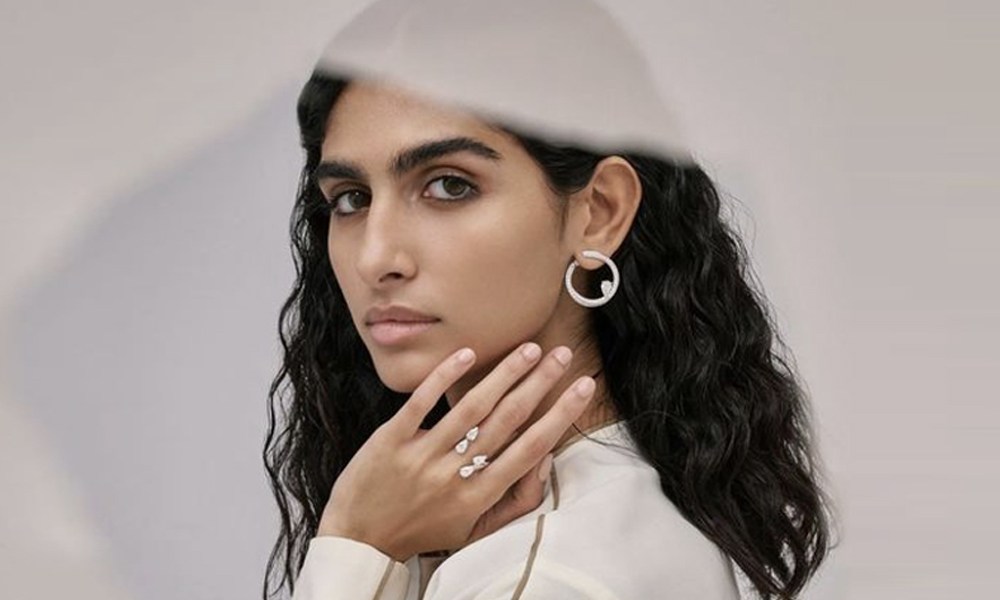
In this week’s Luxury Briefing, I spoke to Repossi CEO Anne de Vergeron at Shoptalk Luxe in Abu Dhabi about the brand’s design- and art-led growth. Also, a look behind the scenes at what is working for luxury brands in creator marketing. Plus, executive moves at On Holding, news to know about Alexander McQueen and Saks Off Fifth, and a new podcast episode on the 2016 trend. For tips or comments, email me at zofia@glossy.co.
Fine jewelry has emerged as one of the clearest success stories in luxury over the past year.
While demand for fashion and leather goods softened, jewelry continued to outperform at both LVMH and Richemont, driven by resilient high-end spending and loyal clients. At LVMH, “watches and jewelry” was the group’s fastest-growing division in 2025, posting 8% growth in earnings reported this week, supported by demand for Bulgari and early momentum from Tiffany & Co.’s repositioning. Richemont, meanwhile, has continued to benefit from its heavy focus on jewelry maisons, where high-ticket purchases have remained steady.
Within that context, high-end jewelry brand Repossi has quietly held its position inside LVMH’s portfolio. “The brand has been [doing] very well within the portfolio,” said Repossi CEO Anne de Vergeron, pointing to the brand’s loyal clients and clearly differentiated offer. Founded in Turin, Italy in 1957 and later established in Monaco, Repossi was acquired by LVMH in 2015, when the group took a majority stake in the family-owned business for an undisclosed sum. Nearly a decade later, the brand remains deliberately small, focused on relevance, design and flexibility rather than scale.
“Repossi is very interesting,” Vergeron said. “It’s a brand which is almost 70 years old.” She added that longevity alone is not enough, saying, “The relevance of a luxury brand today is to see what in the DNA is still relevant today.”
That mindset has shaped how Repossi has evolved since joining LVMH, particularly as jewelry brands navigate higher gold prices — which, this week, have hit $5,000 per ounce — and more cautious entry-level demand. For example, Repossi has leaned into a broad price architecture and deeper client relationships. “We have different types of prices within the house,” Vergeron said. “We are capable of doing almost four segments in jewelry,” spanning entry-level pieces, mid-priced designs, high jewelry and bespoke commissions. In the U.S. market, Repossi’s fine jewelry ranges from around $3,000 to more than $20,000, with bespoke and high jewelry priced higher.
Best-selling Repossi styles reflect the brand’s architectural and minimalist design language. Core ranges include Serti sur Vide, which reworks the classic diamond setting so stones appear to float on the skin — in the same way that many unset gems are traditionally settled between the fingers in jewelry consultations. The brand is also known for its Antifer and Berbere ranges, which use sharp lines and repeating motifs inspired by architecture and cultural symbols to create sculptural rings, bracelets and ear cuffs. The designer Gaia Repossi’s grandfather, Costantino Repossi, founded the brand. A former Fiat designer, his background in industrial design shaped the house’s architectural approach to jewelry.
“We always have at least one ear cuff in our collection,” said Vergeron. “Every year, we have a new ear cuff.” The cuff has appeared in black gold with pavé diamonds, as well as in white and pink gold, and in layered Antifer and Berbere variations over the years.
Those designs have become entry points for high-profile clients. Anna said Kim Kardashian has worn Repossi ear cuffs from current collections, including for her birthday and during her Paris trial appearances last year. Vergeron said Kardashian wanted the brand’s most opulent pieces for her appearance and has since become a repeat client. The same, albeit smaller, ear-cuff designs have also been worn by artist Rosé, previously from Blackpink.
Vergeron said Repossi’s customer base has been a strong differentiator. Repossi defines its clients in three main groups: The first is a fashion-driven audience that avoids traditional fine jewelry and looks for pieces that feel new. That group also drives the brand’s limited-edition product strategy, according to Vergeron. “We always release some limited editions during fashion week,” she said. “We’ve been doing it for four years in a row.”
The second group is made up of design-focused clients. “Some of our clients are designers, photographers, architects, interior designers,” Vergeron said. And the third group includes highly educated professional women, such as entrepreneurs, law-firm partners and C-suite executives. “They like to have something very different,” Vergeron said. “It’s a brand for empowering women.”
For its most valuable clients, Repossi has leaned further into bespoke offerings. “We do a lot of special orders,” Vergeron said. “We can do actual drawings for clients, and look for specific or larger stones for them.” She said this flexibility has helped build loyal customers.
Repossi is not the only jewelry brand thinking carefully about how to differentiate as customers become more discerning.
Kimai, a U.K.-based fine jewelry brand, has leaned into circularity as a core part of its value proposition. The brand offers a Second Life program that allows customers to remake jewelry they already own through personalized consultations. “The jewelry space is one of the highest growing spaces because jewelry is something people are buying for the long run,” said Jessica Warch, co-founder of Kimai.
Geographically, Repossi remains selective. The brand does not operate in China. “We’re in Japan, and we’ve been there for almost 20 years,” Vergeron said, citing a strong connection between Repossi’s minimalist design and Japanese taste. The brand entered South Korea less than two years ago and now operates four boutiques in Seoul. In the U.S., Repossi is stocked at Saks Fifth Avenue and Bloomingdale’s, where demand is strongest at the high end. “In the U.S., our prime focus is much more on high jewelry,” Anna Vergeron. She said sales there have been very positive.
The Middle East has also become an increasingly important market for Repossi, particularly as high jewelry demand remains resilient. Speaking at Shoptalk Luxe in Abu Dhabi, Vergeron pointed to recent expansion in the UAE as part of that strategy — the brand opened a store in November. She added that the region brings both local and international clients into the brand’s ecosystem. “It puts us on the roadmap,” Vergeron said, explaining that connection across Abu Dhabi, Dubai and London helps build confidence and legitimacy among Middle Eastern clients who value consistency and long-term presence.
Emilio Pucci and Loro Piana see exceptional influencer marketing results
According to new data from the influencer marketing platform Traackr, released this week, Pucci’s and Loro Piana’s influencer marketing efforts are increasingly translating to success. In 2025, the brands ranked first and second in growth among luxury brands, respectively, on Traackr’s Brand Vitality Score, or VIT. Pucci recorded 818% growth, and Loro Piana saw 616% growth.
VIT is Traackr’s proprietary metric that evaluates creator marketing performance across four factors: creator volume, mention frequency, average creator audience size and content performance. The framework is designed to capture not just visibility, but also the quality and durability of attention.
Notably, both brands’ growth was driven almost entirely by organic creator activity. “There was no surge in sponsored posts or boosting,” said Pierre-Loïc Assayag, co-founder and CEO of Traackr. “Pucci’s growth came almost exclusively from Instagram, with highly visual content tied to real moments like travel and celebrations.” Loro Piana’s growth, he said, was split between Instagram and TikTok, reflecting its positioning as everyday quiet luxury that lends itself to frequent, repeat mentions.
The data points to a broader shift in how luxury brands are leveraging creators. “Historically, creators played a supporting role for luxury brands,” Assayag said. “There was fear that relinquishing control of the narrative would cheapen the brand.” That is changing, as more brands prioritize creators who could translate luxury into lived experiences rather than overt promotions.
Looking ahead to 2026, Assayag said AI will increasingly guide those decisions. “The brands that will use AI most effectively will be the ones using it to understand long-term creator behavior and cultural alignment,” he said. “AI does not replace taste or judgment. It sharpens it.”
One key takeaway from Traackr’s 2025 data, Assayag added, is that volume alone is no longer a reliable indicator of impact. “There is more content and more creators than ever,” he said. “The brands seeing the strongest results are the ones prioritizing creators who already engage organically and are a natural fit.”
Executive moves
- On Holding has appointed Frank Sluis as chief financial officer effective May 1, ending CEO Martin Hoffmann’s interim oversight of the role following the departure of former CFO Marc Maurer last spring.
Investment round
Phia, the AI shopping agent-based company co-founded by Phoebe Gates and Sophia Kianni, has raised $35 million in Series A funding at a $185 million valuation, led by investment firm Notable Capital. With the new cash injection, the company aims to scale its core AI and ML infrastructure and build what Gates describes as “the AI alignment layer between brands and consumers.” That will include hiring “A-star talent” and expanding Phia’s real-time LLM systems. As described by Kianni, the company plans to strengthen “the intelligence layer behind Phia” to deliver more personalized, high-intent shopping at scale.
News to know
- Kering CEO Luca de Meo is set to meet Italian unions on February 5 over Alexander McQueen’s restructuring plan. This includes potentially correcting redundancies affecting up to one-third of its Italian workforce and reorganizing production as part of a group-wide effort to return the brand to sustainable profitability.
- Saks Global announced plans to wind down most of its off-price business, including closing all remaining Last Call stores, retaining only select Saks OFF 5TH locations and exiting saksoff5th.com as it refocuses on full-price luxury retail.
- Saudi Arabia’s Fashion Commission has signed an MoU with Four Directions Real Estate Development Company to develop a new fashion district in Riyadh. It will potentially be located near King Saud University, and is set to feature fashion show venues, studios, incubators and hospitality spaces, with tentative completion around 2028.
- PVH has partnered with OpenAI to co-create custom AI capabilities for its PVH+ operating model. They’re aimed to support product design, demand planning, inventory optimization and consumer engagement across its Tommy Hilfiger and Calvin Klein businesses.
- Galeries Lafayette has completed the sale of the BHV Marais building — valued at about $325 million — to an undisclosed asset manager, reportedly the investment management company Brookfield. SGM will continue operating the Paris department store following controversy over hosting Shein’s first physical retail space.
Listen in
On this week’s Glossy Podcast, Danny Parisi and Jill Manoff revisit the fashion trends of 2016, with Jill speaking to stylist Micaela Erlanger about why the era’s aesthetics are resurfacing and how that moment shaped the industry. Listen here.
Read on Glossy
Luxury brands are betting on “return on emotion” as AI infiltrates the business. What the India-EU trade deal means for fashion. LVMH doubles down on Tiffany’s and Loro Piana in its earnings.