The Glossy 50 honors the year’s biggest changemakers across fashion and beauty. More from the series →
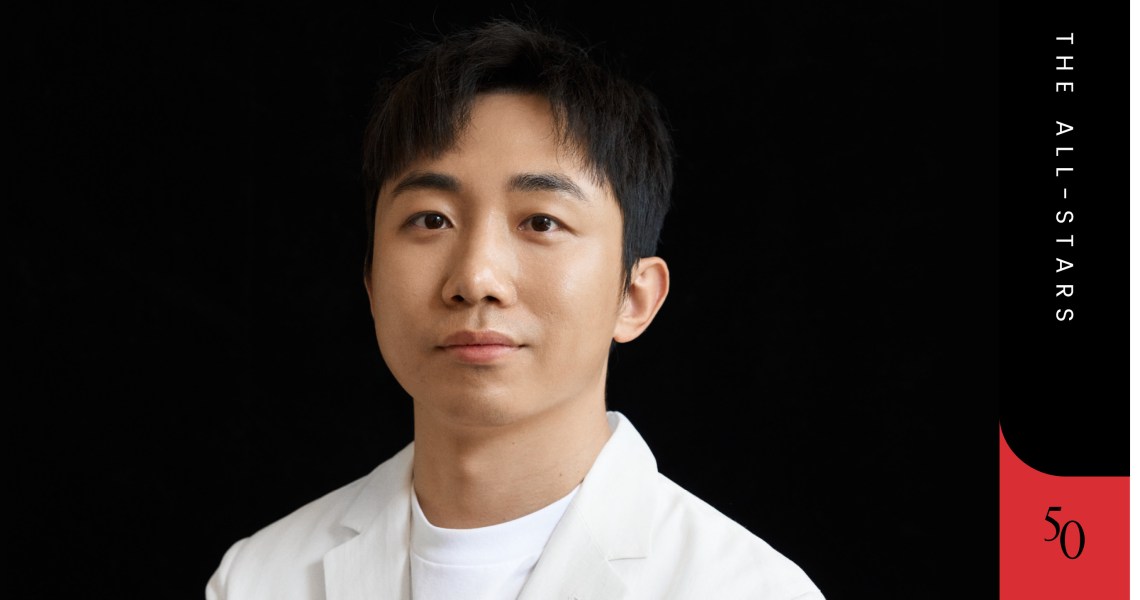
Amid shifting trade dynamics and rapidly evolving consumer behaviour, Pop Mart CEO Grant Wang has guided one of the strongest momentum stories in global retail. The runaway popularity of Labubu has pushed Pop Mart’s once niche collectibles into the mainstream and reshaped the company’s international profile.
“This year stands as a transformative milestone for Pop Mart and Labubu,” Wang said. “Our global expansion scaled new heights, our cultural resonance deepened into mainstream relevance, and our creative boundaries expanded to redefine the pop culture landscape.” During this year’s Macy’s Thanksgiving Day Parade, for example, Labubu floated alongside the world’s most recognizable characters, introducing the character to the 50 million U.S. viewers who had yet to embrace it.
Labubu’s rise was supercharged by fashion, with K-pop stars among the early adopters. When Lisa from Blackpink clipped a mini Labubu to her designer bag, it set off a wave that quickly reached Rihanna, Kim Kardashian, and street-style stars from Seoul to Copenhagen. By 2025, the nine-toothed creature had become an unlikely fashion accessory, dangling from Louis Vuitton and Gucci handbags and popping up in front rows and on TikTok fits.
Demand for the toy has been undeniable, with long lines of hopeful shoppers, sellout drops, viral unboxings and a thriving resale ecosystem. Wang sees consumers’ passion as rooted in emotional connection rather than hype.
“People see something of themselves in our IPs,” he said. “Our characters are playful, imperfect and full of heart.”
For years, that has translated to sales in international markets. “Consistent with previous years, the company has delivered strong performance in the Greater China region and the Southeast Asian markets,” Wang said.
But 2025 pushed Pop Mart into new terrain. It has seen growth in Europe — especially the U.K., France, Germany and Spain — as well as the U.S., Thailand and Japan. In step, it has rapidly opened stores in New York, London, Paris, Berlin, Bangkok and Sydney. Pop Mart is on track to have nearly 200 stores outside of China by the end of 2025. Its first Middle Eastern location, opened in Doha in October, integrated regional design cues, its signature arches, into the store design. “Our creativity remains globally resonant yet culturally authentic,” Wang said.
Financially, the momentum has translated into a standout year. Global revenue in the third quarter surged more than 250% year over year. The company’s Hong Kong–listed shares rose on the news, lifting Pop Mart’s market value to roughly $45.5 billion.
Pop Mart’s collaboration strategy continues to anchor its expansion. “We pursue partnerships that deepen our IPs’ stories and strengthen our connection to fans,” Wang said. Every project must meet two criteria: IP synergy and community resonance — ensuring collaborations feel like extensions of character narratives rather than commercial one-offs, Wang said. In 2025, Pop Mart rolled out a licensed collection with game maker Riot Games and a Uniqlo UT x Pop Mart product capsule — both involved Pop Mart’s The Monsters line, which includes Labubu, among other characters.
Creatively, Pop Mart treated 2025 as a year of discovery. “We have reimagined how Labubu connects with audiences,” Wang said. Every new format of the toy, including the viral mini Labubu series and the expanded plush ranges, quickly sold out.
But Wang is already looking past the frenzy to drive the Labubu universe further next year. “In 2026, we will continue to prioritize operations centered around our IPs,” he said. Fans can expect stronger products, elevated collaborations, content development, early theme-park planning and immersive in-store experiences built around characters like Labubu. “Each IP has its own unique traits,” he said. “Our plan is to continue to find distinct development paths for our characters.”