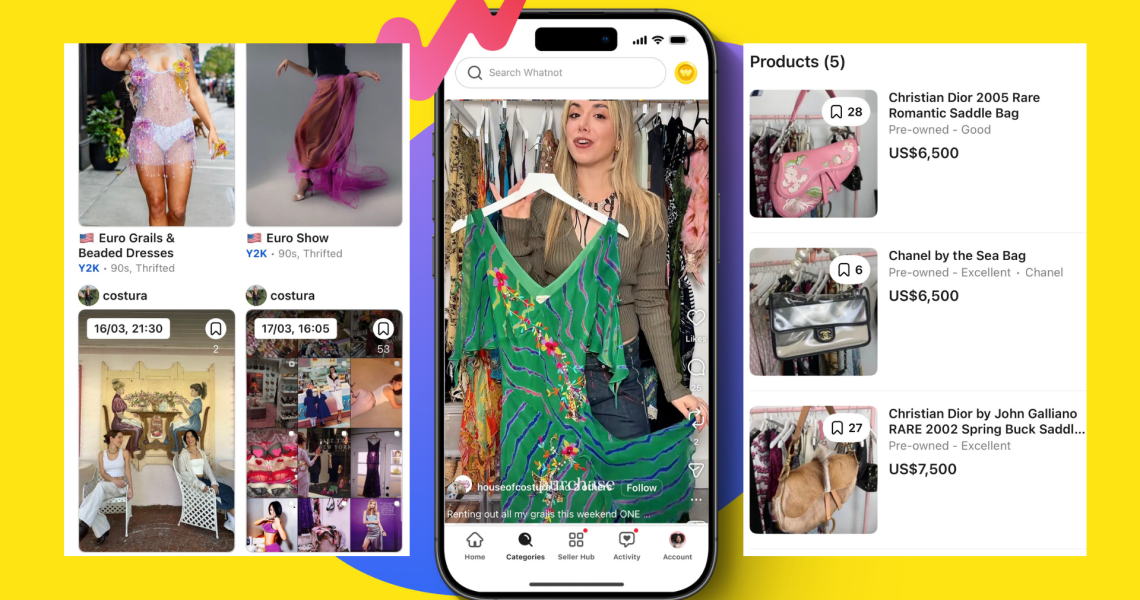
Vintage resale has long been dominated by static product listings, with carefully photographed garments uploaded to marketplaces where they often sit for weeks waiting for the right buyer.
But sellers are now experimenting with livestream sales to showcase rare items and create urgency around one-of-a-kind pieces.
Stephania Garcia, who runs the vintage resale channel House of Costura on live-selling platform Whatnot, auctions Y2K dresses, archival handbags and embellished evening gowns several times a week to live viewers, some of whom tune in for hours. Garcia has built a following of more than 22,200 followers on Whatnot and 11,500 followers on Instagram, where she previews inventory and promotes upcoming shows.
“I was listing on other marketplaces before this, doing the whole static listing process where you take pictures, write out the measurements and wait,” Garcia said in an interview. “But honestly, it was so boring to me. I’ve always loved selling and interacting with people. I have a big personality, and once the live feature came into play, that was it. It completely changed how I wanted to run my business.”
Since joining Whatnot nearly four years ago, Garcia said, her resale business has grown from roughly $25,000 a year to more than $250,000 annually, driven entirely by livestream sales.
Whatnot, originally launched for collectibles like trading cards and sneakers, has expanded into apparel and accessories. In October 2025, it raised $225 million in Series F funding at an $11.5 billion valuation, with CEO Grant LaFontaine calling live shopping “retail’s new normal.”
“Fashion has become our fastest-growing category,” said Armand Wilson, vp of categories and expansion at Whatnot. “It’s now one of the largest categories on the app.”
Whatnot’s active users now spend an average of 80 minutes per day on Whatnot — the company had 20 million reported users in 2025. And its live format appears particularly well-suited to vintage fashion. Unlike modern apparel, secondhand pieces often require explanation. “You can zoom in on details like stitching or tags and explain why a piece is rare,” Wilson said. “That’s something that’s hard to communicate on a static product page.”
Livestream selling is also gaining traction on TikTok Shop, which launched in the U.S. in 2023. The platform has grown rapidly into an estimated $15.8 billion U.S. e-commerce business, with 71.4 million Americans shopping on TikTok in 2025 and sales through TikTok Shop increasing more than 120% year over year, according to the company.
“One of our biggest shows ever was after we got a large Mandalay lot,” Garcia said, referring to her Whatnot livestream featuring styles by the brand. “It was all these beaded silk dresses and corseted pieces, very Y2K, very Nicole Richie and Paris Hilton era. That show ended up being the highest money-making show we’ve done.” Garcia declined to disclose the total revenue from the Mandalay stream, but comparable vintage Mandalay dresses resell for $150-$500, depending on condition and embellishment.
Many of the garments Garcia sells are sourced internationally, particularly in Europe, where vintage eveningwear and embellished garments are easier to find. Some items are deadstock, meaning they were produced decades ago but never worn or sold.
“Right now, people want pieces no one else has,” Garcia said. “They want that one dress that nobody else is going to show up wearing [to a party].”
The livestream format allows her to build anticipation for those items before ever appear in a show.
“With vintage, you really have to build excitement around it,” she said. “Sometimes I’ll promote a dollar-start auction for a week before running the item. I’ll tell people, ‘If we don’t get enough viewers in the room, I’m not running this piece yet.’ It turns into an event.” Those events can last for hours. Garcia typically goes live two to three times per week, with shows ranging from 90 minutes to several hours. Her longest livestream lasted nearly nine hours.
Garcia said livestream auctions allow her to move inventory faster than traditional listings. “With static marketplaces, you can have items sitting there forever, sometimes months, sometimes even years,” Garcia said. Live auctions allow her to move inventory much faster. “If I get 150 pieces in, my goal is to sell those within a week,” she said. “Even if the profit per item is smaller, I’d rather move the inventory quickly because time is money.” She now ships close to 1,000 items per month, often following multi-hour livestream sessions.
Other resale platforms are experimenting with similar formats. eBay launched eBay Live in the U.S. in 2022, initially focused on trading cards and collectibles, before expanding the format in 2025 to luxury watches, handbags and fashion, and rolling it out across Europe.
For brand and retail executives, depending on the category, Garcia’s and others’ live-streaming success proves the power of product storytelling in shaping market demand.
Kirsty Keoghan, global gm of fashion at eBay, said the format works particularly well for categories like vintage and luxury, where sellers can demonstrate materials and condition in real time. Live shopping “really gives the opportunity for a seller and a consumer to understand what they’re selling or buying,” Keoghan said. “You can show what materials something is made of. You just can’t do that in a static listing.”
On eBay, the company reports roughly 1,000 searches for vintage items every minute, highlighting the scale of consumer interest in secondhand fashion.
For Garcia, her long-term goal is to scale House of Costura into a continuously running channel where collaborators host shows around the clock. “I’d love to get to a place where my Whatnot channel is live 24 hours a day,” she said. “Even when I’m not there, someone else is running a show.”
For now, she’s focused on building the audience one livestream at a time. “Once you experience live selling,” Garcia said, “it’s hard to go back to just posting listings and waiting.”