On February 11 in NYC, join Glossy for AI Marketing Strategies, a one-day event where industry leaders will dive deep into marketers’ experiences with and emerging best practices for integrating AI tools into the key layers of the marketing process.
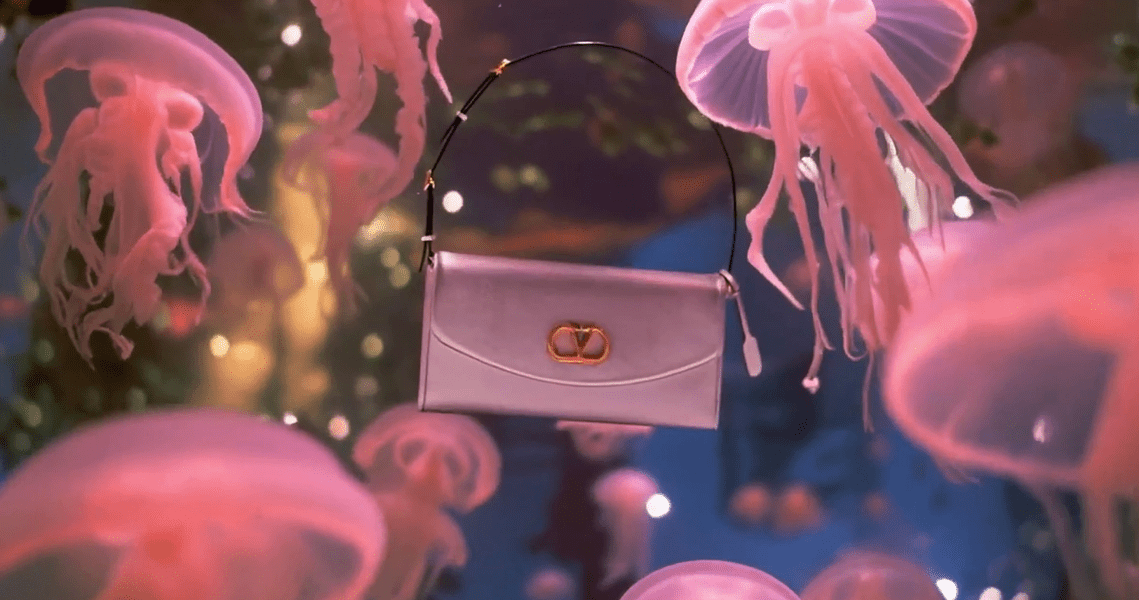
Luxury brands spent much of 2025 experimenting with generative AI in marketing, but the year ended with a clear signal that consumer tolerance has limits. That tension came into focus on December 2, when Italian fashion house Valentino faced widespread criticism after posting an AI-generated video on Instagram promoting its Valentino Garavani DeVain handbag.
The video, part of what Valentino described as a “digital creative project” developed with digital artists, featured surreal visuals of bodies and logos morphing around the bag. Despite being clearly labeled as AI-generated, the post drew hundreds of critical comments, with users calling the imagery “cheap,” “lazy” and “disturbing,” and accusing the brand of prioritizing efficiency over artistry.
The backlash reflects a broader challenge luxury brands are navigating as generative AI tools become more widely available. While AI has been quietly adopted behind the scenes across design, production and operations, its use in front-facing creative remains contentious, particularly in a category built on craftsmanship and human authorship.
“Consumers predominantly view AI-created works as less valuable than human-made images,” said Dr. Rebecca Swift, svp of creative at Getty Images, talking about the Valentino backlash. “While people are excited by AI-generated content for personal use, they hold brands to a higher standard, especially expensive brands. Even full transparency about AI use wasn’t enough to win them over.”
Brands will likely continue to use AI, according to Parallel Pictures, a Berlin-based studio founded in 2021 by Jill Asemota — the studio has produced AI-generated imagery for brands including MCM Worldwide and the German fashion retail group Peek & Cloppenburg. But, rather than lead with fully AI-native campaigns, Asemota said most luxury clients are using AI to extend existing shoots.
“For campaigns, it’s almost always an add-on,” Asemota said in an interview. “Brands come to us and say, ‘We’ve already shot the campaign in real life. Can we create 10 or 20 additional assets that match it for social or digital?’” That’s because brands are producing more content than ever across more channels, while budgets and timelines continue to tighten, she said. “Brands are now feeding social, websites, lookbooks, distribution — all of that constantly, and at the same time. AI helps with that scale, but it doesn’t replace the main campaign.”
AI adoption is most aggressive among those creating content for e-commerce platforms, Asemota said. “In e-commerce, the biggest pain point is volume,” she said. “That’s where brands need content fast and in bulk.”
Based on Parallel Pictures’s internal data, Asemota said AI-generated e-commerce imagery can reduce production costs by up to 70% compared to traditional studio shoots, while campaign-related work typically delivers savings closer to 50%.
Still, Asemota described the current approach to AI among luxury clients as ‘cautious experimentation,’ driven partly by competitive pressure. “There’s a certain FOMO,” she said. “Even brands that are very protective of their image feel they need to test something, or at least experiment, because everyone else is.”
That experimentation has taken different forms across the industry this year; the AI fashion campaigns that shaped the conversation in 2025 included:
- Valentino Garavani with the DeVain handbag digital creative project (December 2025)
- Jil Sander used AI-assisted campaign imagery (February 2025)
Jil Sander incorporated AI-generated visuals into a broader conceptual campaign earlier this year. - MCM Worldwide used AI-generated campaign extensions (Spring 2025)
MCM used AI imagery to create stylized, surreal environments as extensions of traditional campaigns. - Burberry used AI-supported digital storytelling (2025)
Burberry continued to experiment with AI-enhanced movement, leveraging imagery from a 1980s campaign, while keeping the core product imagery for its current campaign rooted in conventional photography. - Luxury e-commerce imagery – scaled, rarely disclosed (2025)
Hugo Boss said it has been using AI imagery across e-commerce platforms since 2023, and Peek and Cloppenburg have also tested it on their sites.
Video remains an area where luxury brands are moving more slowly. Asemota said AI-generated video still struggles to maintain product accuracy once motion is introduced, leading to distortions that make it unsuitable for commercial use beyond short clips. “When models start moving, the product can change or warp,” she said. “For us, that’s not acceptable. The product has to stay true to the original.”
Looking ahead to 2026, Asemota expects experimentation to continue, but within clearer boundaries. “I don’t think brands will fully replace traditional content production with AI,” she said. “What we’re seeing instead is AI being used where it makes sense to support, extend and scale creative output without becoming the main story.”