In this week’s Luxury Briefing, I look into the latest chapter of the department store saga: the closing of LuisaViaRoma’s New York store. Also, how luxury agencies are changing with AI, and news to know from Coperni, PMC and BHV Marais. For tips or comments, email me at zofia@glossy.co.
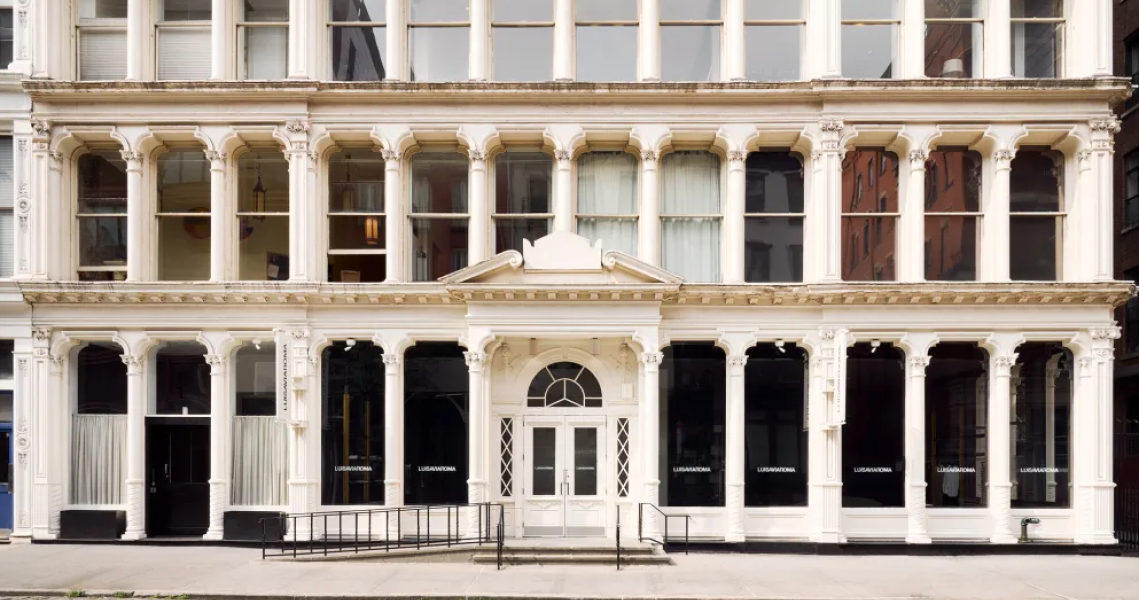
LuisaViaRoma’s New York experiment — its first international store, at 1 Bond Street — has come to an end, less than two years after it opened. The store opened in July 2024 and closed on June 8, 2006, as the company continues to navigate court proceedings in Italy following months of financial strain.
The store was positioned by the company as a U.S. brand statement. StyleZeitgeist was first to report its closure.
In a statement this week to Glossy, the company confirmed the closure of the New York store as part of “a broader process aimed at rationalizing its operating perimeter and reorganizing the company’s activities.” The decision, the company said, forms part of the ongoing procedure in Italy and reflects the need to focus resources on its core activities, while preserving the value of the brand, its digital platform and its luxury retail expertise.
Following the New York closure, LuisaViaRoma’s remaining physical footprint appears to be concentrated in Florence, where it still lists its Via Roma flagship, an experimental store on Via Silvio Pellico and a kids’ store. Its website still lists the New York store, though the company has confirmed that location closed on June 8.
When Glossy interviewed deputy CEO Bradley Carbone at the NoHo store in April 2025, he described the New York flagship as a way to connect LuisaViaRoma’s e-commerce business with a more physical expression of the brand.
“Ninety percent of our sales are digital,” Carbone said at the time. “The flagships are really here to show the brand and show what LuisaViaRoma is.”
Carbone said the United States was the company’s top market, with New York its top region within the country. But he also acknowledged that brand awareness remained underdeveloped in the market, noting that one of the top Google searches was whether LuisaViaRoma was a real store.
That made New York both an opportunity and a risk. “Opening in New York is a true statement,” Carbone said. “You open in New York from a position of strength. If you can be open in New York, you show that you are a player, and then you’re a player on the world stage.”
Erin Mullaney-Page, a luxury fashion consultant, ex-buyer and -merchandiser, and founder of Erin’s Edits and Stilara Agency, said she was “more surprised” when LuisaViaRoma opened a store of that size in downtown Manhattan than when she heard it had closed.
“The store only lasted about two years, which tells you everything,” she said. “LVR was fundamentally an e-commerce business, so the return to physical retail post-pandemic hit them hard because their model was so heavily weighted toward online.”
According to Mullaney-Page, the U.S. had been LuisaViaRoma’s largest market until February 2025, registering double-digit growth, before dropping sharply that March once tariffs were announced. “Opening 16,500 square feet in one of Manhattan’s most expensive neighborhoods right as that was unraveling was brutal timing,” she said. “The overheads alone on a space like that would have been crippling. Pair that with one or two bad sales seasons, and you have a recipe for disaster.”
At the time of its opening, LuisaViaRoma’s strategy was to use the store as part of an omnichannel loop. Customers would experience the brand in person, attend events and connect with stylists, then carry that loyalty back online. Carbone said the company was trying to build “a flywheel” between its physical and digital environments, with the store serving as a community hub through panels, designer events, art installations and affiliate partnerships.
But that same logic of creating a physical hub for the e-retailer has now become the pressure point. The NoHo store was meant to elevate the brand beyond the online price race, where multi-brand luxury retailers compete on search, availability and discounting. Carbone was candid about that challenge last year, saying digital luxury had become “a race to the bottom,” because shoppers who know what they want can simply search for the lowest price.
But Mullaney-Page said the New York assortment also sat in “a slightly awkward middle ground.” While the store carried brands including Maison Margiela, Proenza Schouler, Jil Sander, Chloé, Gabriela Hearst, Helmut Lang and Lanvin, she said much of that offering overlapped with what American luxury shoppers could already access through brand stores or established domestic multi-brand retailers.
“The genius of a European multi-brand is the point of view, bringing those hard-to-find items that you genuinely can’t find anywhere else,” she said. “I’m not sure LVR fully delivered that in New York.”
Independent retail consultant Elena Kirioukhina, founder of high-end fashion brand company Openstyle Consulting, said that the NoHo store may have worsened LuisaViaRoma’s financial strain. “I am absolutely convinced that opening stores in NYC without a deep understanding of the market and the city was bound to lead to challenges,” she said. “The city is very, very expensive, and the cost of business is very high. Only those who know what they are doing can survive.”
The closure also comes amid a broader reckoning for luxury e-commerce and multi-brand retail.
MatchesFashion entered administration in March 2024 and is now being prepared for a 2026 relaunch under new owner Hulcan. Farfetch has continued operating under Coupang since its January 2024 rescue deal, though its former listed entity remains in liquidation proceedings. Saks Global filed for Chapter 11 in January 2026 and won court approval on June 5 to exit bankruptcy with a smaller store base and debt reduced by nearly 75%. SSENSE filed for creditor protection in Canada in late August/September 2025, with its founders finalizing a deal in February 2026 to retain control while restructuring continued.
Mullaney-Page said LuisaViaRoma’s situation is both company-specific and part of a wider industry reset. “The multi-brand luxury model specifically is under enormous pressure because the big houses have become increasingly reluctant to support third parties when they’re investing so heavily in their own DTC channels,” she said. “LVR’s situation has its own particular complications — the tariff exposure, the debt restructuring, the investor exit — but the underlying luxury fatigue is an industry-wide issue, and it isn’t going away.”
For years, multi-brand luxury platforms expanded on the assumption that scale, global reach and access to designer inventory would keep growth moving. Now, many are being forced to answer a harder question: What role do they play when brands are prioritizing direct sales, customer acquisition is expensive, vendor trust is fragile and shoppers have become more selective?
LuisaViaRoma says it has received an offer to acquire the business unit from a new group of investors and is in discussions with the Court of Florence. If approved, the proposal would allow the company to enter what it called “a new industrial phase” based on continuity and relaunch.
As Mullaney-Page put it, LuisaViaRoma will now need to rebuild trust with labels. “Brands want reliable retail partners these days,” she said. “They want to control the payment terms and how their product will be presented in store, and, most importantly, they want assurance that the retailer will still be operating next season.”
The AI reckoning has come for luxury agencies
Luxury brands are asking more of their creative and communications agencies, just as AI is starting to change how those agencies are staffed, structured and paid.
For fashion brands, the appeal of independent agencies has long been that they can move quickly, work directly with senior founders and offer a closer read on culture than larger, more layered firms. But the model is under pressure. PR and communications firms are now expected to handle far more than press, including runway shows, creator strategy, events, Substack placements and affiliate-driven gifting. At the same time, the costs of staying independent are rising, pushing more agency founders to consider acquisitions, mergers or strategic partnerships.
Dogma, the Stockholm-based agency group founded by Einari Eppo Nurmela and Jonas Löhr, sits inside that broader reset. The group owns FwB, Blonde Inc. and Public Image, and has acquired a stake in Dot Dot Dot, the insights platform founded by Christopher Morency, now Dogma’s chief brand officer. Its wider client network has included Prada, Uniqlo, Gucci, Jacquemus, Byredo, Off-White, Bang & Olufsen, Chimi and Zeeker.
Löhr said Dogma has gone from around 50 people to 35 over the last six months, partly because AI tools have made parts of the business more efficient. Paid media had once been a focus area, but he said AI is making that work easier to manage with fewer dedicated resources, reducing the need to hire a separate agency in the category.
That is changing what Dogma wants to acquire next. The group is looking more closely at areas where brands still need sharper outside partners, including events, social media and narrative-led communications. “We need disciplines that are best in class when it comes to real-life events,” Löhr said. “And I still think press — and agencies that can understand narratives — are super important.”
Dogma is building AI agents trained on its archive of work, past ideas and client learnings. “The creative output, it’s getting there, but it’s not there yet,” Nurmela said. For now, the agency’s pitch is speed. “From brief to production, we can do four days instead of four weeks,” Löhr said.
Dot Dot Dot, the insights platform Dogma acquired a stake in last year, is using AI more selectively. Christopher Morency, Dogma’s chief brand officer and Dot Dot Dot’s founder, said the team uses AI “at times in creative [briefs] to think about what could be.” That includes Moon Shot, Dot Dot Dot’s bi-monthly series exploring what brands could build next if they expanded beyond incremental product launches. Its latest edition imagined “GLAZED by Rhode,” a fictional food brand built around Rhode’s existing use of dessert language, its Erewhon smoothies, its bakery-themed pop-ups and its “glazed donut skin” positioning.
“Apart from that, to be honest, I don’t use it yet,” Morency said.
News to know
- Coperni has entered a court-ordered receivership in Paris after accusing its majority shareholder and distributor, Tomorrow London Group, of failing to pay bills. Founders Arnaud Vaillant and Sébastien Meyer are seeking to regain control of the brand.
- In publishing news, PMC has acquired Vox Media, adding brands including The Verge, Eater, SB Nation, PopSugar, Thrillist and The Dodo to their portfolio. The company already owns fashion and beauty trade titles WWD, Footwear News, Beauty Inc and Sourcing Journal under Fairchild Media Group.
- Historic Paris department store BHV Marais is being sold by Société des Grands Magasins to a management-led ownership team, which plans to end its controversial partnership with Shein and rebuild its core homeware, DIY, furniture and lifestyle offering.
Listen in
Fresh off a reported $10 billion valuation, Quince is trying to prove it can be more than a low-price online retailer. On this week’s Glossy Podcast, head of brand strategy Dakota Kate Isaacs joins senior fashion reporter Danny Parisi to discuss how the company is building a clearer brand story, testing pop-ups and expanding into categories from furniture to fine jewelry. Listen here.
Read on Glossy
Original Penguin and Ralph Lauren see an opportunity in Pitti Uomo. Fashion is the biggest category on live shopping app Whatnot. Aritzia is opening new stores in smaller locations like St Louis.