For this week’s Luxury Briefing, I spoke to the CEO and creative director of Agnona Stefano Aimone about the brand’s new flagship store and material innovations. Also, insights on the relaunch of Robert Marc, a buyer’s take on Dior and news to know. For tips or comments, email me at zofia@glossy.co
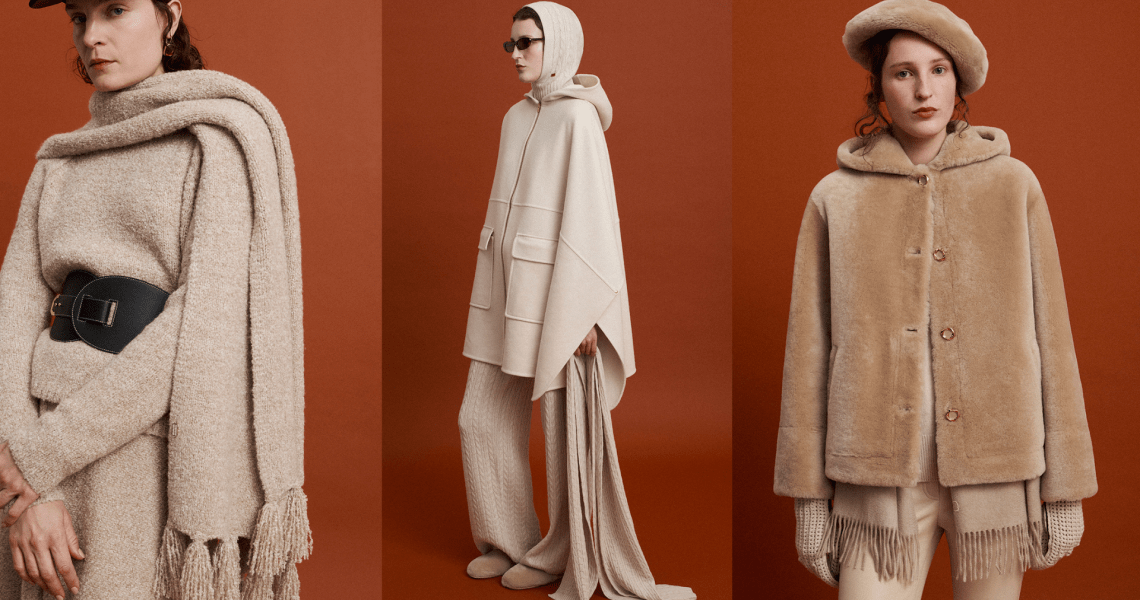
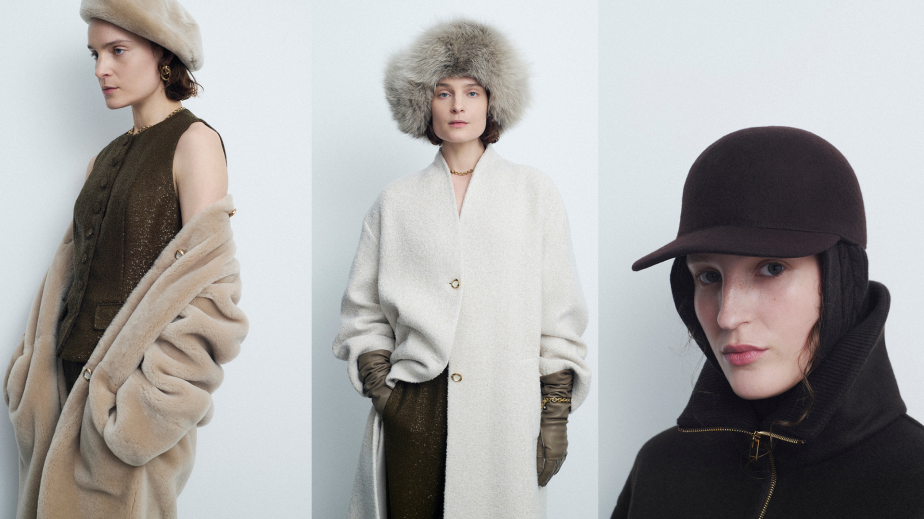
At Milan Fashion Week, Agnona presented a collection centered on tactile materials like shearling, wool and technical cashmere. The presentation was well-timed, with the company preparing to open a new flagship store in Milan next month, a move the brand sees as crucial to its next phase of growth.
“Today, you can find a fantastic cashmere sweater at Uniqlo,” Stefano Aimone, CEO and creative director of Agnona, said after the presentation, noting how widely available the fiber has become across the market. Rather than criticizing mass retailers, Aimone said the comment reflects a broader change in the market: cashmere, once a marker of luxury, is now available across a wide range of price points.
For Aimone, the challenge is no longer simply making great cashmere, but also proving that the brand offers something beyond that, from product innovation to a more immersive retail experience.
For its Milan Fashion Week presentation, Agnona recreated the atmosphere of an English garden at dawn, with frost-covered plants surrounding the collection to emphasize the tactile qualities of the garments. The brand’s recent collections have experimented with fabric innovations including double-construction cashmere, bouclé textures and a water-resistant “RainWeaver” cashmere designed to combine softness with weather protection.
Founded in 1953 in Borgosesia in Italy’s Piedmont region, Agnona began as a wool mill producing luxury fabrics from cashmere, lambswool and angora for couture houses including Christian Dior, Givenchy, Yves Saint Laurent, Balenciaga and Chanel. The company later expanded into ready-to-wear while maintaining its focus on fibers such as cashmere, vicuña and alpaca.
Those materials remain central to the identity of the Biella textile district, the northern Italian manufacturing hub where companies like Agnona, Zegna and Loro Piana built global reputations for luxury wool and cashmere production. According to data from Reuters, Italy produces around 50–55% of the world’s luxury goods, relying on a dense network of small specialist manufacturers.
For decades, Agnona was closely tied to the Zegna ecosystem. The Ermenegildo Zegna Group acquired Agnona in 1999 as part of its strategy to expand beyond textile production into luxury fashion. A new chapter began in 2020 when Stefano Aimone and his father, Roberto Aimone, purchased 70% of the company from Zegna.
Aimone, the great-grandson of Zegna founder Ermenegildo Zegna, stepped in as CEO and creative director. Before taking over Agnona, he built his career across European fashion houses and textile groups. “I always worked in menswear, from Dolce & Gabbana to Antwerp, to the Vanity Fair Group in Switzerland, and then at Zegna,” he said.
The acquisition allowed him to shift focus. “I wanted to complete my career exploring womenswear,” Aimone said. “That world is much more creative, much more challenging.”
When Aimone took over five years ago, the focus was rebuilding the collections, the team and the production base in the Biella textile district. “There have been years of rebuilding,” Aimone said. “We didn’t necessarily want to push revenue right away. Because if you go out to market without a solid product, you risk ruining everything you’re trying to achieve.”
Growth now will depend in part on entering markets like China, the Middle East, Latin America and the broader Asia-Pacific region, where the brand has historically had limited presence. Agnona generates more than 90% of its sales internationally, with key markets including South Korea, the United States and the U.K., while Germany, Austria and Switzerland remain important European markets.
Today, Agnona generates just under €15 million in annual revenue, or roughly $16 million, with plans to reach €20 million, or about $22 million, within the next three years as the brand expands internationally as reported by AFP.
That scale places the company far below the category’s largest players. Loro Piana, widely considered the global leader in noble-fiber luxury, generates well over €2 billion (about $2.3 billion) annually, according to estimates. “We don’t want to become as big as Loro Piana,” Aimone said. “They are delivering fantastic quality. But we want to stay small.”
The brand still produces entirely in Italy, reflecting the brand’s longstanding commitment to the country’s textile craftsmanship. “At Agnona, everything originates in the material,” Aimone said.
Cashmere remains a cornerstone, but the collections also incorporate noble fibers such as vicuña, alpaca, wool and silk sourced through specialized global supply chains. Vicuña comes primarily from Peru and is one of the rarest natural fibers in the world, Aimone said, while premium cashmere is sourced from Mongolia and Inner Mongolia.
Loro Piana, widely considered the global leader in noble-fiber luxury, has emphasized rare materials such as vicuña and baby cashmere while investing in direct control of fiber sourcing. Brunello Cucinelli has similarly positioned its brand around Italian craftsmanship and artisanal production, emphasizing the value of “humanistic craftsmanship” rather than focusing solely on cashmere. And previous Agnona owner Zegna has also doubled down on material storytelling through initiatives such as Oasi Cashmere, which focuses on traceable fiber sourcing and vertically integrated production.
Price positioning reflects Agnona’s place within the upper tier of Italian luxury. Its cashmere knitwear typically ranges from about $800-$1,500, while outerwear and double-face cashmere coats can exceed $4,000 depending on fiber composition and construction.
Distribution remains largely wholesale, with Agnona selling through partners such as Harrods and online luxury platforms including Farfetch and Ssense, alongside its own e-commerce.
The next phase for the brand focuses on direct retail. The new Milan flagship opening next month will mark the brand’s first step toward building a closer relationship with consumers.
The store is designed less like a traditional boutique and more like an immersive brand environment, according to Aimone. Its HQ space in Milan combines the showroom, archive and atelier, allowing visitors to see fabric books, sketches and prototypes alongside the finished collections. “When people step in, they can really enter our world,” Aimone said, noting that guests are able to watch tailors working in the atelier.
A greenhouse-style rooftop space in the HQ hosts workshops and small community events, from hand-knitting to plant-based craft sessions. “It’s not only about showing the product,” he said. “It’s about sharing the culture and values of the brand, too.”
That Agnona customer, Aimone said, values subtlety over logos and is interested in craftsmanship. “They appreciate quality and heritage,” he said. “They study how a garment is made and where it comes from.”
Designers across the industry say customers increasingly recognize material quality instinctively. “When you buy really good quality pieces, you immediately feel it,” said Oleksandra Liakh, the founder of Ukrainian label Roksalana, in a separate interview about premium wool and cashmere.
Running a small luxury house today also means navigating growing pressure within Italy’s manufacturing ecosystem. Aimone said consolidation among suppliers has intensified since the pandemic, with fewer mills and workshops handling increasing demand from global luxury groups.
The scrutiny comes as Italy’s luxury manufacturing system faces growing legal and regulatory pressure. In 2025, a Milan court placed LVMH-owned cashmere brand Loro Piana under judicial administration after investigators found labor abuses at subcontracted workshops in its supply chain, part of a broader series of probes involving brands including Dior, Armani and Valentino.
For Agnona, that pressure reinforces its long-term philosophy. Rather than chasing scale, Aimone sees the brand’s future in slow growth rooted in textile expertise. “The essence of Agnona lies in the material,” he said. “Precious, enveloping, tactile.”
Robert Marc turns to DITA founders to lead next design chapter
Luxury eyewear brand Robert Marc is embarking on a new design era as it approaches its 45th anniversary, appointing John Juniper and Jeff Solorio, founders of the high-end eyewear brand DITA, as its new designers, launching their first collection for Spring 2026. The collection, dubbed Volume 1: The Feeling Remains, debuted March 5.
The move is part of a broader repositioning effort. The company is dropping “NYC” from its name, aiming to push beyond its reputation as a New York optical cult favorite to build a more global luxury eyewear brand. The brand is owned by Canadian optical group New Look Vision, which operates about 34 luxury optical stores across the U.S. and previously handled design in-house under Luxury Optical’s creative leadership.
“[The designers’] work is grounded in a personal connection to the brand and deep knowledge of luxury eyewear,” said Antoine Amiel, CEO of New Look Vision Group and Robert Marc. “This new design era reflects our spirit of reinvention and a shared vision for the future.”
Juniper said the focus is on sharpening the brand’s existing strengths rather than reinventing it. Robert Marc’s strengths lie in its optician-led design, recognizable hinge detail, decades of brand credibility and craft-driven materials like buffalo horn and Japanese acetate. “With 45 years of history, Robert Marc has something rare, with credibility and brand value built over time,” he said.
The new frames feature Japanese acetate, titanium and hand-carved buffalo horn, continuing the brand’s focus on small-batch production and craft.
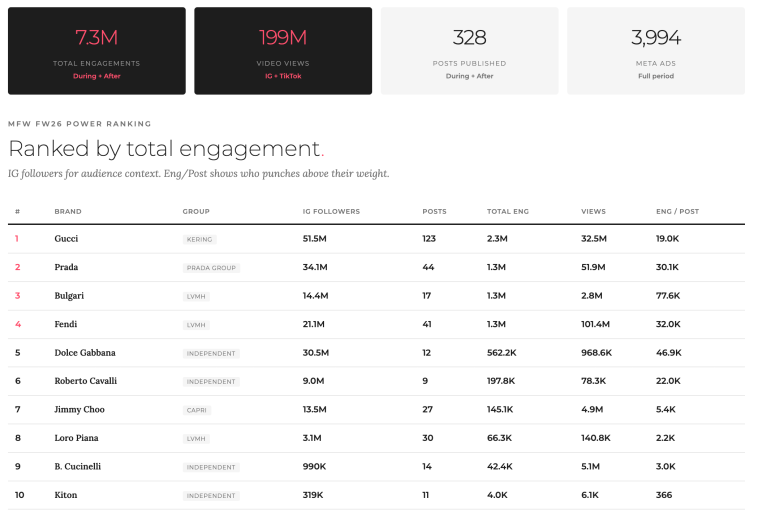
Who won Milan Fashion Week? Results shared from luxury’s first data integration layer LuxuryIQ MCP by DLG
Results shared by DataLab Group through its LuxuryIQ MCP data integration layer show which brands generated the most online visibility and engagement during Milan Fashion Week, which wrapped earlier this week.
Gucci ranked first in total engagement with 2.3 million interactions across 123 posts, while Prada generated nearly the same engagement (1.3 million) with just 44 posts, indicating more efficiency per post. Bulgari stood out for performance efficiency, delivering 77,600 engagements per post — the highest in the ranking — despite publishing only 17 posts and having a smaller audience than Gucci and Prada.
The buyer’s take on Dior at Paris Fashion Week
Dior’s runway show on Wednesday earned praise from retailers. According to Simon Longland, director of fashion buying at Harrods, “This marks Jonathan Anderson’s fifth show for the house and his second for women’s ready-to-wear, and, for me, it is his strongest collection to date. What was particularly compelling was the sense of true alignment between designer and maison. You could feel a genuine harmony in how the codes of Dior were interpreted and evolved.”
He added that the collection “struck a delicate balance: romantic yet modern, soft yet assured. It is at this point that a designer moves beyond introduction and begins to define a legacy within a house.”
Earnings
- On Thursday, Prada Group reported 8% organic revenue growth for the full year of 2025. Growth was driven by strong demand for Miu Miu, which grew 35%, while the Prada brand remained broadly stable in a challenging luxury market. The company expects continued but more normalized growth in 2026, with Miu Miu slowing after several years of rapid expansion and Prada returning to modest growth. Meanwhile, Prada has begun integrating Versace, planning to reposition the brand toward full-price sales and tighter distribution as part of a long-term turnaround. “During the last three to four years, the [luxury] industry has lost something like one consumer out of five,” Andrea Guerra, CEO of Prada Group, said during the earnings call.
News to know
- Microsoft-backed OpenAI is scaling back direct in-app purchases in ChatGPT, shifting checkout to external apps integrated with the platform after facing challenges with real-time merchant data and transaction safeguards.
- Martine Rose has canceled production of her Fall 2026 collection despite strong wholesale orders, citing circumstances beyond her control, as disruptions ripple through Tomorrow Ltd., the platform backing her brand. The situation has also led Coperni — another Tomorrow-backed label — to cancel its planned Paris Fashion Week show due to logistical and production challenges. This comes amid leadership turmoil at Tomorrow following the reported departure of chief executive of brands Alessandra Rossi this week.
- Christine Hunsicker, founder of fashion rental platform CaaStle, pleaded guilty to securities fraud after admitting she falsified financial statements from 2019-2025 to inflate the company’s revenue and attract more than $300 million from investors.
Listen in
On this week’s London Fashion Week edition of the Glossy Podcast, international fashion reporter Zofia Zwieglinska speaks with Mytheresa chief buying director Tiffany Hsu about the Fall 2026 collections, including highlights from Burberry, Simone Rocha, Erdem, and emerging designers Daniel Del Valle and Stevo Smith. Listen here.
Read on Glossy
Fashion brands are feeling the effects of the war in the Middle East. On launched a pair of leggings to rival Lululemon. Creator marketing is evolving with a loyalty layer.