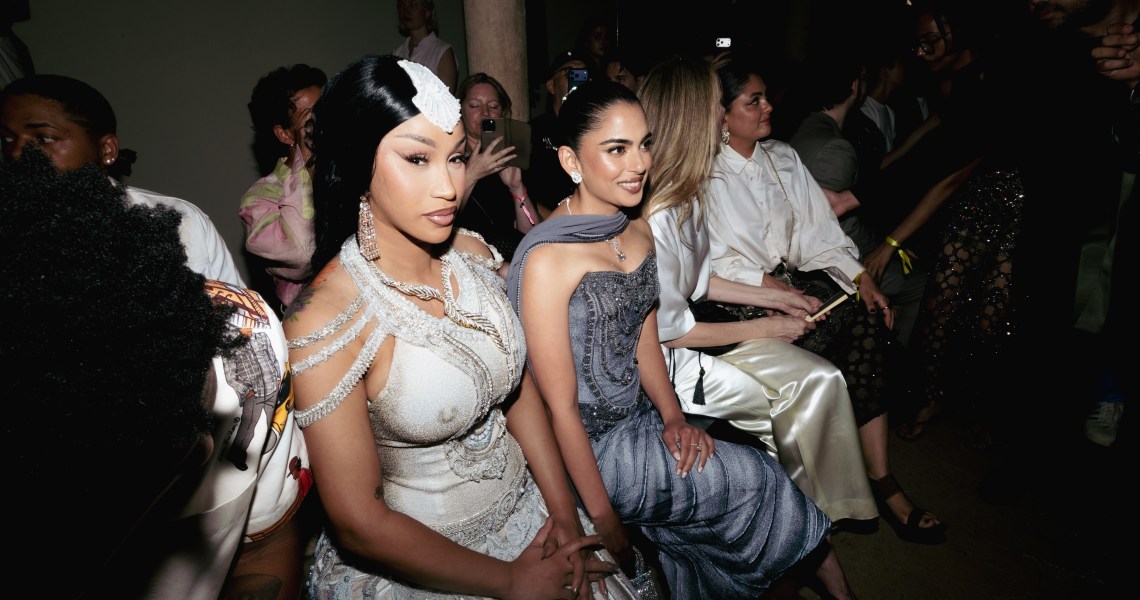
In this week’s Luxury Briefing, Glossy digs into Haute Couture Week in Paris with luxury sourcer Gab Waller, concierge specialist Isabel Bazzani, designer Rahul Mishra and Bain senior partner Federica Levato — the brands taking part are increasingly looking to younger customers as their next long-term clients, the sources said. Also, why Pandora and Levi’s chose the event to launch new collaborations, and executive moves at Tory Burch. For tips or comments, email me at zofia@glossy.co.
At Paris Haute Couture Week, which ran from Monday to Thursday, the runway dresses may have been designed for only a small pool of clients. But in a luxury market where shoppers are becoming more selective, the value of couture increasingly extends beyond the gown.
The personal luxury goods market fell to $419 billion in 2025, or €358 billion, down 2% in current-currency terms, according to Bain & Company’s latest luxury report. Bain expects the market to grow 2-4% this year, while luxury experiences continue to outperform goods.
Buying couture represents a significant step up from off-the-rack products, even for an established luxury client. While top-end ready-to-wear pieces can cost $15,000-$30,000, couture at the major houses typically starts at around $50,000 and can exceed $800,000 for the most elaborate creations, according to previous Vogue reporting.
A client is not only buying a garment when they decide to buy couture; they are entering a world of show invitations, private appointments, direct access to designers, fittings, customization, exclusivity and long-term service. Previous reporting has found that houses may alter runway designs around a client, develop entirely private commissions or restrict the same look from being sold to another customer in the same region. And the scarcity of couture has become more valuable as even once-elusive luxury products have become increasingly visible.
That does not mean the most theatrical runway looks are the ones clients actually buy. “The looks that show up all over our feeds aren’t necessarily the ones filling appointments,” said luxury sourcing and concierge specialist Isabel Bazzani. She said more wearable pieces, including Ashi Studio’s hourglass bustier and skirt and Jonathan Anderson’s Dior separates, have generated more immediate orders because clients can already imagine wearing them to a wedding, gala or private event.
Bain found that luxury consumers are becoming more selective and less forgiving of weak products or service. “The appetite for luxury remains strong. The tolerance for disappointing experiences or products does not,” said Federica Levato, Bain senior partner and co-author of the report.
Meanwhile, for a maison, a relationship with a couture client can also lead to their spending across ready-to-wear, jewelry, handbags and accessories, and can provide insights for future collections.
This season, luxury sourcing expert Gab Waller is most clearly seeing a heightened interest in couture around Chanel. Matthieu Blazy presented his second couture collection for the house this week. His first ready-to-wear collection for Chanel, which debuted in October 2025, was widely praised as one of the strongest debuts of the season, while the house has since said Blazy’s designs are helping attract new shoppers and supporting a return to growth.
“Ever since Matthieu Blazy came in, it really has been absolutely transformative for my clients’ sourcing requests,” she said, pointing to a surge in inquiries around Chanel shoes, handbags and runway pieces.
“Couture is surprisingly not a huge area for the sourcing industry, because the clients don’t necessarily need us,” Waller said. “They go directly [to the brand].”
But some recent inquiries appeared to come from clients new to couture. Rather than immediately requesting a commission, they asked what pieces may cost and how access worked, Waller said.
Once a client moves forward, the runway look is only the starting point. Bazzani said pricing is typically disclosed during a private appointment after the show or re-see, when measurements are taken and potential changes are discussed. “The final garment often evolves through the many changes to colour, cut, materials, neckline or embellishment,” she said. That process can continue for months and may change again after the toile fitting, before final production begins.
India-based Rahul Mishra, who presented his 14th collection during Paris Haute Couture Week, is seeing a similar evolution in the client base. “Although couture will always remain a very small and specialized clientele, we continue to see steady growth,” he said.
His clients now come from the U.S., Europe, the Middle East, China, Korea and India. Mishra said more French clients also commissioned pieces during the house’s latest Paris re-see.
In addition, both Waller and Mishra are seeing younger clients invest in the category. Waller said some of the youngest clients attending couture shows are now in their early to mid-30s, rather than the more traditional 40-50-year-old customer. Bain, meanwhile, found that U.S. consumers under 35 are increasing their luxury spending around four percentage points faster than older shoppers.
“What is changing is the profile of the first-time couture client,” Mishra said. “Increasingly, we see women choosing couture earlier in life for reasons beyond ceremonial occasions.”
For many, the first step into couture may not be a dress. Waller said her younger clients are most interested in Chanel’s couture shoes and handbags, including the collection’s beanstalk-inspired footwear and novelty bags.
Those products can act as an entry point into the wider couture world. A ready-to-wear client may first attend a show, buy an accessory tied to the collection and later move toward private appointments or a full commission.
“I’m not necessarily seeing clients spend less; they’re simply becoming more selective,” Bazzani said. Rather than purchasing across multiple houses, many are concentrating their budgets on fewer pieces that feel exceptional, personal and collectible. She is also seeing continued interest in high jewellery and one-of-a-kind creations that promise lasting value.
Mishra said his couture commissions typically range from $20,000-$50,000, while highly exclusive bespoke pieces can exceed $200,000. “Clients today are investing more thoughtfully, but often more meaningfully,” he said. “Increasingly, couture is being acquired not only as clothing, but as collectible art.”
That reflects Bain’s finding that luxury consumers are becoming more selective and conscious of value, even at the top end of the market. Luxury experiences are also growing 1.5 times faster than luxury goods.
For Mishra, that has meant designing some runway looks as separates that can be styled in multiple ways. “For today’s woman, the value of couture lies in its ability to be both an heirloom and a living part of her wardrobe,” he said.
The service surrounding the garment is also important for the designer. Mishra’s atelier offers lifetime aftercare and restoration, while the designer remains personally involved in many client journeys. “Long-term loyalty is earned through trust, exceptional craftsmanship and an experience that feels deeply personal from the first sketch to the final fitting,” he said.
For houses, the return extends beyond the commission. Mishra described couture as the brand’s “research and development laboratory,” with its techniques and ideas later feeding into its ready-to-wear line AFEW Rahul Mishra, as well as jewelry and accessories.
As consumers demand more meaning, service and emotional connection, the haute couture collections and shows are becoming an even more useful way to pull high-spending clients closer. As Waller put it: “It truly is the admiration of it all. It shows respect and admiration of the brand.”
It helped that the couture calendar this week was refreshed by a wave of debuts, including Pierpaolo Piccioli’s first couture collection for Balenciaga, Duran Lantink’s couture debut at Jean Paul Gaultier and Manish Malhotra’s first appearance on the official Paris schedule.
How Pandora and Levi’s are tapping Couture Week’s cultural cachet
Couture Week’s commercial value increasingly extends beyond the houses on its official schedule. The surrounding calendar has become an important marketing platform for accessible global brands seeking to borrow from Couture’s fashion authority and the week’s buzz.
Pandora used the week to debut Pandora Wonders, an ongoing initiative centered on a series of limited-edition product capsules that launched with pieces by stylist Harry Lambert. The collection, centered on freshwater cultured baroque pearls and priced from approximately $102 (€89), is being sold in limited quantities through Pandora and Dover Street Market, alongside a Café Nuances takeover in Le Marais.
“We are not ‘showing’ in a traditional way at Couture; we’re instead popping up in a fun and unexpected way,” Pandora CMO Jennie Farmer told Glossy. The project is designed to build fashion credibility around the mass-market jeweler, while keeping prices accessible. Pandora Wonders will continue through future “acts,” or collections, each focused on a different material.
For its part, Levi’s used the opportunity to unveil a 10-look project with Christelle Kocher that reworked its familiar denim silhouettes using pearls, feathers, pleating and other couture techniques.
Executive moves
- Tory Burch has appointed Klitos Teklos as chief brand officer, a newly created role overseeing global brand strategy, visual merchandising, social media and marketing.
News to know
- Fashion and luxury stocks fell on Wednesday, as renewed U.S.-Iran fighting raised fears of a prolonged oil shock, weaker tourism and slower consumer spending, while the IMF cut its global growth forecast to 3%. Capri CEO John Idol also said Middle Eastern tourists are already traveling and shopping less in Europe and the region, adding pressure as he works to rebuild Michael Kors and Jimmy Choo through lower prices, fewer products, and store and marketing investments.
- Hugo Boss urged shareholders to reject Frasers Group’s approximately $43.45-per-share offer as too low, arguing its existing strategy offers greater long-term value.
- Marine Serre has entered receivership after client defaults strained cash flow, with court protection intended to restore liquidity and finance its next collection.
- This week, the British Fashion Council urged the incoming U.K. government to increase investment in fashion, citing rising costs and limited funding. It also announced subsidized London studio space with the charity King’s Foundation, noting that the mayor’s office has invested nearly $1 billion in the creative sector over the past decade.
Read on Glossy
Garage is getting in front of Gen Z mall-shoppers by launching stores. On is betting on nearshoring and robots to scale its Lightspray franchise. How Bandit Running is expanding internationally while staying hyperlocal.