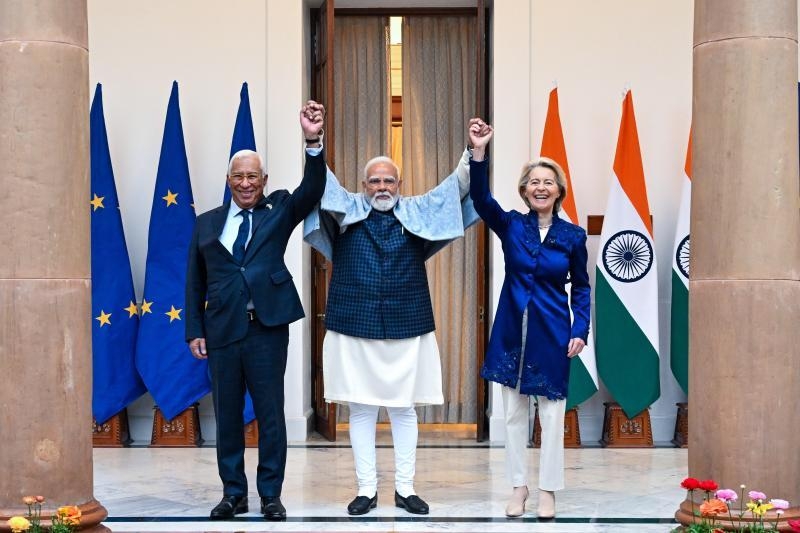
This week, we take a look at a historic new trade deal between the E.U. and India, one of several major deals being signed between nations and regions without U.S. involvement.
They’re calling it “the mother of all trade deals.”
A new agreement between the European Union and India — which together represent nearly 2 billion people — is on the verge of being finalized, as of January 27, and multiple industries are starting to process just how much the deal will shake up global trade.
The deal would reduce tariffs on nearly 97% of E.U. exports to India and 99.5% of Indian exports to the E.U. Estimates put the savings for European firms at over €4 billion in duties alone, and E.U. analysts expect exports to India to double by 2032. Notably for the fashion industry, categories like textiles, jewelry and leather goods are all expected to have tariffs cut to zero.
Experts told Glossy that the fashion industry stands to see big gains from this deal, in both directions. In fact, Maria Pechurina, director of international trade at Peacock Tariff Consulting, called the textile industry “undoubtedly the leading beneficiary of the new agreement.”
Pechurina said the E.U. currently imports around $125 billion worth of textiles from India annually.
“European fashion brands — fast-fashion, mid-market, and private-label — will have increased capacity for sourcing from India due to these cuts and will see an immediate reduction in landed cost, boost in sourcing flexibility and increase in negotiation power,” Pechurina said. “European manufacturers, however, will enter a more competitive environment, as the production of price-sensitive, basic garments and home textiles may be squeezed by the volume of duty-free Indian imports.”
Many of the world’s largest fashion companies manufacture at least partially in India. That includes fast-fashion brands like H&M and Zara, mass brands like Gap, athletic brands like Puma and Adidas, and luxury brands like Fendi and Gucci.
Trade between India and the E.U. already stands at $136 billion, as of 2025, which eclipses the $132 billion trade relationship between India and the U.S. But the new deal is likely to widen that gap even further.
In addition to reducing expenses for European brands that manufacture in India, it will also encourage those same brands to target the Indian consumer, according to Mark Burstein, vp of Americas for the supply chain management company Inspectorio.
“The impact of this deal will be felt across several groups, but perhaps the most notable impact will be on European fashion brands looking to expand their presence in India,” Burstein told Glossy. “The removal of tariffs and trade barriers will make it easier for European brands to enter the rapidly growing Indian market, which is seeing a rising middle class and increased demand for high-quality, branded apparel. This opens up a great opportunity for European brands to expand their footprint without the additional cost burden of import duties.”
According to a report from Euromonitor International last year, India is one of the fastest-growing luxury consumer markets in the world, just ahead of the United Arab Emirates and slightly behind South Africa in growth percentage. Last year, the luxury market in India was estimated at $12 billion.
The deal comes at an obviously troubled time for international trade. President Trump’s approach to negotiations, including threatening European allies with explicit tariffs and implicit military force, has sent many other nations seeking new trade agreements that reduce reliance on an increasingly unpredictable U.S.
In addition to the deal with India, the E.U. is also in the midst of signing a similarly large-scale trade deal with Mercosur, a coalition of Latin American countries including Brazil, Argentina, Paraguay and Uruguay. That deal is currently being reviewed by the European Court of Justice. But if passed, it would similarly cut tariffs between the two regions. The E.U. has also signed trade deals with individual countries like Mexico and Indonesia in the year since Trump’s inauguration.
Since Liberation Day in 2025, when the Trump Administration enacted sweeping tariffs on countries around the globe, more trade deals have been struck without U.S. involvement. India has signed deals with Britain, New Zealand and Oman, while Canada has been courting further trade deals with China.
“The United States is being seen more and more as an unreliable trade partner in just about every sector, and countries are shuffling their assets to secure business elsewhere while simultaneously detoxing from their U.S. relationships,” said Jarvis W. Jefferson, an assistant professor of fashion merchandising at Virginia Commonwealth University.
Pechurina said the flurry of trade deals between other nations and regions is a direct consequence of the U.S. attempt to reshape global trade.
“Countries are seeking to reduce reliance on both the U.S. and China, pursuing access to other consumer markets and sourcing pathways,” Pechurina said. “Expect more trade deals that can meet this dual objective to come down the pipeline.”
Stat of the week
Numerous luxury brands reported earnings this week, with a modest Chinese luxury recovery being one of the common threads. LVMH saw a 1% increase in Chinese sales, which, while small, marks a stabilization and return to growth for the region.
Glossy’s Zofia Zwieglinska reported last week that another European luxury brand, Burberry, is also seeing double-digit growth among Chinese Gen-Z shoppers.
News to know
- Paris Couture Week is in full swing, and shows from Matthieu Blazy at Chanel and Jonathan Anderson at Dior have already emerged as two of the buzziest.
- Sydney Sweeney launched a lingerie brand this week called Syrn. A publicity stunt involving her hanging bras on the Hollywood Sign was reportedly done without the permission of the Hollywood Chamber of Commerce.
- Phia, the AI-powered fashion discovery app founded by Phoebe Gates, received another $35 million in investment funding this week. It joins other well-funded AI-centric fashion startups like Daydream in securing investor interest.