Stanley’s latest fashion collaboration with Brazilian fashion brand Farm Rio nearly achieved its four-week sell-through target in seven days. But for the 113-year-old drinkware company, the more consequential test will take six months.
Stanley 1913, part of PMI WW Brands, LLC, is increasingly tracking what collaboration products customers purchase after the initial drop. The strategy is part of its effort to convert the limited-edition demand that fueled the Quencher phenomenon into a broader lifestyle business.
The Quencher once represented more than 80% of Stanley’s global product mix, according to the company. Today, it accounts for around 40-50%. While the handled tumbler remains its top-selling silhouette, Stanley is expanding across café products/, fitness products, coolers, lunch bags and backpacks.
“We look at how those consumers who are acquired through that collaboration come into the brand and what they do after they’ve purchased,” said Kate Ridley, chief brand officer of PMI WW Brands, LLC (Stanley 1913) in an interview. “We generally don’t measure that in the first couple of weeks. We look at it over a six-month time horizon.”
Stanley 1913’s collection with Brazilian fashion brand Farm Rio launched globally on August 18, spanning Quenchers, bottles and a soft cooler in three tropical prints. The range, priced from $55-$155, reached nearly 50% global sell-through during its first week, according to Stanley. Six of its 10 top-selling products that week came from the collaboration, despite minimal paid-media support.
Sell-through exceeded 50% in North America, Canada, EMEA, Brazil and Argentina. The Tropical Woods print reached almost 100% global sell-through in less than a week.
The response comes as Stanley expands its distribution and product assortment outside North America. “We’re still seeing amazing growth momentum, even as we scale,” Ben James, Stanley’s general manager for EMEA, told Glossy. “We’re finding new distribution points and new channels of distribution.”
That performance exceeded Stanley’s expectations. Products tied to an individual celebrity, such as Olivia Rodrigo, typically feature one silhouette and are expected to sell out within 24-72 hours, Ridley said. Stanley had expected the wider Farm Rio assortment to sell through over approximately four weeks.
“It was very pleasantly surprising to us that we had such an immediate response,” Ridley said. “We need to have enough inventory that the presentation can stay live for at least a couple of weeks.”
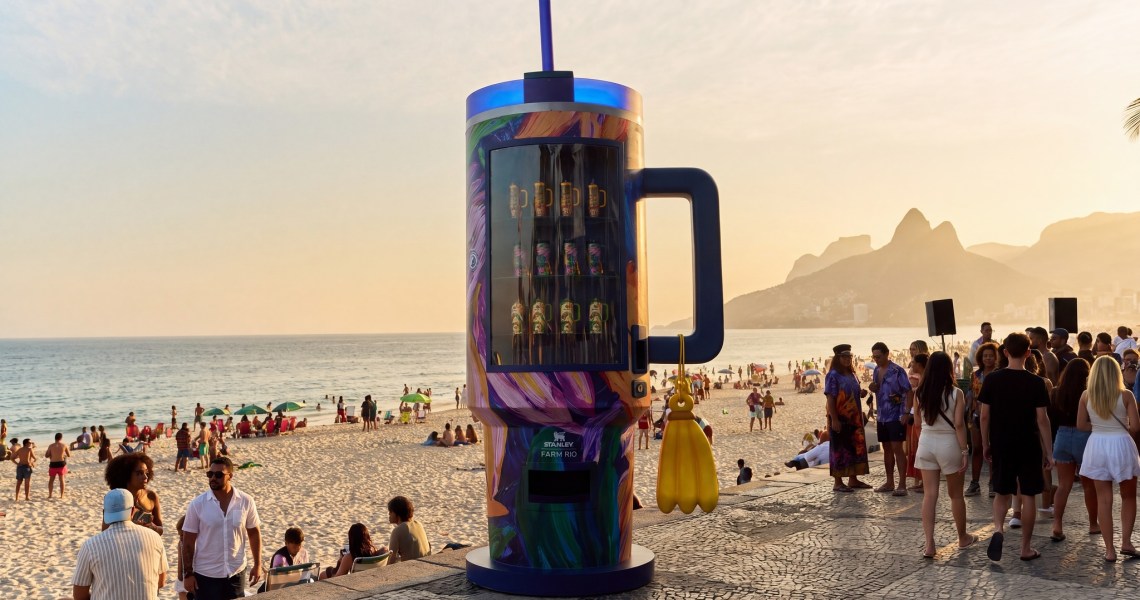
Stanley supported the launch with events in New York, where products sold out within hours, and a Rio de Janeiro beach activation centered on a Quencher-shaped vending machine. The collaboration accumulated 12,500 “Notify Me” registrations across Latin America ahead of its release.
Unlike Stanley’s partnerships with musicians and athletes like Post Malone, Olivia Rodrigo and Lionel Messi, Farm Rio was not primarily intended to introduce the brand to a new demographic. Instead, the companies wanted to strengthen their relationships with overlapping communities interested in color, design and self-expression.
The partnership also arrived at a pivotal moment for Farm Rio. Last week, its parent company, Azzas 2154, announced plans to break up the group following disagreements between its controlling shareholders. Farm Rio is expected to become an independently managed, privately held company jointly owned by Alexandre Birman and Roberto Jatahy; Morgan Stanley is exploring a potential partnership or sale.
For Stanley, the longer-term test will be whether Farm Rio customers return for Stanley’s permanent product assortment. Ridley pointed to the company’s Post Malone collaboration as an example.
The partnership attracted male customers and stronger demand from Europe and Asia-Pacific than Stanley expected. Over the following six months, the company found that those shoppers were particularly interested in its café products.
“We saw a big uplift in how our café products were selling with that cohort,” Ridley said. “We use those collaborations as an entry point into the brand, and then learn more about those customers and what they’re interested in.”
Stanley will promote its expanded assortment through a holiday campaign launching in late October. But as it attempts to recruit customers beyond its existing fan base, the company is also reconsidering a tool it has historically used sparingly: discounts.
“I don’t think there’s an inverse relationship between being a premium brand and discounting,” Ridley said. “There are times throughout the year that consumers just expect it.”
Stanley sees promotions as an entry point for shoppers reluctant to spend around $50 on a water bottle. Like collaboration customers, those shoppers are grouped into cohorts so the company can measure whether they return and what they subsequently purchase.
The company also coordinates offers with wholesale and marketplace partners, including Amazon, sometimes pairing a promotion with an exclusive product. However, Ridley said Stanley remains in a “discovery phase” because it has not historically depended heavily on markdowns.
“We are not a very promotional brand. We don’t do it very often, and we recognize that, in the future, we could probably do more of it,” she said.
Shopping periods are also starting earlier, with some U.S. retailers now requesting back-to-school assortments in June. Holiday and Black Friday promotions are stretching in the same direction. However, Stanley’s testing has found that demand loses momentum after the opening days of an offer, creating a tension between extending promotional windows and preserving urgency.
“On one hand, there’s the opportunity to extend,” Ridley said. “On the other, there’s the need to drive urgency related to a shorter time frame.”