This week, we take a look at the American brands descending on Pitti Uomo in Florence. As the European consumer faces a tougher economic outlook and looks to spend less on fashion, affordable American brands have an opportunity to expand into the European market.
Pitti Uomo, the annual menswear trade show held in Florence, is meant to show off the best of Florentine and Italian tailoring. But this year, multiple Americans have a presence.
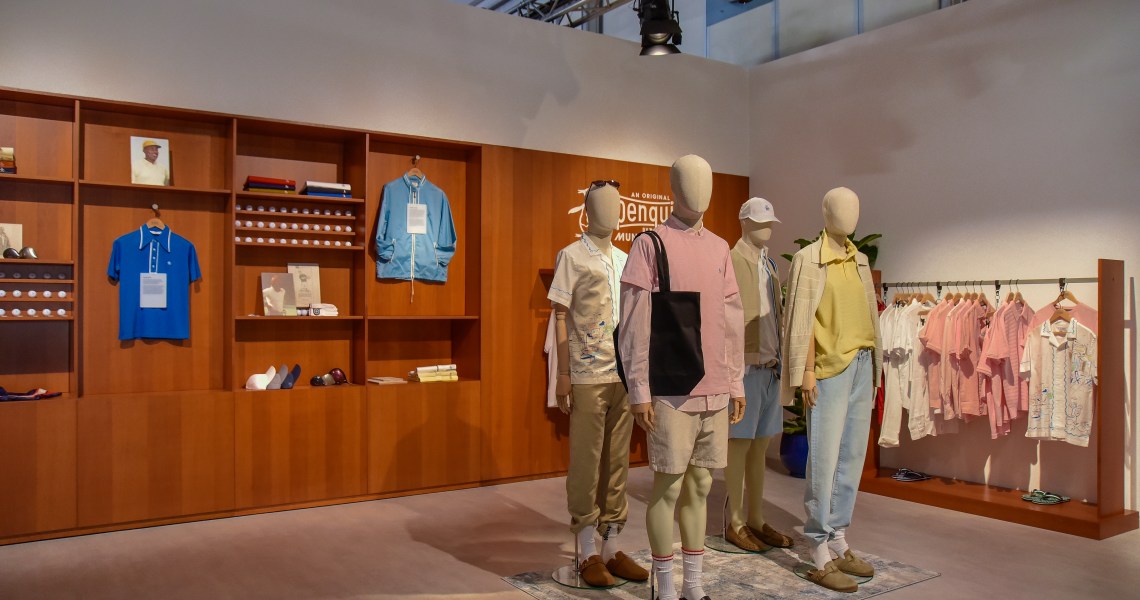
Original Penguin, a 70-year-old heritage menswear brand based in Miami and owned by Perry Ellis International, has returned to the Pitti stage for the week after a nine-year break from showing in Florence. Ralph Lauren and Thom Browne, two more American heritage brands, have also returned to the show for the first time in several years. In addition, Dover Street Market, the New York-based clothing store, had the honor of its own brand, DSM Kei Ninomiya, being named the second guest designer for the year, alongside Irish designer Simone Rocha.
While Pitti has been becoming more global and less focused on Europe over the last two years, the influx of American brands is notable. It comes at a time when American brands are seeking expansion abroad and European consumers are seeking more affordable options. Michael Miille, who became creative director of Original Penguin in 2024, said there’s an appeal to both classic American sportswear and American-inspired streetwear that is finding an audience at Pitti this year.
“I believe there’s something about the ease of American sportswear that people are interested in,” Miille said. “One of the most searched tags on TikTok for men’s fashion is ‘#oldmoneystyle,’ which is very effortless and casual, and that’s tied to an ease that is often expressed by American brands.”
Pitti is part of Original Penguin’s efforts to expand its European business by appealing to European and global retail buyers attending the show. While it already has a presence in North and South America, as well as a few Asian nations like Japan and the Philippines, Miille said Europe and the Middle East are key growth regions. In April, Original Penguin opened a new showroom in London, with more permanent and pop-up stores planned for countries like Spain, Switzerland and Italy later this year.
The brand now has a presence in more than 1,200 multi-brand retailers and 96 of its own stores. Both Original Penguin and Perry Ellis International are privately held. Revenue at Original Penguin grew by single digits last year. Perry Ellis’ total revenue is close to $1 billion annually.
Miille said that the desire for men’s clothing that is comfortable and effortless was on display at Pitti, with many more brands showing streetwear, sportswear and casual clothes, compared to Pitti’s traditional focus on tailoring. Original Penguin brought experimental pieces like denim golf pants, where the pattern was laser-etched rather than stitched, along with a swim collection. Meanwhile, collections from the South Korean designer Jiyong Kim and the Danish brand Sunflower showed off sun-weathered denim and loose, unbuttoned looks.
Miille attributes this shift, in part, to the international fashion consumer trading down in their spending. While many luxury brands have narrowed their focus to the highest-spending consumer, there has been a general shift toward value. Original Penguin sells suits in the $500-$600 range, for example, while its golf gear can be as low as $90 for a pair of pants.
Rafaello Napoleone, a board member of Pitti Immagine in charge of international relations, said that the last few years, between tariffs and economic crises, have had a drastic impact on the global fashion scene.
According to Boston Consulting Group, more than half of European consumers are worried about their daily personal finances, up from 40% two years ago, and are spending less on categories like handbags and accessories. The European economy has been particularly hit hard by fuel prices rising by as much as 10%, putting a damper on consumer spending. That pessimism presents an opportunity for affordable American brands looking to expand internationally.
“There is a serious crisis in the international order, which is clearly reflected in the economy and particularly in trade and global mobility,” Napoleone said. “We see its impact clearly, especially in the fashion sector. In the trade fair sphere, all this is translating into changes in the way operators participate and into a consequent reduction in operating margins, inevitably leading to the need to control costs while seeking new opportunities.”
Stat of the week
The shipping logistics company Descartes provided Glossy with data showing that imports to the U.S. from ports affected by the closure of the Strait of Hormuz fell 93% in May. In May 2025, 1.5 million tons of cargo came from these ports to the U.S., but last month that had fallen to just over 100,000 tons.
Now, with an alleged peace deal on the line, those ports may start to reopen. But the situation in the Strait will be far different, with shippers likely having to pay larger fees to the Iranian government for its use.
News to know
- The French department store BHV is ending its relationship with Shein. Shein opened its first physical store at BHV Marais last year, drawing sharp criticism from both consumers and government regulators over its labor and environmental practices.
- Lululemon issued an apology for a press event at the Great Wall in China, which was billed as highlighting traditional Chinese culture. The set dressing included a taiko, which is a traditional Japanese drum, provoking anger on Chinese social media.
- Dolce & Gabbana is reportedly considering selling some of its real estate portfolio to refinance its debt. In April, the brand confirmed that it was in negotiations with creditor banks to alleviate some of its debt, which exceeds $500 million.