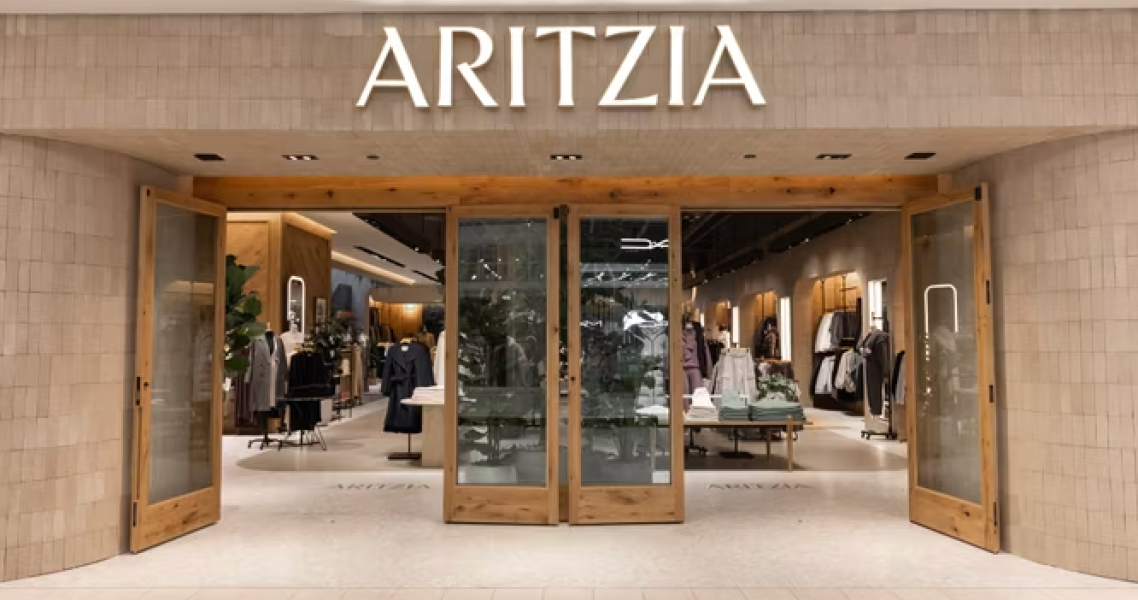
Aritzia’s new U.S. stores are lifting online sales for the brand. At Aritzia’s new store in St. Louis this weekend, teens shopped in groups, mothers browsed with daughters, and customers moved between racks of white dresses, denim, linen separates and soft tailoring. The store follows Aritzia’s now familiar retail language: pale stone floors, warm wood, low tables, lounge seating and generous fitting-room areas.
Together, Aritzia’s recent store openings in new U.S. markets, including St. Louis, as well as Birmingham, Fort Worth and New Orleans, have had a desired effect for the brand. According to Aritzia’s chief digital officer, Margot Johnson, opening a boutique in a new market like St. Louis produces a “strong and sustained lift” in digital sales in that region, in the high double digits. That dynamic is central to Aritzia’s U.S. expansion strategy as the Canadian retailer pushes into more cities beyond its earliest U.S. strongholds of New York, California and Chicago.
It presents a strong case for opening stores at a time when retailers are scrutinizing the profitability of new locations. According to Johnson, for consumers, stores are increasingly becoming the first brand touchpoint. Johnson said a new boutique raises awareness in the market, brings in new clients and then helps drive local digital sales.
In the last 12 months, Aritzia opened 14 new boutiques and repositioned four existing stores. In fiscal 2027, it plans to open another 12-13 boutiques and reposition four to five more. On the company’s latest earnings call, executives said the next wave of stores spans Atlanta, Dallas, Fort Worth, Cleveland, Las Vegas, Florida, The Woodlands in Texas and Carlsbad, California.
“What’s most notable today is the level of awareness and demand we’re bringing into new markets,” said Jennifer Wong, CEO of Aritzia, told Glossy. “Through growing brand affinity, we’re entering cities with a stronger connection to the brand already established. As a result, our boutiques are performing right out of the gate.”
Aritzia has previously said it sees potential for 180-200 boutiques in the U.S. In fiscal 2026, the U.S. boutiques it opened were tracking to pay back in less than a year, ahead of the company’s 12- to 18-month target, according to Wong.
The company’s financials support a more aggressive rollout. For the fourth quarter of fiscal 2026, Aritzia reported record quarterly net revenue of $1.2 billion, up 33% year-over-year. U.S. revenue increased 38% to $755 million, while digital revenue grew 29% to $488 million. Digital represented 41% of net revenue in the quarter. On the earnings call, leaders said the company had reached its fiscal 2027 revenue target a year early.
The U.S. opportunity is becoming less concentrated in coastal fashion markets. Aritzia’s next wave of openings includes cities outside the markets that have historically anchored premium-apparel growth, suggesting the brand is seeing enough demand to justify a broader national push.
“In new markets specifically, what’s encouraging for us is that the new clients that come to us stay with us, which has been our model for decades,” Wong said. Wong pointed to existing brand affinity, pre-opening demand and customer retention as factors supporting the rollout.
The expansion also suggests that Aritzia’s core assortment — defined by tailoring, outerwear, fleece, dresses and other “Everyday Luxury” categories — is resonating across markets. “Our assortment has resonated extremely well across all regions,” Wong said.
Digital is helping create that demand before stores open. Over the past year, Aritzia has expanded its digital ecosystem, including through the launch and growth of its Aritzia app, which saw a million downloads in December. The company is also working to connect the path from discovery to purchase, whether a customer first encounters the brand through digital shopping, a boutique, marketing or a creator. As stated on its earnings call, the brand is doing this through full-funnel marketing, the Aritzia App, affiliate and influencer programs, SMS, and AI-driven search improvements. Once a boutique opens, that awareness turns into store traffic, while the physical store gives customers another reason to shop online.
The growth comes as apparel companies continue to manage tariff pressure. For its part, American Eagle said its second-quarter outlook included a $20 million incremental tariff headwind, while Abercrombie & Fitch forecast around 120 basis points of year-over-year tariff pressure in the second quarter.
But, in the fourth quarter, Aritzia expanded gross margin despite pressure from tariffs and the suspension of the de minimis exemption, helped by lower markdowns, initial markup improvement, occupancy leverage and tighter merchandising and allocation, Wong said on the earnings call.
The company is also making moves in the acquisition space. Aritzia announced the acquisition of the L.A.-based casualwear brand Fred Segal on February 19, with terms not disclosed. The deal included the Fred Segal brand, intellectual property and trademarks, plus a lease for its original 29,000-square-foot Melrose Avenue flagship. The acquisition gives Aritzia another way to build relevance in a key U.S. market.
“Fred Segal offers another platform for cultural engagement in Los Angeles, grounded in its legacy as a defining force in shaping L.A.’s stylistic and cultural identity for decades,” Wong said.