For much of the last decade, independent fashion brands could scale with little more than a Shopify site and a social following. But that model is breaking down.
Tariffs, tighter enforcement of de minimis rules and the collapse of once-reliable retail partners are pushing brands toward platforms that can shoulder operational complexities. That includes Wolf & Badger, a 16-year-old marketplace focused on emerging designers.
The U.K.-based marketplace now receives 300-400 inquiries per month from brands looking to sell through its channel, according to the company. Brands accepted onto the platform are vetted for product quality, design-led differentiation and supply chain practices, and pay a annual fee of under $1,800 (which works out at $150 per month compared to the previous price of $400 per month), with Wolf & Badger taking a commission on each sale. The company works with just under 2,000 brands globally and generates roughly $100 million in gross merchandise value, with the U.S. now accounting for around 55% of its customer base.
That momentum reflects the evolving landscape of fashion retail. Within the last year, multi-brand retailers Saks Global and Ssense filed for bankruptcy, while Matches closed down in 2024, though it has since signaled a potential return. Together, the disruptions have underscored how fragile even well-known fashion platforms have become. For independent brands, the fallout has reinforced the need for diversified and lower-risk routes to market.
According to Wolf & Badger CEO and co-founder George Graham, speaking with Glossy during Shoptalk Luxe last month, “The routes to market are becoming fewer and far between.”
“Twenty years ago, there were plenty of amazing wholesale accounts, with boutiques and department stores looking to bring a wider mix of new brands and products to their customers,” he said. “But actually, those department stores played it increasingly safe. And, sadly, some of them are disappearing.”
While Graham did not single out Saks Global by name, he said moments like the company’s bankruptcy tend to accelerate brand interest in alternative retail models.
“At different periods, where it’s been a more challenging economy or the consumer space has had difficulties, we see more demand from brands,” he said, adding, “And that’s something we’re seeing now.”
Specifically, many brand founders are seeking out collaborative retail partnerships, rather than passive marketplace exposure. That includes Wolf & Badger, said Bank Innegern, founder of Mulgaro, a design-led label focused on small-batch leather accessories. “The team is really responsive, and that has pushed me to put more care into how Mulgaro shows up on the platform, from refining our listings to creating exclusive pieces,” he said.
Maria Kalavria, founder, head of design and CEO of Altra-Volta, a contemporary womenswear brand with a focus on sustainable materials, echoed the sentiment. “What stood out for us was the curation and the way they support independent brands,” she said. “Onboarding was straightforward and well structured, and it’s given us visibility with an international community that actually feels aligned with what we’re doing.”
According to Graham, many independent labels respond to wholesale contraction by doubling down on their direct-to-consumer business. Kalavria from Altra-Volta confirmed that direct-to-consumer has become more important for her brand. But, he said, the strategy has become increasingly difficult to sustain alone.
“They got onto Shopify. They paid their $10 a month. They set up a site. But they’re increasingly finding that customer acquisition costs are going up and they need more in-house expertise,” he said. “Then, when they do generate an order, shipping internationally and seeing duties being applied to a U.S. customer — if it’s a U.K. or European brand, for example — poses [financial] challenges that are near insurmountable for a smaller-scale brand.”
Recent changes to de minimis thresholds and enforcement have compounded those challenges. As of last August, de minimis is no longer applicable in the U.S.
According to Jackson Wood, director of industry strategy for global trade intelligence at the supply chain software firm Descartes, many small brands are now confronting supply chain complexity they were previously insulated from. “One of the things that was very good about de minimis was that it simplified supply chains for small businesses to the degree that has allowed the explosion in e-commerce that we’ve seen,” Wood said. “But what it also did is give companies a little bit of a false sense of confidence that supply chains are easy.”
For brands caught between unstable wholesale partners and increasingly expensive DTC growth, Wolf & Badger positions itself as a hybrid alternative. The platform handles cross-border logistics, duties and returns on behalf of brands, while also providing marketing support, discovery tools and operational infrastructure. Unlike traditional wholesale, brands do not take on upfront buy-ins, seasonal markdown exposure or inventory transfer risks.
For some brands, Wolf & Badger has become a way to replace lost department store volume or test U.S. demand without setting up local fulfillment, staffing or paid acquisition campaigns, according to Graham. Its collective structure, Graham said, has become increasingly valuable over the last year as trust and discovery fragment across social platforms, AI-powered search and emerging shopping agents.
“Individually, these brands might enrich their data or integrate technology through Shopify,” Graham said. “But the shopper or the agent won’t necessarily know which brands to trust. They won’t know if the quality is there or if it will arrive on time. But we [act as a collective group of trusted brands].”
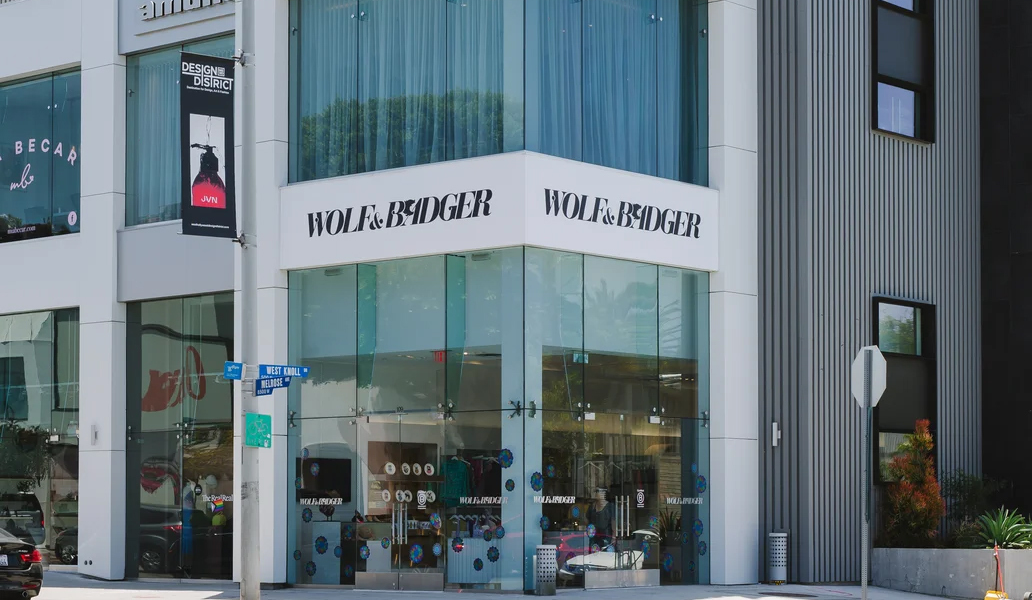
Physical retail is a critical part of that trust layer. Wolf & Badger operates stores in London, New York and Los Angeles — Graham described them as brand-building anchors rather than transactional showrooms. “First and foremost, the stores remain a human touch point,” he said. “They’re places where shoppers can come and engage with the brands we carry.”
Those stores host frequent meet-the-maker events, where designers interact directly with customers, personalize products and explain their production processes. QR codes and in-store education tools connect the physical experience back to the online marketplace, allowing Wolf & Badger to bridge channels. “It’s important to lean into that tangible, tactile nature of coming to a shop: trying things on, discovering something new and having fun,” Graham said.
Wolf & Badger sits alongside a growing set of alternative retail and marketplace models, including Faire, Garmentory and The Folklore, that are increasingly stepping in where traditional wholesale and lightweight DTC models fall short.
Looking ahead, Wolf & Badger plans to expand while deepening its position in its core markets. The company continues to scale in the U.S. while pushing further into Europe, and it is seeing early organic traction in parts of Asia and the Middle East, including Japan and South Korea. Graham said flagship stores in select cities remain a longer-term possibility as those markets mature.
Despite the opportunity created by retail disruption, Graham was careful not to frame consolidation as a win for alternative platforms. “Overall, we’d like to see a healthier and more robust consumer environment where brands can flourish in a number of different ways — not just have to rely on platforms like us,” he said. “But in the meantime, we’re here to help.”