Lunar New Year is about a week away, and fashion brands are going all in on the Year of the Horse.
The holiday is celebrated by about 2 billion people globally, from across East and Southeast Asia to the vast diaspora communities in the U.S. This year, brands like Miu Miu, Le Vian, Levi’s, Jil Sander and Burberry have debuted Lunar New Year capsule collections, collaborations and campaigns. In China, the Lunar New Year almost always correlates to a spike in retail spending, with 2025 seeing a 5% spike in the month of February. As the East Asian consumer markets of China, Japan, South Korea, and Singapore have become more important to Western fashion brands, the Lunar New Year is serving as a way for brands to appeal to that growing segment of their audience.
Le Vian, a centuries-old jewelry company, debuted a collection this month themed around all things equestrian, and featuring horseshoe and horseshoe-bit motifs set with turquoise and gold. When CEO Eddie LeVian was doing his trend forecasting last year, the team identified both Lunar New Year and the trend toward Americana and westernwear as moments Le Vian should capitalize on.
“The equestrian theme plays a big role in the past and present of the U.S., and it represents the lunar calendar,” LeVian said. “It was a natural way to tie those two themes together.”
Le Vian’s revenue is in the mid-nine figures, LeVian said, and while its main markets are English-speaking countries like the U.S. and the U.K., it is distributed globally in more than 2,700 stores including East Asia. LeVian said the Lunar New Year collection is meant to appeal to both consumers in those markets and to many people whose families celebrate Lunar New Year in the West. It is being marketed through Le Vian’s regular channels, including Instagram and influencer gifting.
Stephanie Callahan, co-founder of the apparel brand Find Me Now, which she launched with her mother Su Pask in 2020, said that cultural mixing is a big part of her own Lunar New Year collection.
Find Me Now released a collection titled “Lunar Carnaval” on February 4 that combines Callahan’s Korean and Brazilian heritages. The Brazilian holiday of Carnaval often falls on or near the Lunar New Year in mid-February.
“It’s very personal,” Callahan said. “It’s our opportunity to have this moment tied to our heritage, and it’s a time of year when we can celebrate the complexity of our identity through the brand. And that’s something that’s hard to do all of the time.”
Find Me Now does most of its business in North America but also sells internationally in markets like Hong Kong. Callahan, who lived in Hong Kong for five years, said the fashion customer in the East Asian and specifically the Chinese regions has grown accustomed to the presence of Western fashion brands, and there is far more competition for that market now than there has been in previous years. To market the collection, Find Me Now partnered with companies including the skin-care brand Superegg and the matcha brand Nami Matcha for a joint Instagram giveaway.
“The novelty [of Western brands] will always be there, but it definitely hit a peak 5-10 years ago,” she said.
Roots is one such Western brand with a long history in the East Asian market. It was one of the first Western brands to sell in Taiwan more than 30 years ago, according to the brand. Today, it has more than 100 partner-operated stores in Asia and a Roots storefront on Tmall in China.
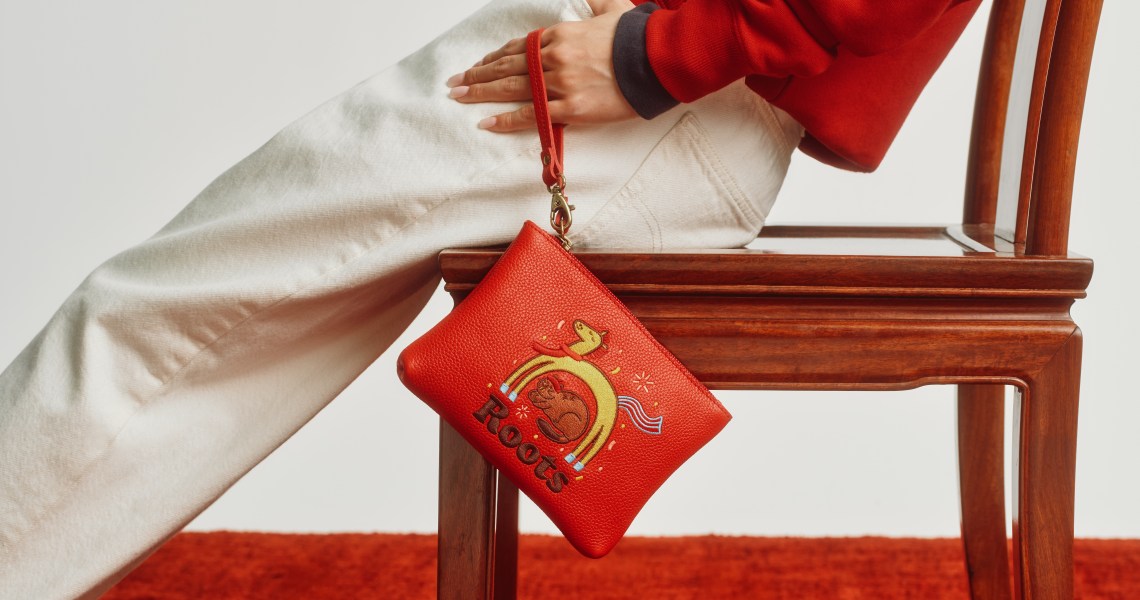
For this year’s Lunar New Year, Roots similarly emphasized cross-cultural diffusion by partnering with Chinese artist Sun Jiayi, who went to school in Canada. The pair created a collection primarily of knitwear and accessories featuring Sun Jiayi’s illustrations of a horse, representing the holiday, and a beaver, both Roots’ logo and a symbol of Canada. Roots is promoting the collection on its socials and has been posting video interviews with Sun Jiayi as part of the marketing rollout.
Roots CEO Meghan Roach told Glossy that the collection represents both Roots’ interest in selling in Asia directly as well as the diversity of its Western markets. According to a 2021 Census, nearly 20% of Canada’s population is of Asian descent. Roots’s most recent quarter, ending on November 1, saw its revenue grow to $71.5 million, a nearly 7% increase from the same period last year, driven in part by strong sales in China and Taiwan.
“We always try to be authentic to the region and what’s relevant to those markets,” Roach said. “We have done collaborations before. We’ve worked with [Hong Kong actor] Edison Chen, and our last biggest Lunar New Year collection was for Year of the Tiger [in 2022], which we did on our own without a collaborator. But we have employees from China, Taiwan and other Asian markets, and we’re proud of the diversity of our home.”
Roach echoed the idea that the novelty of Western brands appealing to Asian markets has worn off.
“In the last five years, you see a lot more domestic brands gaining popularity in China, like Anta [the Chinese activewear conglomerate which recently took a stake in Puma],” Roach said. “These domestic brands are doing a really good job of representing the local market, and the customer there is much more sophisticated than they were before. It’s changing rapidly.”
Despite a slowdown in Chinese spending on fashion and luxury in recent years, the last quarter shows that China remains a growth opportunity for fashion brands. Burberry cited interest from young Chinese consumers as helping to animate its recent resurgence, including a 6% increase in sales in China and double-digit growth among Gen-Z shoppers. In January, LVMH said its Chinese sales were recovering after several months of decline.
Roach said that, as China continues to hold appeal for Western companies, brands need to step up their game to compete.
“There are some great Lunar New Year collaborations this year,” she said. “Some brands are doing it in a way that reflects the local market, others are just assuming they know what those markets want. But there are a lot of domestic brands that are doing well, and it speaks to the fact that that consumer has a much stronger voice now.”