Glossy+ Research is your destination for in-depth, data-driven analysis at the intersection of fashion, beauty, and retail. This exclusive category delivers actionable intelligence on the industry’s most pressing topics—from evolving consumer behaviors and digital marketing strategies to the impact of tariffs, supply chain shifts, and emerging design talent. Stay ahead with exclusive briefings, expert commentary, and proprietary research that empower brands, marketers, and executives to make informed decisions. Whether you’re seeking the latest on advertising innovations, e-commerce trends, or the business implications of cultural moments, Glossy+ Research provides the clarity, context, and foresight you need to navigate a rapidly changing landscape. Unlock the competitive edge with Glossy+ Research—where industry leaders turn for trusted insights and strategic guidance.
Data for this index was collected by Dash Social
Table of contents
Introduction
As creator marketing becomes a fixture in many brands’ marketing strategies, creators’ roles are shifting and expanding. Brands may pay creators to produce sponsored content, gift products to them in the hope of organic posts, or rely on a combination of creator- and brand-produced content published on their own social media accounts.
Overall, social media remains the leading channel for creator partnerships: 96% of respondents to Glossy’s first-quarter survey of brands and agencies said they partner with creators to create social media content. Within social media, Instagram (90%), Facebook (80%), YouTube (72%) and TikTok (63%) were the platforms marketers said they used most.
Across these social platforms, brands are taking various approaches to creator campaigns, from sponsored and gifted posts to content formats like product demonstrations, styled photos and event coverage. Understanding how these approaches perform can help brands make informed decisions about creator partnerships, content formats and campaign investment.
To measure the impact creator content has on brand campaigns, Glossy+ Research analyzed the engagement levels on leading creators’ social media campaigns from January to September 2026.
Methodology
The Glossy Creator Marketing Index collected data from 1,755 social media posts and 20 branded social media campaigns, analyzing the top posts associated with each campaign’s hashtag and scoring them across a set of key dimensions to create a total index average score. Results are dependent upon the list of social media campaigns and the time period of data collection, generating a snapshot of the creator marketing landscape at a specific moment in time.
Glossy’s Index collected social media data from January to September 2026. Due to data restrictions, TikTok views were not captured. Data collection was conducted by Dash Social, an agentic social platform powered by brand-intelligent AI.
The social media campaigns were selected by Glossy’s editorial team.
Platform performance varies across Instagram, TikTok and YouTube
When considering video content performance by platform, Instagram Reels received far more video views than YouTube’s Shorts and long-form videos, while TikTok videos had higher average engagement in later analysis. However, these results should be considered within the context of the Index’s focus on branded social media campaigns, meaning that the majority of posts included marketing-focused content rather than non-brand-related content, which performs the best on YouTube. Additionally, on YouTube — a video-first platform with a core strength in long-form content — most of the captured posts consisted of Shorts rather than long-form posts.
Average engagement rate — engagement divided by follower count — was only measurable on Instagram. When looking at average engagement rate by format type on Instagram, Reels performed the best among Instagram’s formats at an 11% engagement rate, underscoring the strength of short-form video on Instagram. Still posts came in second with a 7% engagement rate, followed by Carousel posts at 5%. Carousel posts can contain videos, but views were not counted as part of the average engagement rate for Carousel posts with video. Likewise, views were not counted as part of the average engagement rate for Still posts or Reels.
The top 75 posts associated with each campaign’s hashtag were identified based on overall engagement, including likes and comments across platforms. When Glossy analyzed those top-performing posts by platform, with engagement weighted equally across platforms, Instagram accounted for the largest share of posts associated with campaign hashtags.
However, TikTok posts within the top 75 generated higher average engagement than posts on other platforms. In other words, Instagram appeared more frequently among the highest-performing posts overall, while the top-performing TikTok posts generated greater engagement on average.
According to Glossy’s analysis, Instagram is a more consistent platform for performance, while TikTok has greater reach potential and a higher engagement ceiling. For brands running longer campaigns or prioritizing consistency, Instagram offers a more predictable environment for creator marketing. For smaller brands or those with limited budgets, TikTok is likely the better platform choice for creator marketing. While engagement on TikTok isn’t as consistent, its higher engagement ceiling gives creator content a better possibility of reaching a wider audience.
Product demos perform well under specific circumstances
Looking more closely at sponsored and gifted posts, the Index defines them as follows. Sponsored posts refer to content created through a direct partnership between a brand and a creator. Gifted posts feature products that brands have sent to creators, typically as part of a PR effort, without a paid content agreement. Glossy classified posts as sponsored or gifted based on disclosures in captions, including paid labels, disclaimers, and hashtags such as #ad, #paid, #gifted and #PR. In some video posts, creators verbally expressed whether they had been paid by a brand.
The most common content types across both sponsored posts and gifted posts were product demonstrations and style shots. The Index defines a demo as content about a single brand or product that includes a description and shows a person using the item. A style shot is content that showcases a product in a scenic or visually styled setting without an explanation of how to use the item.
Style shots appeared more frequently in gifted posts than they did in sponsored posts, by a ratio of 19 to 15, indicating that creators favor that format when featuring products they have received for free without a formal content agreement. One possible explanation is that demos can appear to be overtly promotional since they feature one product as opposed to a “get ready with me” (GRWM) format that typically showcases multiple brands. Creators may want to avoid producing content that could be interpreted as advertising when it comes to gifted items, according to Glossy’s analysis.
When comparing average engagement rates, sponsored posts outperformed gifted posts across content types, with one notable exception: demos — the most used content format type — where gifted posts performed best. Style shots displayed the opposite pattern, performing better in sponsored content where they also delivered the highest overall engagement among the content formats analyzed.
One potential factor behind this difference is the level of production and associated costs behind the content. Gifted style shots were often simple flat lays or product images, while sponsored style shots frequently included product videos. Brands often give creators larger budgets to develop content for sponsored product posts. That distinction is particularly important for product categories like fragrance, where brands rely on visual storytelling to communicate abstract qualities like mood and sensory experience.
While engagement provides a strong measure of how audiences respond to creator content, reach — calculated by average views — offers another important metric of performance. Glossy’s analysis found that sponsored posts had greater overall reach based on views than gifted posts, by a margin of 334,055 to 48,008. Within sponsored posts, style shots (707,646), demos (250,764) and influencer events (231,595) had the most views. Among gifted posts, demos generated the most views (81,023), well below sponsored formats.
That margin of difference is likely also linked to budget differences, according to Glossy’s analysis. Brands typically provide creators with paid media budgets to amplify sponsored posts beyond a creator’s existing audience, while gifted posts are limited to a creator’s own audience. As a result, sponsored content can generate both organic and paid reach, while gifted product content relies on organic distribution with more limited reach.
High-performing campaigns pair creator content with brand investment
This Index exclusively analyzes brand-generated hashtags that incorporated either a brand name or a trademarked product name, such as #exaggereyes, #chocolatesoleil and #hydroboost.
The majority of the highest-ranked campaigns had a strong social media presence with a significant number of brand posts on the brand-owned handle, in addition to creator posts. By contrast, lower-ranked campaigns had a weaker presence on brand-owned channels, with no brand-generated posts in many cases. These findings suggest that while creator participation is an important driver of campaign success, brands’ own social media activity also plays a critical role, according to Glossy’s analysis.
Many of the highest-ranked campaigns also included a mix of gifted posts and sponsored posts. Gifted posts came from both macro- and micro-creators, indicating that high-ranked campaigns sent products to a wide range of content creators. However, investment was another important factor. All of the highest-ranked campaigns had large budgets backing them, highlighting the growing role of pay-to-play social media campaigns, where brands must invest in both creator partnerships and amplification to build reach.
Not all campaigns with paid support performed equally, however, suggesting that investment alone does not guarantee stronger performance.
Case studies: High-performing campaigns take different paths
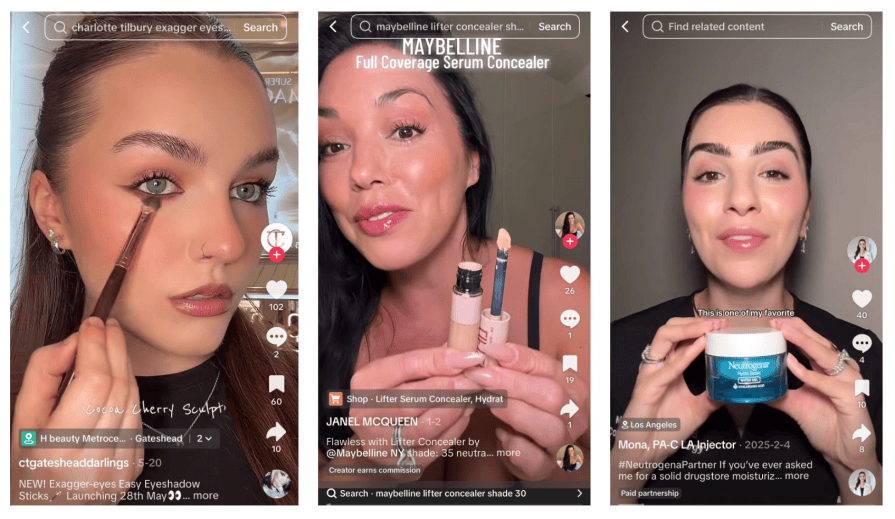
Charlotte Tilbury’s #exaggereyes campaign ranked No. 1 in Glossy’s Index. One of its defining characteristics was the use of gifted posts: 35% of the campaign’s posts came from creators who received gifted products, the highest share among the campaigns Glossy analyzed.
Charlotte Tilbury’s collaboration with Influenster, a product sampling and review platform owned by Bazaarvoice, generated a large portion of the gifted posts for the #exaggereyes campaign. Rather than selecting creators and sending them PR packages directly, the brand relied on Influenster to collect user-generated content for its own use. Most of the gifted posts were demo videos, a format that Glossy’s analysis found generated higher average engagement within gifted posts than sponsored posts.
Neutrogena’s #hydroboost campaign ranked No. 2 in the Index and focused on a product-line extension. Neutrogena heavily invested in sending gifted products and directly collaborating with creators. As a result, the Hydro Boost campaign had the highest share of brand-seeded content — sponsored or gifted posts — at 39% of all posts.
The campaign also incorporated the broader #hyaluronicacid hashtag alongside the branded #hyrdoboost hashtag. This strategy allowed Neutrogena to not only position the Hydro Boost product as a line extension but also connect the campaign to the larger hyaluronic acid product category, potentially exposing the campaign to audiences with a broader interest in hyaluronic acid products.
Like Neutrogena’s campaign, Too Faced’s #chocolatesoleil campaign promoted a product-line extension but with a focus on the Brazilian market. Thirty-four of the top 75 posts associated with the Chocolate Soleil campaign hashtag mentioned Brazil, including content from Too Faced’s Brazilian social media account and other Brazilian creator accounts, indicating a deliberate focus on localizing the campaign for that market.
The campaign also had the lowest share of sponsored or gifted posts among the 10 highest-ranked campaigns, with 74 of its top 75 posts classified as organic posts. Instead, the campaign focused heavily on the product launch and activity generated through Too Faced’s brand handle to entice creators to test the product and create content about it.
Taken together, these campaigns show that there is no single formula for a successful brand-generated hashtag campaign. High-performing campaigns combined product seeding, creator partnerships, brand-owned content, organic activity and localized strategies in different ways. According to Glossy’s analysis, brand-generated hashtags can give brands greater ownership of the campaign conversation, particularly when tied to a specific product or launch, but their narrower focus may limit the volume and variety of content generated around them.