Beauty consumers do not have an information problem; they have a discernment problem.
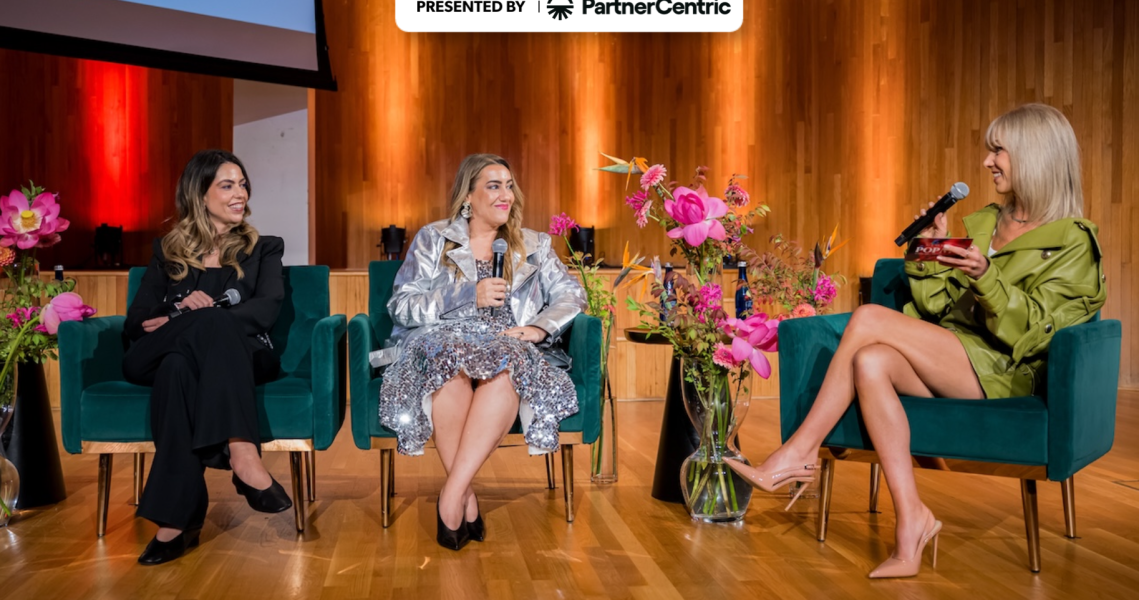
That was one of the central ideas from the Glossy Pop NYC panel earlier this month featuring Alexis Androulakis and Dr. Christina Basias Androulakis, the married couple behind The Lipstick Lesbians beauty education platform. The duo also discussed beauty misinformation, meaningful innovation and why better technology will make human expertise more valuable.
Alexis has worked across makeup artistry, product development and consulting, while Christina holds a Ph.D. in education and technology. Together, they have built a following of nearly 1.8 million by explaining how beauty products are formulated, packaged and marketed. The business now extends beyond social content into product-development consulting, professional speaking, and an eight-hour paid course covering the development of lip, cheek, eye and face products.
The Lipstick Lesbians grew out of Fempower Beauty, the lipstick company the couple launched in 2019. They invested between $500,000 and $1 million of their own money in the business before they ran out of funding. A TikTok account originally intended to market Fempower found a bigger audience after Christina began filming Alexis evaluating products in Sephora. The account gained more than 500,000 followers within its first year. Fempower closed in 2025 as the pair focused on education and content.
That background has shaped how the pair thinks about the expanding volume of beauty advice online.
“We are definitely more exposed,” Christina said during the panel. “There is more beauty content, more product and more advice coming at us than ever before, but access to information isn’t the same as understanding it.”
She encouraged consumers to question where a claim originated, who benefits from it and whether credible evidence supports it. Social platforms can complicate that process by rewarding definitive opinions about products that will inevitably perform differently for each user.
“Extreme opinions often receive the most attention, but attention and expertise aren’t the same thing,” said Alexis. “There can be pressure to declare that a product is either revolutionary or terrible, when the reality is usually much more nuanced.”
Alexis said creators need better access to the formulators, manufacturers and scientists working behind beauty products. Misinformation is not always deliberately deceptive. It can also expose gaps in the information available to creators expected to explain complicated products to large audiences.
AI could help consumers and creators summarize research, compare ingredients and prepare questions for experts. But Christina warned that it can also hallucinate or reproduce misinformation with convincing confidence.
“AI can support your research. It shouldn’t replace the research,” she said.
The technology may be particularly useful for personalization, provided shoppers give it enough context. Someone asking for the “best mascara” could want length, volume, curl, separation, longer wear or easier removal. The answer depends on both the person’s natural lashes and their preferred result.
But even a detailed digital profile cannot account for every emotional or physical element of beauty. Recommendations based on shade, skin type and purchase history may still miss how someone wants to look or feel.
“AI can recommend a lipstick, but it cannot tell you exactly how that lipstick will feel on your lips,” Alexis said. “Technology can help narrow the possibilities, but the human experience completes the decision.”
The pair is testing its own approach to consumer-led innovation through Leaked Labs, a direct-to-consumer brand launched in March. Its debut $34 product, Amplify Flexi Powder, replaced the traditional makeup pan with flexible pigment discs. Products are released in limited quantities, with customer feedback determining whether they are scaled, reformulated or archived. The first release is now listed as archived on the brand’s website. When asked about Leaked Labs’ performance and future, the founders did not disclose sales figures or provide details of upcoming launches.
That model offers a practical version of the beauty literacy the pair advocates: Consumers are not only told that something is innovative, but invited into the evaluation process.
In addition, with Leaked Labs, the founders are challenging the industry’s tendency to equate innovation with longer wear, bigger claims or elaborate packaging. “At a certain point, we don’t need 96-hour makeup,” Alexis said. Instead, she said, the brand is targeting thinner textures, dimensional finishes and formulas that create new sensory experiences, for example.
As AI agents become a more regular part of beauty research and shopping, the pair expects technology to get better at organizing information and narrowing choices. Its limit will be translating that information into an experience that feels personal.
“What should remain human is taste, storytelling, touch, intuition and connection,” Alexis said. “Beauty has never been only about correcting or optimizing something. It is about play, identity, emotion, and the way we connect with ourselves and one another.”