
This State of the Industry report, sponsored by Swap, explores how brands, retailers and agencies are adopting agentic commerce, including agentic storefronts, to enhance shopping experiences.
Artificial intelligence is the new entry point in e-commerce, as more shoppers rely on AI-powered summaries and assistants to discover products. Beyond discovery and product recommendations, AI agents are also helping shoppers evaluate options, make decisions and even complete purchases.
According to Salesforce data, AI and agents drove 20% of all retail sales and accounted for $262 billion in holiday spend during the 2025 holiday shopping season. To keep up, brands and retailers are implementing agentic tools to better personalize shopper experiences and drive growth. Others are rethinking the traditional e-commerce model from the ground up — shifting from static websites to agentic storefronts with conversational experiences that guide customers every step of the way.
For this new State of the Industry report, Glossy and Swap surveyed 80 brand, retailer and agency respondents to learn how they are adopting agentic tools. Ninety percent of respondents are already using AI to improve their consumers’ shopping experience, the survey found.
“Most people hear ‘agentic commerce’ and think about the discovery moment: how does my brand show up when someone asks an AI what jacket to buy?” said Juan Pellerano-Rendon, Chief Marketing Officer at Swap. “That’s a real and important question to surface in LLMs, but it’s only the entry point.
“What makes our first agentic storefront genuinely transformative is what happens after discovery. A real agent doesn’t just surface a product and hand the consumer off to a static website,” he said. “It understands context, it asks questions, it remembers what you looked for last time. That continuity is what changes the economics.”
As AI becomes more deeply embedded in everyday life, including e-commerce, new (sometimes similar) terms have emerged to describe different capabilities.
- AI agent: A tool that uses a large language model to browse and perform actions on the internet.
- Agentic AI: Refers to assistants that will be able to act autonomously without follow-up questions and user intervention.
- Agentic commerce: The ability to purchase goods or services with the help of an AI agent.
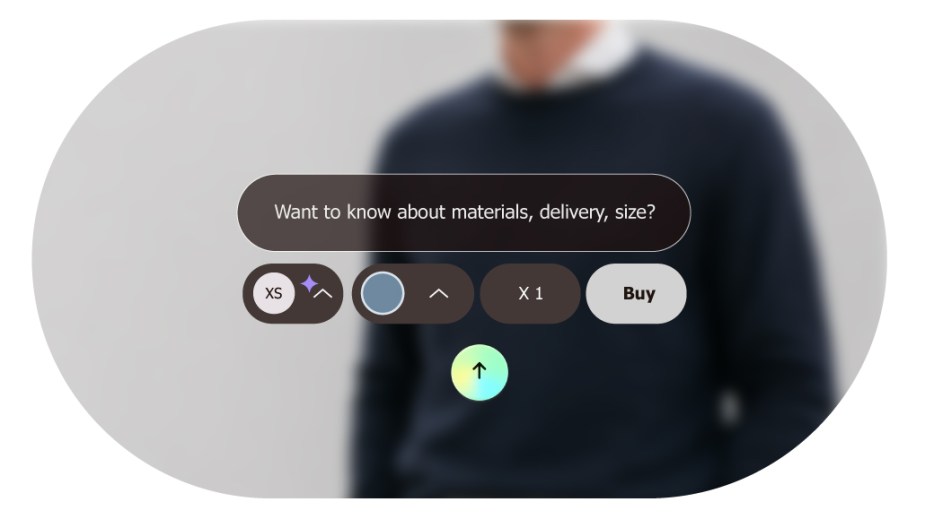
- Agentic storefronts: AI-native, immersive, conversational experiences that guide shoppers from discovery to purchase. Typically on a brand-owned .ai domain.

In 2026, brands and retailers are catching on and adapting their online presences in response to dramatic shifts in consumer use of AI — embracing the presence and even use of AI agents.
More than half of respondents (56%) are primarily using an internal agentic AI tool, while 33% are primarily working with third-party tech providers. Eleven percent are deploying their agentic AI tools through an about even split of internal tools and third-party providers.
Additionally, the majority of respondents (71%) report that their e-commerce sites are set up to be discoverable by AI agents. However, 20% are unsure if that is the case, while 9% do not have an AI-discoverable e-commerce site.
According to 2025 Glossy+ Research, more than 1 in 5 brand and agency pros said their companies have seen decreases in upper-funnel search traffic (37%) and lower-funnel search traffic (21%) as a result of AI.
“The window to get ahead of this is narrower than most brands realize,” said Pellerano-Rendon. “Discoverability in an agentic world isn’t just about SEO anymore. It’s about whether your product catalog, your brand context and your customer data are structured in a way that an AI agent can actually work with.”
Discovery is just one part of agentic commerce, however. As AI tools become more accessible to both consumers and businesses, they are becoming more ubiquitous across e-commerce sites themselves.
When it comes to engaging consumers via agentic AI, more than 4 in 10 respondents are doing so through AI-native/conversational product discovery (46%), in-chat purchasing (46%) and virtual try-on (41%). Brands, retailers and agencies are also using agentic AI to provide personalized recommendations based on user preferences (39%). Less common applications include voice-to-checkout (31%) and hyper-individualized homepages (30%).
Major players such as Google and Amazon have also introduced similar capabilities to reach consumers. As reported by Glossy, Google rolled out new shopping features throughout 2025, such as price comparisons and virtual try-ons, for its Gemini AI platform. In October 2025, Amazon launched its AI-powered “Help Me Decide” feature to give users recommendations on similar products based on their shopping history.
“Seventy percent of shoppers leave a site without buying, and a significant portion of that abandonment isn’t price or indecision; it’s friction,” Pellerano-Rendon said. “They couldn’t find the piece that matched the occasion, the fit, the aesthetic. When an agent closes that gap, when it understands you’re looking for something specific for a specific moment, conversion follows.”
Accurate and actionable data is essential for organizations to effectively inform their agentic AI tools. More than half are using core product attributes (56%) — such as product names, descriptions and materials — and review signals (54%) — including ratings and review content.
Other critical data sources include customer and payment data for checkout (45%), real-time inventory data (39%), shipping and return policies (39%), FAQs (38%) and current pricing and offers (36%). These point to the full-funnel use of agentic tools, from discovery and consideration through to purchase.
Additionally, 43% of respondents use existing brand content and communication guidelines, such as voice and tone, to inform their agentic AI tools — alluding to how brands and retailers are prioritizing the seamlessness of these tools and looking at them as an extension of their brand identity.
For instance, Gemma, Pandora’s AI sales agent, was developed to guide customers through emotionally driven conversations about gifting, relationships and memory. According to Glossy, Gemma narrows its recommendations based on its learnings, suggesting relevant jewelry and explaining how each option connects to the story, mirroring the guidance of an in-store associate.
Agentic capabilities compound across the funnel, Pellerano-Rendon explained, creating a continuous experience. Conversational discovery helps shoppers get oriented, while occasion-based recommendations deepen consideration and features such as virtual try-ons close the gap between interest and confidence.
“Each layer builds on the last, and the data from one interaction makes the next one smarter,” Pellerano-Rendon said. “Intent data, captured in real time, is the most underutilized asset in commerce right now. Traditional e-commerce generates click data.
“An agentic storefront generates conversation: what a customer asked for, how they described what they wanted, what they tried on and rejected before they converted,” he said. “That signal is infinitely richer, and most brands don’t have the infrastructure to capture it, let alone act on it.”
Beyond on-site chatbots, AI assistants and partnerships with external AI models, brands and retailers — as well as their partner agencies — are also experimenting with agentic storefronts. In this context, agentic storefronts are AI-native, immersive, conversational experiences that guide shoppers from discovery to purchase inside the brand’s own site.
“A .com and a .ai can coexist and serve meaningfully different experiences to different consumer segments,” Pellerano-Rendon said. “As AI becomes further embedded in daily life, the static website — a grid of products, a search bar, a checkout flow — will feel like the mall directory feels today. Functional, but not what you’d choose if you had a better option.”

Seventy percent of respondents are currently experimenting with or using an agentic storefront in some form, including 40% who are actively deploying an agentic storefront.
Another 23% are not currently testing or using an agentic storefront, but plan to within the next 12 months. Only 7% do not have current plans in this area.
Among those with significant investments in agentic commerce tools and/or agentic storefronts, 62% named improved brand discovery as one of their leading goals. Again, this reflects the impact and significance of shoppers’ changing discovery habits, away from search and social media toward AI search and assistants.
At least half of these respondents are also prioritizing increased conversions (57%), improved UX/personalization (56%) and lowered customer acquisition costs (50%). And while 43% are investing in agentic commerce and agentic storefronts with the aim of creating an entirely new revenue channel, their other priorities are sure to impact the bottom line — whether in the short term (reduced customer returns, 49%) or long term (increased customer loyalty, 47%).
As brands and retailers become more well-versed in agentic storefronts, however, they do anticipate some challenges. Chief among them are data requirements (57%) and measuring agentic storefront ROI (57%).
Measurement around agentic commerce has been cited as a challenge by major brands. For instance, Modern Retail reported that Fabletics lacks a sense of how many sales come from AI engines, though the activewear brand has enabled checkout within Perplexity and gets traffic from ChatGPT.
In the case of agentic storefronts running on .ai domains, however, Pellerano-Rendon advised that they may be more measurable than most brands expect. When these agentic storefronts run alongside a traditional e-commerce site, brands can directly compare metrics such as conversion rates, average order value, return rates and time on site between the two experiences.
Cost is another significant concern (46%) among respondents using agentic commerce. And while more than half of respondents (53%) are concerned about low consumer interest or trust in agentic storefronts, brand safety (35%) and diminished brand identity (35%) are seen as less significant challenges.
“The data we’re already seeing — 2x conversion rates, 3x time on site, 20% reduction in returns — tells us consumers do prefer the better option when they have access to it,” Pellerano-Rendon said. “The question for brands isn’t whether to make the shift. It’s whether to make it early enough to matter.”
Although only a minority of respondents are not using agentic commerce and/or storefronts, among this cohort, cost and bandwidth are the main obstacles to adoption.
While data requirements are anticipated to be a leading challenge among adopters of agentic tools, only 8% of non-adopters cited insufficient data or data quality as the reason for holding back their investment.
“One of the most common concerns we hear is that brands don’t know if their data is ready. The honest answer is, it doesn’t need to be perfect to start,” Pellerano-Rendon said. “What matters is that you own it. That ownership is the foundation on which everything else is built.”
Unsurprisingly, 42% of this cohort said they would need lower costs to adopt agentic AI commerce and/or storefronts. Similarly, 53% of current users said lower costs would accelerate their investment in the technology. Adopters and non-adopters alike also said technology improvements and more technical training would likely spur increased investment.
“What I would say to brands in the resistance or wait-and-see camp: the signal from shoppers is already unusually strong for something this early,” said Pellerano-Rendon. “Consumer engagement with agentic storefronts is moving faster than brand adoption. That gap doesn’t usually close in the brand’s favor. The category has early movers and everyone else, and the early movers are building a data and experience advantage that will be very difficult to close later.”
Regardless of whether they are currently using agentic commerce and agentic storefronts, the majority of respondents (88% of current adopters and 58% of non-adopters) predict their investment in this technology will increase over the next 12 months. This includes 25% of current adopters who expect to significantly increase their investment in agentic commerce and storefronts.
Ultimately, respondents’ bullish attitudes toward agentic commerce reflect market shifts that are already underway. Bain & Co. projects the agentic AI market could reach $300 to $500 billion by 2030, while McKinsey estimates that AI agents may generate as much as $1 trillion in U.S. retail revenue by the same year.
Even as predictions vary, the time for the beauty and fashion industries to prepare is now — according to Nielsen, 49% of consumers already receive beauty recommendations from generative AI as they seek more personalized shopping experiences.
“2026 is the year this goes from early adopter territory to a recognized strategic priority,” Pellerano-Rendon said. “You’ll start to see brands that launched agentic storefronts in the last 12 months posting results that are hard to argue with, and that will pull the rest of the market forward.”

The brands, retailers and agencies focused on agentic commerce now are ahead of the competition in terms of technology as well as data, Pellerano-Rendon explained. Agents learn through every customer conversation, try-on and occasion-specific request — continuously generating proprietary interaction data that makes the experience more precise.
“The brands getting the strongest results are the ones treating this as a product relationship, not a vendor relationship, iterating constantly, sharing feedback and letting the agent learn from real customer behavior,” Pellerano-Rendon added. “Our approach is always to build in close partnership with the brand. Every client we work with has a different catalog, a different customer, a different set of constraints. The agent needs to reflect that.”
For stakeholders getting started with agentic commerce and agentic storefronts, he recommended thinking beyond the constraints of a traditional static site to consider shopping experiences that will serve customers better.
“Commerce is shifting faster than it has at any point in the last two decades. The static website had a remarkably long run,” Pellerano-Rendon said. “What replaces it will be shaped by the brands willing to move before the mainstream catches up. The opportunity isn’t just to adopt a new channel. It’s to define what modern commerce looks like for your category before someone else does.”
About Swap
Founded in 2022 by Sam Atkinson and Zach Bailet, Swap built the first agentic storefront, replacing traditional static websites with immersive, agent-led commerce experiences that take shoppers from product discovery to virtual try-on to checkout in a single branded flow. Trusted by 800+ brands, Swap also provides best-in-class infrastructure, from cross-border, returns and inventory to tax and global compliance, helping merchants sell anywhere and scale globally on one unified platform. To learn more, visit Swap Commerce.