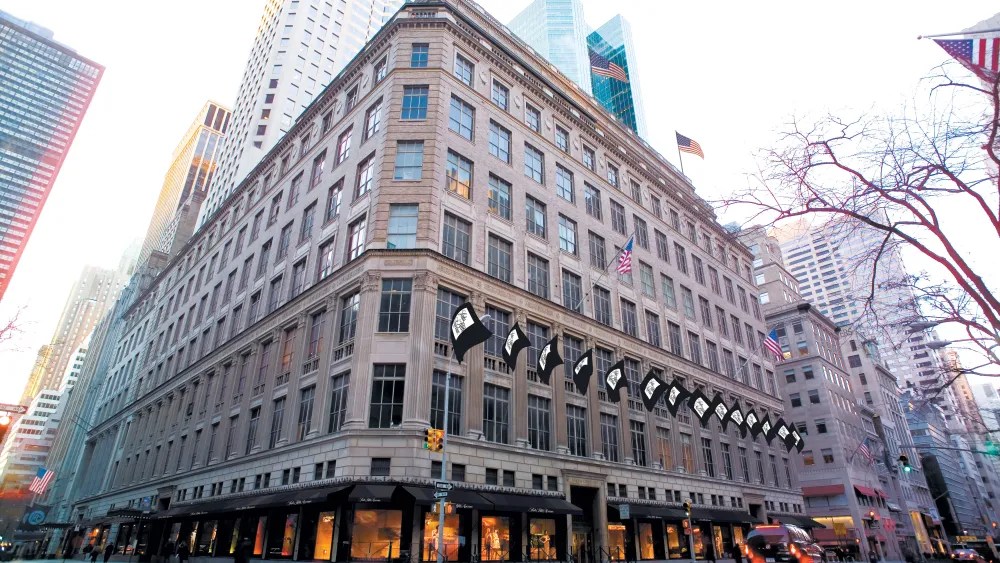
This week, we take a look at the possibly impending Saks Global bankruptcy and what legal recourse the brands that are still owed money by the company may have. Also, new data from Adobe offers insight into the growing adoption of buy-now, pay-later platforms among fashion consumers.
What will happen to brands if Saks goes under?
Saks Global is in a rough spot. Since CEO Marc Metrick stepped down on January 3, rumors have swirled that the company is approaching bankruptcy. This comes less than two years after its billion-dollar merger with Neiman Marcus.
As Glossy has previously reported, Saks has been notorious among fashion brands for its failure to pay on time. Numerous brands have told Glossy over the years that Saks has delayed payments for months, sometimes owing them tens of thousands of dollars, and requiring them to send the outstanding debt to collections to be reimbursed or to take Saks to court. Saks did not respond to a request for comment on this story.
Now, with Saks reportedly missing a $100 million interest payment this week, what will happen to the brands that are still owed money?
An instructive example is what happened when Matchesfashion collapsed in 2024. At the time of its bankruptcy filing, Matches owed over $100 million to brands like Gucci, Toteme and Anya Hindmarch. Administrators at the time estimated that creditors would likely receive only a fraction of that amount, approximately $800,000 in total. While U.K. and U.S. laws differ, bankruptcy proceedings in the U.S. usually end with a similar outcome: Creditors get some, but likely not all, of the money they’re owed.
It all depends on Saks’s liquidity, and that figure isn’t looking good. Data provided to Glossy by Creditsafe shows that the average Days Beyond Term (the delay on debt payment) for retailers is 10-11 days. Saks is averaging over three times longer, with a high of 41 days in 2025. Ragini Bhalla, head of brand at Creditsafe, told Glossy that this pattern highly suggests a consistent lack of cash that does not bode well for brands getting what they’re owed.
“In terms of what happens to the brands if Saks files for bankruptcy, it is a loaded question,” said Brad Sandler, partner at the law firm Pachulski Stang Ziehl & Jones LLP. “It depends on the value of the assets and whether there is sufficient asset value to pay the secured creditors and other higher priority creditors, such as tax claims, wages and the like. It also depends on whether any of the brands are critical vendors to any ongoing business, and here, some vendors could be deemed critical and demand payment for future shipments. At the end of the day, any Saks bankruptcy is likely to be ugly for the brands, and it is likely that the brand community will receive pennies on the dollar, absent some litigation recovery, because the unsecured claim pool will likely be enormous, potentially well in excess of a billion dollars.”
Companies like Jovani Fashion Ltd. and Catherine Regehr, Inc. are currently suing Saks Global for hundreds of thousands of dollars of missed or delayed payments for their brands.
Cyrus Vantoch-Wood, founder of the investment firm Insurgent, told Glossy that there would be a more wide-reaching effect on the brands that sell at Saks than just losing out on money.
“When payments become unreliable, brands are forced to manage uncertainty around cash flow, inventory and planning,” Vantoch-Wood said. “For smaller or independent labels, that uncertainty alone can be destabilizing. But the deeper damage is psychological. Department stores historically justified their power by offering stability, access and scale. When those fundamentals wobble, confidence erodes quickly.”
He said it’s likely that many brands would be turned off by the prospect of working with a big department store like Saks in the future. However, larger retailers remain necessary for many brands, which rely on them for scale and awareness. Vantoch-Wood suggested that brands need to be “brutally clear” about the financial exposure, or risk, that would come with entwining themselves with a retailer.
“In 2025, U.S. department stores continued to shrink selling space, and Bain’s latest luxury research shows offline multi-brand retail underperforming, often propped up by discounting and loyalty mechanics rather than genuine demand,” he said.
Sandler concurred, adding that brands should immediately stop sending products to Saks if they haven’t already been paid.
“If Saks files for bankruptcy, vendors will also be at risk for monies they received within 90 days of the bankruptcy, as Saks may try to claw that money back under the Bankruptcy Code,” he said. “While many vendors worry about this ‘preference’ risk, at this point, it is better to get the money in the door and deal with any preference exposure down the road.”
Holiday shopping was all about BNPL
Buy-now, pay-later was ascendant this holiday season, according to new retail data from Adobe shared with Glossy.
Overall, online holiday spending reached $257.8 billion in 2025, a nearly 7% year-over-year increase and a new record for e-commerce, according to Adobe’s data. Also notable was the milestone hit by BNPL.
Adobe said over $20 billion in online spending this past season was through BNPL, a nearly 10% increase from the previous year.
Cyber Monday was the biggest day for BNPL, with over $1 billion spent in the U.S. on that day alone. In an Adobe survey, consumers said categories such as apparel, furniture and electronics were most likely to drive BNPL adoption.
Vivek Pandya, director of Adobe Digital Insights, told Glossy via email that the rise of both BNPL and mobile commerce this holiday season reflects an ongoing consumer desire for “flexibility.”
“The majority of BNPL purchases are also taking place on smartphones, at 82.2%, as consumers continue to prioritize flexible shopping options and experiences from brands,” he said.
More data provided by Block, the parent company of Square and Afterpay, found that average BNPL basket sizes grew 10% this past holiday season and that BNPL spending per customer was up 6%. In other words, more people are using BNPL and they’re spending more per transaction.
The growth in these platforms, which include companies like Klarna and Afterpay, has led to some pushback. In December, the North Carolina Department of Justice sent letters to the six largest BNPL companies asking for default rates, consumer contracts and other data to assess the harm they can cause for potential regulation.
But fashion brands are still interested in partnering with BNPL services. Revolve expanded its partnership with Affirm just before the holidays, bringing Affirm to Revolve’s stores and online in Canada and the U.K.
News to know
- Hailey Bieber stars in Victoria’s Secret’s new Valentine’s Day campaign. Amid the brand’s ongoing comeback and the perception that it missed the mark last Valentine’s Day, VS is looking to make a bigger splash this year.
- Nike finally sold RTFKT, its ill-fated NFT and digital fashion brand, which ceased operations last year. The move comes as Nike CEO Elliott Hill continues to refocus the company, cutting underperforming segments and making leadership changes.
- The Japanese conglomerate Marubeni has purchased the British sportswear brand Gola, the two companies announced on Wednesday. Marubeni also acquired Gola’s sister footwear and apparel brands, including Lotus, Ravel and Frank Wright, and its licensed brands, Dunlop and Lonsdale.