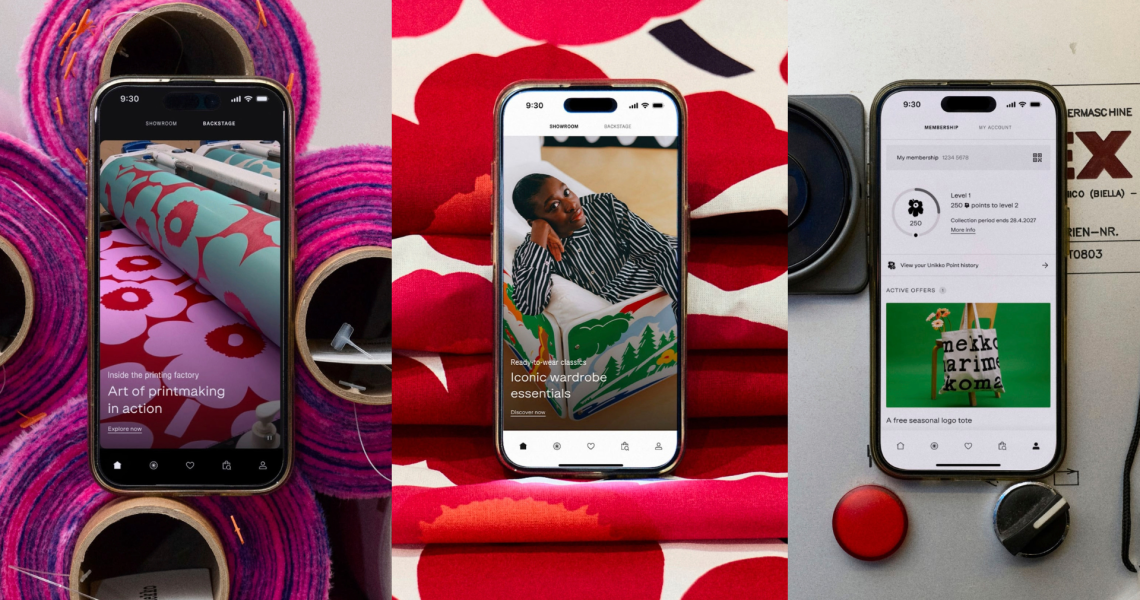
Marimekko’s launch of its first mobile app on December 10 arrives at a moment when fashion brands are rapidly building their own closed digital ecosystems — but the company is taking a distinctly different path from the rest of the industry. It was designed to showcase the 70-year-old brand’s print archives, as a priority over shoppable products, according to the brand. The goal is to give loyalists a reason to spend time with the brand and to create a deeper, more measurable relationship with its most engaged customers.
“We see the app first and foremost as a backstage pass to the Marimekko world,” said CTO Mikki Inkeroinen. The centerpiece is the brand’s digital print library, which includes more than 3,500 prints, designed from 1951 to the present. The app lets users filter prints by decade, theme or artist, and explore the stories behind them. Materials shared with Glossy describe it as a place to immerse oneself in the art of printmaking and experience the archive in an unprecedented way.
Inkeroinen said the archive was always core to the brand’s identity but not formerly accessible to customers in a mobile format. “The app allows us to serve the friends of Marimekko even better than before,” he said. “It is a place to spend time, to discover new parts of the brand and to be the first to see what is coming next.”
The app also invites users into its Helsinki fabric-printing mill through videos and dedicated content.
“Based on data, we know that our customers find videos and stories about our fabric printing factory fascinating and engaging,” Inkeroinen said. Users can explore the fabric-making process, for example, and meet the designers responsible for Marimekko’s most iconic prints. 2024 marked the 60th anniversary of Unikko, Marimekko’s poppy motif designed by Maija Isola in 1964. The pattern became globally recognizable for its bold modernism and has resurfaced with each new wave of interest in Scandinavian design.
According to Marimekko, the app was led internally as part of its 2023–2027 digital transformation focus.
Along with the app comes the introduction of Unikko Moment — a notification-based surprise, offering users a quick activity like a quiz or vote that earns loyalty points or other special rewards. The feature is attached to Friends of Marimekko, the brand’s loyalty program, where points can be traded in for early access, exclusive offers and event invitations.
Other recent fashion app launches show different brand approaches. Aritzia’s app, launched in October, prioritizes creator styling inspiration, boutique-level guidance and personalized feeds. Zara’s rebuilt app, relaunched last year, leans heavily into AI styling and automated product suggestions. In August, Alo Yoga expanded its wellness app to also include shopping, class scheduling and content. Cult Gaia and Ralph Lauren used recent app updates to improve navigation and clienteling. Across these examples, the primary purpose is to drive commerce or replace social feed discovery with brand-owned equivalents.
Within Marimekko’s app, shoppable products sit below the print archive on the homepage. The app also features wishlists, wardrobe tracking through My Items, UGC inspiration and streamlined checkout support. “We wanted the shopping experience to feel effortless,” Inkeroinen said, noting that logged-in customers see auto-populated delivery details for faster checkout.
Inkeroinen said the timing of the app launch aligns with Marimekko’s long-term growth plan. “End-to-end digitality to drive omnichannel growth and efficiency is one of the five strategic success factors to scale [our] growth in our 2023-2027 strategy,” he said. Marimekko is currently experiencing steady global growth. In the third quarter of 2025, reported October 31, the company’s net sales rose 8% year over year to €50.8 million (about $54 million), driven by a 15% jump in wholesale and strong international demand. For the first nine months of the year, net sales reached €134.8 million (about $143 million), up 5% year over year, with international sales growing 8%. Marimekko’s retail partners span department stores, and partner-owned stores and franchisees Asia and Europe.
Alongside its retail expansion — it now has roughly 170 stores globally, with flagships in Hong Kong and Paris opened in October — Marimekko has been scaling its cultural footprint. The brand’s touring Field of Flowers archive exhibition traveled through Japan, Taipei, Tokyo, Ho Chi Minh City and Osaka this year, while its fashion shows in Copenhagen in August and Bangkok in September drew international audiences. During Milan Design Week, Marimekko staged a capsule collection featuring Maija Isola’s prints curated by visual artist Laila Gohar, and during Helsinki Design Week, it hosted events tied to its Artek collaboration and a print-focused installation at the Habitare exhibition space.